
NAPLAN results for Victorian schools

The Australian Curriculum, Assessment and Reporting Authority has now published the statewide 2026 NAPLAN data results – and again Victorian schools, through your leadership, have achieved outstanding results.
On 5 key metrics, Victorian schools have done well.
1. Year-on-year improvement
When we look at our performance in 2026 compared to the previous year, mean scores were higher in more than half (12) of the 20 tests. It is particularly pleasing to see our Numeracy performance improve at each of Years 5, 7 and 9 in addition to achieving the highest mean score of any jurisdiction for Year 3 Numeracy.
This improvement in Numeracy was also reflected in the fact that more students in Years 5, 7 and 9 achieved in the Strong or Exceeding bands in Numeracy in 2026 compared to 2025.
2. Relative performance
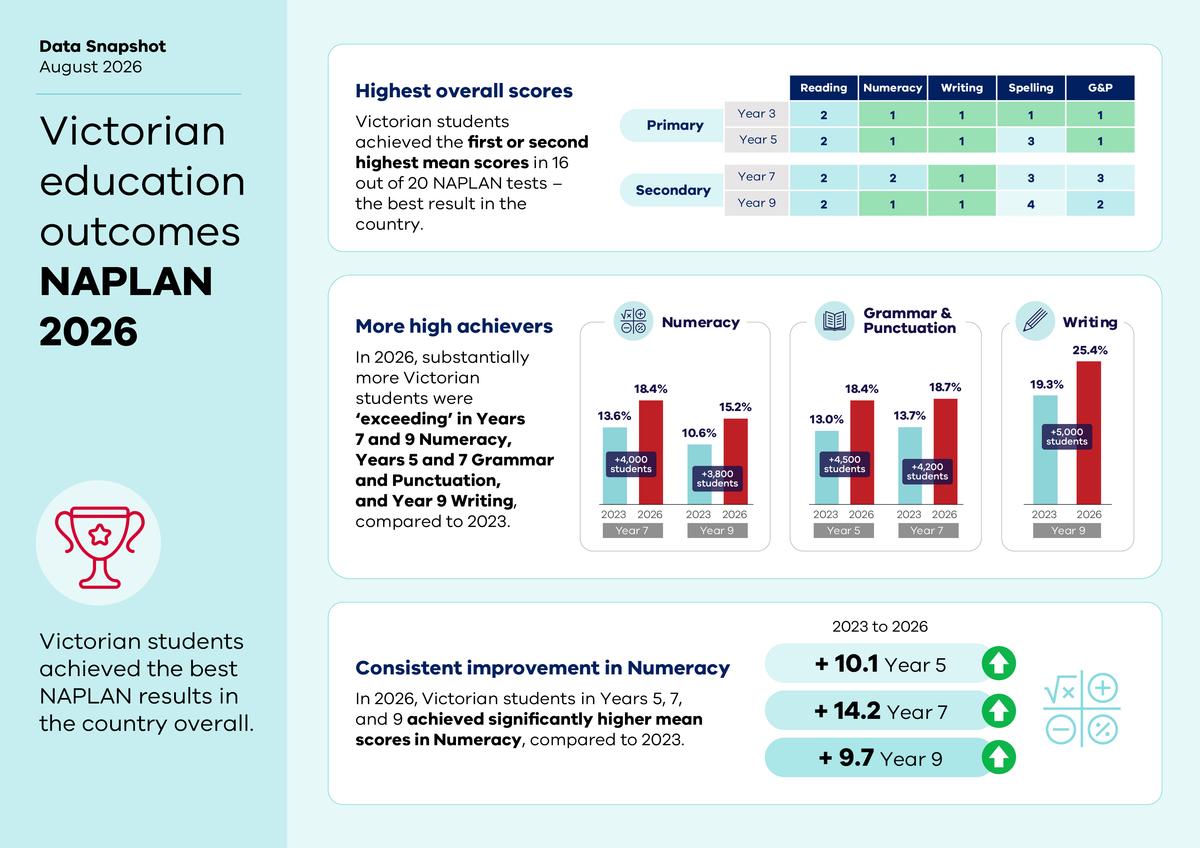
The 2026 Victorian NAPLAN results were again the best in the country. We ranked either first or second in 16 of the 20 tests, ahead of any other jurisdiction.
3. Fewer students needing additional support
We had fewer students at Year 3 needing additional support than any other jurisdiction, including the ACT. This is evidence of the effectiveness of the work our primary principals are leading.
4. Equity
There were mixed results for equity gaps. For example, in Year 3 Reading the attainment gap based on parental education levels closed compared to 2025.
The gap for inner regional students and students in major cities was smaller than in 2023 or 2024, but slightly larger compared to last year.
The same was the case for First Nations students’ performance compared to non-First Nations students, and it is very pleasing Victorian First Nations students achieved the highest mean score in Year 3 Reading of First Nations students in any jurisdiction.
5. Middle Years student engagement
In 2026, Year 9 student participation in any domain in NAPLAN was the highest participation rate recorded since 2009.
While these results are exceptionally good, and a result of the outstanding professionalism of Victoria’s school staff, there remains work to be done.
Any student who remains in the “Needs Additional Support” category for Reading, Writing or Numeracy is one student too many.
We also need to continue to do more to lift the average attainment levels for our priority cohorts including First Nations students, rural and regional students and students from families with lower parental levels of education.
Nevertheless, these results should provide the Victorian community with a high level of assurance that Victorian schools are producing great results.
To this end, please see the infographic below to support communication about Victoria’s results to your school community through your normal communication channels.

David Howes
Deputy Secretary
Schools and Regional Services