Staying Safe Online

Technology is a wonderful way for children to learn, connect and be creative, but it also comes with responsibilities. Helping children develop safe and respectful online habits is an important part of keeping them protected in today's digital world.
At school, students learn about digital citizenship and the importance of being safe, kind and responsible whenever they are online. Families play a vital role in reinforcing these messages at home.
Simple ways to support your child online:
- Keep communication open. Regularly ask your child about the games they play, the apps they use and who they interact with online.
- Set clear family expectations. Agree on screen time limits, suitable apps and where devices can be used in the home.
- Use privacy settings. Check that games, apps and social media accounts have appropriate privacy and safety settings enabled.
- Remind children never to share personal information, such as their full name, address, school, passwords or location.
- Encourage children to speak up. If something online makes them feel uncomfortable, worried or unsafe, reassure them they can always tell a trusted adult.
- Lead by example. Model respectful online behaviour and healthy screen habits as a family.
Remember, online safety isn't about knowing every app or game—it's about building trust so children feel confident asking for help when they need it.
Helpful Resources for Families
- eSafety Commissioner – Australia's leading source of advice on keeping children safe online.
- Raising Children Network – Screen Time & Digital Technology – Practical, age-appropriate advice for families.
- Common Sense Media – Reviews of apps, games and movies, plus digital parenting guides.
- Alannah and Madeline Foundation - Resources to support Australian families to build essential digital skills to develop a generation of safe and strong digital citizens who are capable and compassionate.
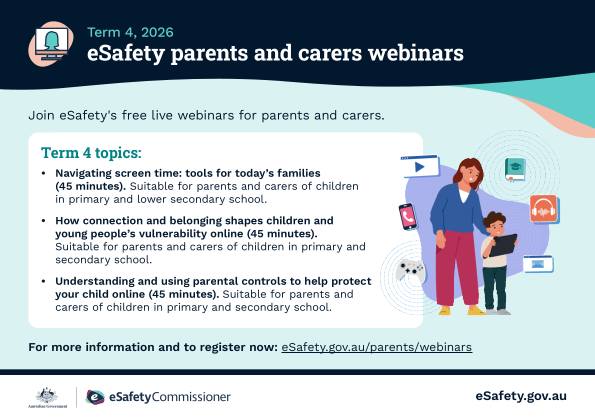
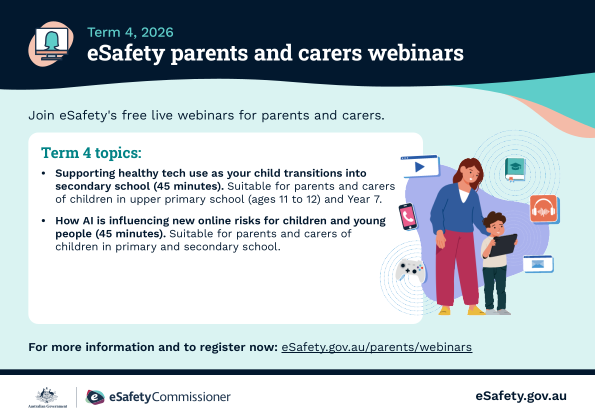
How AI is influencing new online risks for children and young people
AI (generative artificial intelligence) is built into many of the apps, games and services we use. While these tools can offer positive experiences, they also bring new risks, especially for children and young people.
Understanding what these risks look like, how to reduce them, and what to do if something goes wrong is important.
This 45-minute webinar for parents and carers will cover these areas.
- The types of AI-related risks your child may come across in their everyday online activities, including AI companion chatbots, deepfakes, AI influencers, and AI-facilitated cyberbullying and other online-harassment related risks.
- How these technologies can affect your child's safety, privacy, development, and mental and social wellbeing.
- Practical, easy-to-use strategies and resources to help you guide and support your child, including what to do if something goes wrong and where to seek help.
Suitable for parents and carers of children, including teens, in primary and secondary school.
Term 4
19 November 2026, 12.30pm (AEDT)
Register here - https://register.gotowebinar.com/rt/6695798671288245851
Supporting healthy tech use as your child transitions into secondary school
This 45-minute webinar explores the social pressures, peer influences, and technological challenges children face as they transition into secondary school. It also offers practical strategies for navigating online friendships and connections to help minimise negative experiences.
You'll learn:
- what social pressures they may be experiencing online
- how they can build digital resilience and critical reasoning
- how to talk to your young person about what they see and do online
- practical strategies for promoting positive peer interactions and help seeking behaviours.
It's suitable for parents and carers of children in upper primary school (ages 11 to 12) and those with children in Year 7.
Term 4
- 24 November 2026, 12.30pm (AEDT)
Register here: https://register.gotowebinar.com/rt/3984300742611167830