Mental Health & Wellbeing Students/Parents/Carers Support
Articles, Videos & Resources



 Ripponlea Primary School

Mental Health & Wellbeing Students/Parents/Carers Support
Articles, Videos & Resources

Mental Health and Wellbeing Update
Nikki Olsen | Mental Health and Wellbeing Leader | Ripponlea Primary School
This week’s focus: Friendships – helping children solve problems and feel included
Friendships are one of the most important parts of school life for children. Having friends helps children feel that they belong, and the ups and downs of friendships are where they learn to share, take turns, negotiate, say sorry and bounce back.
In our wellbeing survey across Years 1–6, 171 students told us about their experiences of school, friendships, learning confidence and wellbeing. Friendship problems and being left out came through at every year level, which is why I have chosen this topic for this week.
43.3% of students (74 of 171) gave a less-favourable response to a question about friendship problems.
What did our students tell us?
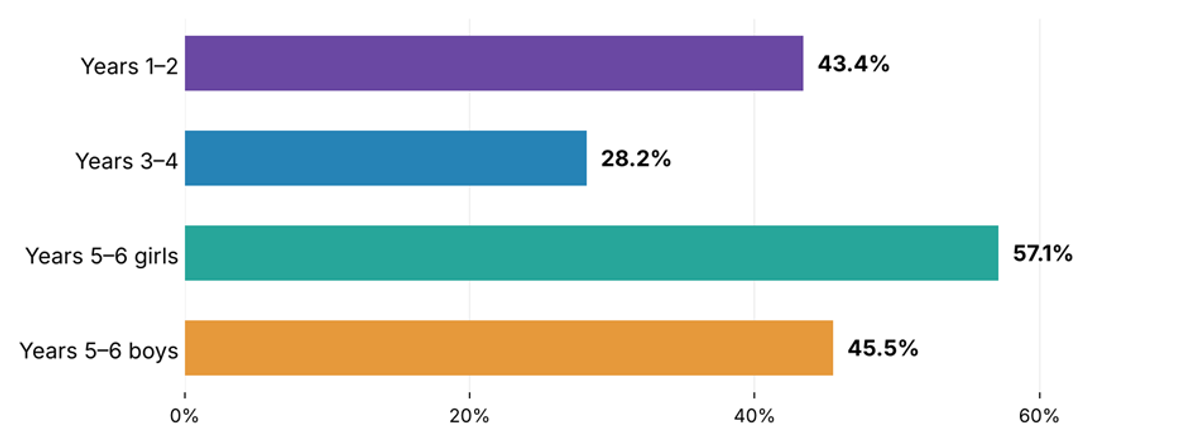
The graph shows the percentage of students giving a less-favourable response to a friendship question. Each year level answered a different survey, so it is the pattern that matters rather than the exact numbers.
Years 1–2
Survey item: what students do when a friendship problem happens. 43.4% (23 of 53) said they need an adult or don’t know what to do.
Years 3–4
Survey item: knowing how to fix a friendship problem. 28.2% (11 of 39) said they don’t know how. Being left out (10 of 39) and cheating or unfair play (9 of 39) were the most common problems.
Years 5–6 girls
Survey item: what causes the most friendship problems. 57.1% (20 of 35) chose arguments and disagreements. 54.3% (19 of 35) said the hardest part when something goes wrong is that they keep thinking about what happened.
Years 5–6 boys
Survey item: which unkind behaviours cause the most problems. 45.5% (20 of 44) chose leaving people out or ignoring others. Boys also linked physical conflict to cheating or not following the rules of a game, and to students getting angry (20 of 44 each).
There is also lots to celebrate. 91% of Years 1–2 students (48 of 53) said they have friends to play with, 98% of Years 5–6 boys (43 of 44) said time with friends helps them feel happy at school, and 77% of Years 5–6 boys (34 of 44) feel confident helping someone who is being bullied.
Note: The wording above describes the survey items; it is not a word-for-word copy of the questions. These are the responses of one survey on one day.
Friendship problems are normal – and a chance to learn
Most friendship problems are not bullying. Arguments, falling out and changing friendship groups are a normal part of growing up, and with support children can learn to sort many of them out. Bullying is different, and it always needs adult help.
| Friendship conflict | Bullying |
| A disagreement or falling-out between children | The ongoing and deliberate misuse of power in a relationship |
| Usually a one-off or occasional event | Repeated over time |
| Both children are often upset and want it sorted out | One child is targeted and finds it hard to stop |
| Can often be resolved with talking, a fix or a repair | Needs an adult to step in and follow up |
If you are unsure whether something is conflict or bullying, please talk with your child’s teacher or with me.
Why children don’t always speak up
When a friend does something that upsets them – changing the rules of a game so they win, pushing in, or always taking over – some children say nothing. They would rather put up with the behaviour than tell their friend how they feel. They may worry that their friend will be cross or that they will lose the friendship; they may feel too shy to speak up, or they may simply not know how to say it.
The problem is that when children don’t tell their friends how a behaviour affects them, their friends don’t know. The behaviour keeps happening, the frustration builds, and then, seemingly all of a sudden, children get tired of that person and choose not to play with them. The friend ends up excluded without understanding why.
Every child has the right to be safe and free from harm, and everyone has the right to say how they feel.
Friendships work both ways. When a friend says that something is upsetting them, the person doing the behaviour needs to listen and change what they are doing. That is how friendships stay strong.
Being assertive – what it looks and sounds like
Being assertive means saying how you feel and what you need in a calm, firm and respectful way. It sits in the middle: not staying silent (passive) and not yelling or being mean (aggressive).
| Passive | Assertive | Aggressive |
| Says nothing and puts up with it | Says how they feel, calmly and clearly | Yells, threatens or is mean back |
| Looks away; quiet voice | Looks the person in the eye; calm, firm voice; stands tall | Glares; loud voice; gets in the person’s face |
| “It’s fine.” (when it isn’t) | “Stop. I don’t like it when you change the rules because it makes me feel left out. Please play fairly.” | “You’re a cheat! I’m never playing with you again!” |
What are we doing at school?
From Foundation to Year 6, students are learning the same Friendship Plan. Using the same words at school and at home makes it easier for children to remember what to do:
1. Stop and get calm: pause before reacting – take some slow belly breaths, walk away for a moment or get a drink of water.
2. Say it: look them in the eye and use a calm, firm voice – “Stop. I don’t like it when you ___ because it makes me feel ___. Please ___.”
3. Make a positive choice: if it keeps going, find a fair next step (like taking turns), move away, play something else or find another friend.
4. Get help: if it keeps happening, ask a teacher. Children can ask to talk privately or write their teacher a note.
Unsafe or hurt? Go straight to an adult – there is no need to try the other steps first.
Children are also practising how to join a game, how to play fairly, how to listen and change what they do when a friend gives them feedback, and how to make a real apology.
How can parents help?
1. Listen first, before fixing
When your child comes home upset about a friend, the most helpful first step is to listen calmly. Children are more likely to keep telling you things when they feel heard.
2. Practise being assertive
Speaking up takes courage, and it gets easier with practice. You can help at home:
3. Help your child listen to feedback
Sometimes your child will be the one doing the behaviour. If a friend tells them something upsets them, help them see this as useful information, not an attack. Talk about changing what they do, and how that helps keep the friendship.
4. Help your child make an apology – and forgive
A real apology has three parts. Practise them together:
Say what you did: “I’m sorry I changed the rules.”
Show you understand: “That wasn’t fair to you.”
Say what you’ll do: “Next time I’ll stick to the rules.”
5. Help your child make a positive choice
If your child has spoken up and the problem keeps going, they don’t have to stay and keep arguing. Walking away is not losing – sometimes it is the strongest choice, because it stops a small problem from becoming a bigger one. Help your child think of two or three things they could try, then let them choose one.
| If your child says… | They could try… |
| “No one will play with me.” | Asking “Can I play?” – and if not, making a positive choice: finding another game or friend, inviting someone else to play, or using the buddy bench. |
| “They changed the rules so they’d win.” | Saying it: “Stop. I don’t like it when you change the rules because it makes me feel it’s unfair. Let’s agree on the rules.” If it keeps going: “I’m going to play something else now.” |
| “My friend is cross with me.” | Giving it some time, then making a real apology for their part and asking, “Are we okay?” |
| “They keep saying mean things.” | Getting calm, then saying in a firm voice, “Stop. I don’t like it when you say that because it makes me feel upset.” If it keeps happening, getting help from a teacher. |
6. Practise joining in and fair play
7. Help your child let go after a falling-out
Many older students told us they keep thinking about what happened. Talking it through once is helpful; going over it again and again can make the worry bigger.
In our next newsletter, I will share more about helping children step out of the “replay loop” and see other perspectives.
8. Grow friendships outside school
When should you contact the school?
Please let your child’s teacher or me know if:
When a child or parent tells us about a concern, we will listen, take it seriously and check back in with your child afterwards.
Remind your child that asking for help is okay
In our survey, some students said they worry about being called a “dobber”, or about talking in front of other students. Please let your child know:
Useful evidence-based resources for families
A final message for families
Friendship skills take time and lots of practice. Every time a child gets calm, speaks up, makes a positive choice or asks for help, it is a step forward. By listening, practising the Friendship Plan at home and helping children choose a fix, we can work together to help every Ripponlea student feel safe, heard and included.
If you have any concerns about your child’s friendships or wellbeing, please contact your child’s teacher or me.
Nikki Olsen
Mental Health and Wellbeing Leader
Ripponlea Primary School