
NAPLAN 2026
NAPLAN testing continues to provide a rich vein of discussion at all levels of education in Australian society. Now in its eighteenth year, NAPLAN testing has evolved considerably since it’s launch by then Education Minister, Julia Gillard. Fundamentally, NAPLAN provides a diagnostic reference point for students, parents and teachers to support the holistic understanding of each child’s literacy and numeracy. When considered alongside other information, NAPLAN provides a useful insight to support each child’s education.
Changes to NAPLAN since 2023
In 2023, NAPLAN reading and numeracy testing fundamentally changed. Tailored testing was introduced (Fig. 1) to enable more accurate diagnostic information to be gathered through measurement of each child’s skills. Adaptive or tailored testing, as it is known, dynamically responds during the reading and numeracy tests to provide more targeted questions dependent on the answers each child has provided. This, in turn, provides much more specific information and insight into a child’s literacy and numeracy skills.
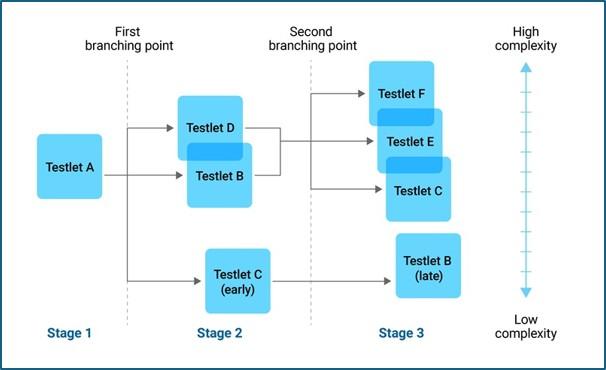
Figure 1: A diagrammatic representation of adaptive testing
How to read a NAPLAN report
Your child’s NAPLAN report will provide a guide to their performance in each of the five areas of assessment: numeracy, reading, writing, grammar and punctuation and spelling. Results from each test will be interpreted as having demonstrated one of four possible levels of proficiency:
Exceeding: the student’s result exceeds expectations at the time of testing.
Strong: the student’s result meets challenging but reasonable expectations at the time of testing.
Developing: the student’s result indicates that they are working towards expectations at the time of testing.
Needs additional support: the student’s result indicates that they are not achieving the learning outcomes that are expected at the time of testing. They are likely to need additional support to progress satisfactorily.
Further information regarding what each of these levels means at each of Years 3, 5, 7 and 9 can be found at www.nap.edu.au.
How to use a NAPLAN report
NAPLAN is a standalone measure of each child’s literacy and numeracy skills. It should be considered as such. NAPLAN questions (multiple choice, completed to time) are not a mode of assessment often used by teachers at other times in the year. This should not be ignored either. For Year 3 students, each child’s achievement serves as a benchmark to inform the learning journey to come. For children who have completed NAPLAN previously, growth is an important focus for attention.
I would encourage parents to sit with their children and to look at what the report is saying, using the information provided as a stimulus for conversation about literacy, numeracy and school more broadly. What are they enjoying? What do they find challenging? This reflective process is all part of developing self-regulated learning habits where we are able to think about our own thinking and learning habits. This level of reflection becomes a powerful tool towards flourishing throughout not only school but life beyond Year 12.
As a school community we are, once again, very proud of all our students who give of themselves each and every day. This dedication to their studies and their self is reflected in their NAPALN achievement which, collectively, once again reaffirms the tremendous culture of learning that we are so fortunate to be a part of here at Huntingtower.
Should you have any specific questions regarding your child’s NAPLAN proficiency, I would encourage you to contact your child’s teacher in Years 3 and 5, or their English and Mathematics teachers in Years 7 and 9.
Cameron Bacholer
Vice Principal - Teaching & Learning