
Mathematics

Counting on Year 1 Edition
Welcome to the next instalment of our newsletter series, where we pull back the curtainto showcase the hands-on maths learning happening right across our classrooms! This week, we are excited to spotlight how this looks in Year 1!
The Year 1 Focus: Cracking the Pattern Code!
This term, our Year 1 students have been diving deep into the world of repeatingpatterns. But they aren't just making pretty designs; they are learning to actively identify,create, and label the mathematical structures behind them.
Why Patterning Matters? Patterning is the very foundation of algebraic thinking. Beforechildren can solve complex equations in high school, they must first learn to recognizepredictable structures and mathematical relationships. By isolating the "repeating unit"(the core of the pattern), students learn to generalize, think logically, and predict "what comes next." This vital conceptual understanding aligns perfectly with the Victorian Curriculum, which challenges Year 1 students to investigate and describe mathematical patterns and sequences.
What it Looks Like (Hands-on in the Classroom)
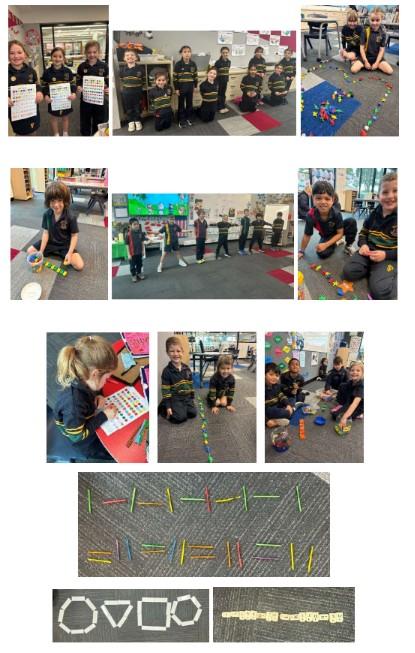
In the classroom, students have been using a variety of concrete objects—like counters, unifix blocks, and even natural materials—to build different sequences. The game-changer is that they are learning to mathematically label the repeating unit using letters.
Our Year 1s have been busy exploring:
- Two-item repeating patterns: Such as AABB (e.g., red block, red block, blueblock, blue block) or AAB (e.g., triangle, triangle, square).
- Three-part repeating patterns: Introducing the ABC structure (e.g., leaf, stick, stone, leaf, stick, stone).
The students were challenged to build a physical pattern, physically separate the core "repeating unit" from the rest of the sequence, and use letter cards (A, B, C) to label their work. By doing this, they successfully proved their mathematical thinking to their peers and teachers! (Check out the wonderful photos below of our Year 1s proudly building and labelling their pattern creations!)
Expert Insights: Fostering a Positive "Maths Mindset"
Just as our teachers' beliefs evolve as they witness new approaches succeeding in theclassroom, we want to help build that same mathematical confidence at home. Here isthis week's simple strategy for families:
Weekly Mindset Strategy: Model Mathematical Curiosity
One of the most powerful ways to overcome math anxiety is to show your child that youare a curious learner, too! You don't need to have all the answers. When you are lookingat a problem together, or even just doing everyday tasks at home, try thinking out loudusing "I wonder..." statements.
- "I wonder how many different ways we can arrange these blocks?"
- "I wonder what would happen if we started this pattern with a different shape?"
"I'm not sure how to figure this out yet, but I wonder if we can draw a picture to help us?"
By modelling curiosity rather than just seeking the "correct" answer, you show your childthat mathematics is an exciting puzzle to explore, rather than a stressful test to pass. Let's keep the mathematical conversations going both in the classroom and at home!
Warm regards,
Charlotte Spence
Classroom Teacher (Prep CS) and Mathematics Leader