
Wellbeing Centre Newsletter
R U OK? Thursday 10th September
Come to school dressed in your happy clothes!
This may be a favourite t-shirt, a snuggly jumper, or your favourite colour. Just make sure these are clothes that are safe and appropriate for a school day.
R U OK? — The Power of Checking In and Listening
Next Thursday we will be acknowledging R U OK? Day. This is a wonderful opportunity for our school community to pause and think about the importance of looking out for one another. While R U OK? Day is held on one special day each year, checking in with our friends, family and classmates is something we can do every day.
Sometimes, a person might be having a difficult day without us knowing. They may be worried, lonely, frustrated, sad or simply not feeling like themselves. A simple “Are you OK?” can let someone know that we care and that they don't have to face things alone.
The importance of checking in
For children, learning to notice how others are feeling is an important part of developing empathy and positive relationships.
We can encourage children to look for little signs that someone might need some extra support — perhaps a friend is quieter than usual, isn't joining in a game, looks upset or seems different from their usual self.
Checking in doesn't mean we have to fix someone's problems. Often, the most helpful thing we can do is listen.
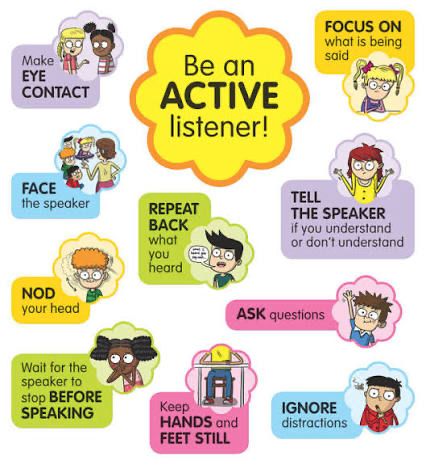
What does it mean to be an active listener?
Active listening means giving someone our full attention and showing them that what they are saying matters.
We can teach children to:
- Put distractions aside and give the person your attention. You don't have to make eye contact — you can show you're listening in whatever way feels comfortable for you.
- Listen without interrupting.
- Show we're listening by nodding, using facial expressions or saying things like “I see” or “That sounds hard.”
- Ask gentle questions to help us understand.
- Remember that we don't always need to solve the problem.
- Respect their feelings, even if we don't feel the same way.
It is important for children to understand that:
“You don't have to fix it. You can listen, care and help them find an adult who can.”
It is also important for our students to understand that if a friend is sharing something unsafe or worrying that it is important to seek the help of a trusted adult.
Sometimes a person is not ready to talk and that is ok too. It doesn’t mean they are not friends, it just means they are not ready or might want to talk to someone else.
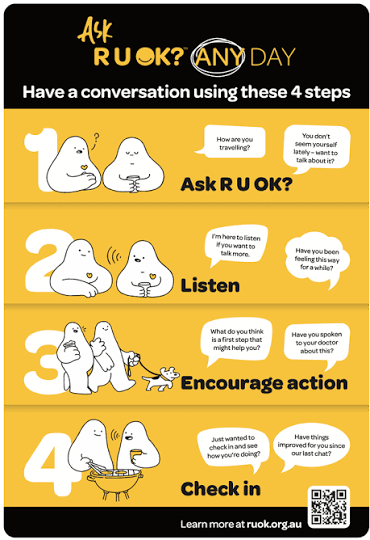
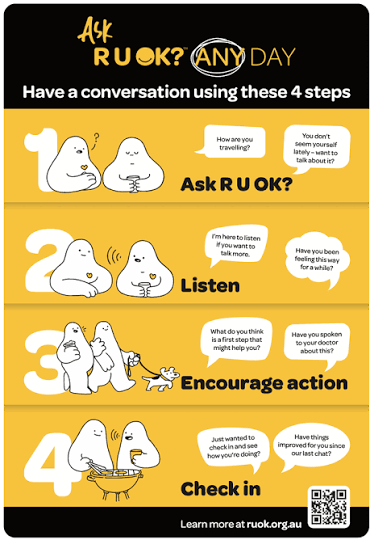
The 4 steps to asking R U OK?
The skill of active listening
Active listening is a skill that many people both children and adults, struggle with in life. Here are some fun activities you can try at home to help build active listening skillsWhy not turn active listening into a family game? These activities are simple, fun and help children practise an important life skill.
“Tell Me Three Things”
Take turns choosing a topic — a favourite animal, sport, holiday, book, game or something funny that happened during the day.
One person talks for one minute while the other person listens without interrupting.
When the minute is up, the listener has to remember and share three things the speaker said.
Swap roles.
Finish the Story
One person starts a story with a sentence such as:
“Yesterday, I went to the park and something very surprising happened…”
Take turns adding one sentence at a time.
The challenge is to listen carefully to what the other person says so that your next sentence makes sense.
This is a great way to practise listening rather than simply waiting for your turn to speak!
A little check-in can make a big difference
This R U OK? Day, let's remind our children that kindness doesn't have to be complicated.
A smile.A kind word.Inviting someone to play.Sitting beside someone who is alone.Asking, “Are you OK?”And most importantly, stopping to listen.
When we teach children to notice others, ask questions, listen with care and seek help from trusted adults, we are helping them build the skills they need to create safe, caring and connected communities.
R U OK? Day is one day — but looking out for one another can happen every day.