
Teaching & Learning Page
Ms Charleston & Mr Chapman (Learning Specialists)
Teaching & Learning Page
Ms Charleston & Mr Chapman (Learning Specialists)
We had a huge day of learning at our Curriculum Day on Wednesday 12th August. A big thank-you to all of our dedicated teachers and Education Support staff who took a deeper dive into our learning around literacy assessment and word problems in mathematics. It was a fantastic opportunity to build our shared understanding, reflect on our current practice and consider how we can continue to strengthen our teaching and learning. A huge thank-you to our Learning Specialist Team, Adrian Chapman and Trina Charleston, for leading the sessions and sharing their expertise, as well as the wider leadership team for the time and thought that went into planning such purposeful professional learning. Most importantly, thank you to all our staff for their enthusiasm, openness to new learning and commitment to continually improving practice.
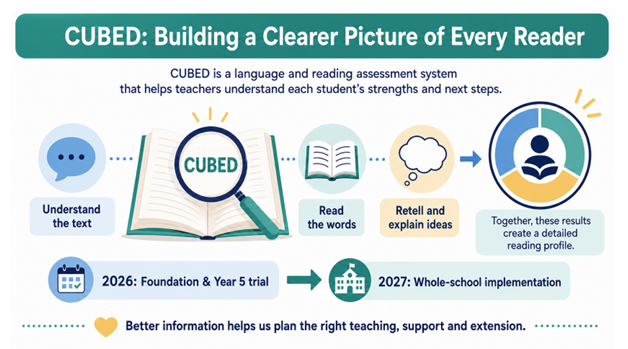
Building a Clearer Picture of Every Reader During the first part of Curriculum Day, our teachers explored CUBED, a language and reading assessment system that provides a detailed picture of each student as a reader. Foundation and Year 5 are trialling CUBED this year, ahead of whole-school implementation in 2027. The ongoing information gathered will help teachers plan the right teaching, support and extension for every reader.
Building Confident Word Problem Solvers
Word problems are an important part of mathematics because they ask students to do more than simply complete a calculation. Students need to understand a situation, decide what information is important, choose the mathematics they need and determine whether their answer makes sense.
At Surfside, we are continuing to strengthen the way we teach students to approach and solve word problems, with a focus on developing confident, flexible and independent mathematical thinkers.
From Learning a Skill to Applying It
Our approach to teaching mathematics is supported by the Instructional Hierarchy, which describes how students develop their learning through four stages:
Acquisition → Fluency → Generalisation → Adaptation
During Acquisition, students are learning a new skill or concept. Teachers provide explicit instruction, modelling, worked examples and guided practice to help students develop accuracy.
As students become more confident, they move into Fluency, where they practise previously learned skills so they can use them more accurately and efficiently.
The next important step is Generalisation — being able to recognise when, where and how to use what has been learned.
This is where word problems play an important role.
A student might be able to confidently calculate 48 ÷ 6, but can they recognise when division is needed within a story or real-world situation? Can they still recognise the mathematics when the numbers, vocabulary or context change?
This ability to transfer learning to different situations is an important part of becoming an independent mathematician.
UPS-Check: A Strategy for Tackling Word Problems
To help students approach word problems in a consistent way, we use our UPS-Check attack strategy.
U – Understand What is happening in the problem? What problem type is this? What do I know? What am I trying to find out?
P – Plan How could I represent the problem with a graphic organiser? What strategy or operation might help me?
S – Solve Carry out the mathematics using an appropriate and efficient strategy.
Check – Check Does my answer make sense? Have I answered the question that was actually asked?
UPS-Check encourages students to think about the problem before jumping straight into a calculation.
Our Next Step: Schema-Based Instruction
As part of our continued development of mathematics teaching at Surfside, staff are beginning to explore and implement Schema-Based Instruction (SBI).
Although the name sounds complicated, the idea behind it is quite simple: many word problems have a similar underlying structure, or schema, even when the story, numbers and vocabulary look completely different.
For example, students can learn to recognise structures involving change, totals, differences, comparisons and equal groups.
Rather than teaching students to search for a particular key word and then select an operation, SBI encourages them to ask:
“What is happening in this problem?”
Students can then use a visual representation, such as a bar model, to show how the quantities are related. Once they understand the structure, they are in a much stronger position to decide how to solve it.
This approach complements our UPS-Check strategy. UPS-Check provides students with a consistent process for tackling a problem, while Schema-Based Instruction can strengthen the Understand and Plan stages by helping students recognise and represent the mathematical structure.
Moving Towards Independent Problem Solvers
Our goal is not for students to memorise a particular trick for each type of word problem. Instead, we want them to develop a toolkit of strategies that they can confidently apply when they encounter something new.
As students move into the Generalisation phase of their learning, the question gradually shifts from:
“Can I do this calculation?”
to:
“Which problem type is this?”
Through explicit teaching, opportunities to practise, UPS-Check, visual representations and our developing use of Schema-Based Instruction, we are supporting students to make that important transition.
Ultimately, successful problem solving is not just about getting the answer. It is about understanding the problem, seeing the mathematics within it and having the confidence to work out what to do next.