
Mathematics

Counting on Preps!
Welcome to the first entry in our new newsletter series! Over the course of this term, wewill be pulling back the curtain on our classrooms to showcase the maths learninghappening across different year levels. As we collaborate on high-impact professionaldevelopment this year, our goal is to share the practical strategies our teachers use tobring key educational theories to life and show you how these methods translate intopositive student outcomes.
We are kicking things off with our wonderful Preps, who hit a massive milestone last Friday—celebrating their 100 Days of School!
To prepare for the big celebration, the Preps spent the week diving into skip counting by10s all the way up to 100.
Why Skip Counting Matters
Skip counting isn't just a fun way to count quickly; it is a foundational algebraic skill. By learning to skip count, children begin to recognise structure and predictable patterns in our number system.
More importantly, it serves as a direct bridge to addition and place value. Instead ofseeing "100" as a massive, overwhelming blur of individual units, skip counting helpschildren understand that 100 is actually composed of smaller, friendly groups chunkedtogether. This conceptual understanding directly aligns with the Victorian Curriculum Foundation stage, which focuses on developing number sense, connecting numbernames to quantities, and subitising (recognising small groups of objects withoutcounting them one by one).
What 100 Looks Like (Hands-on in the Classroom)
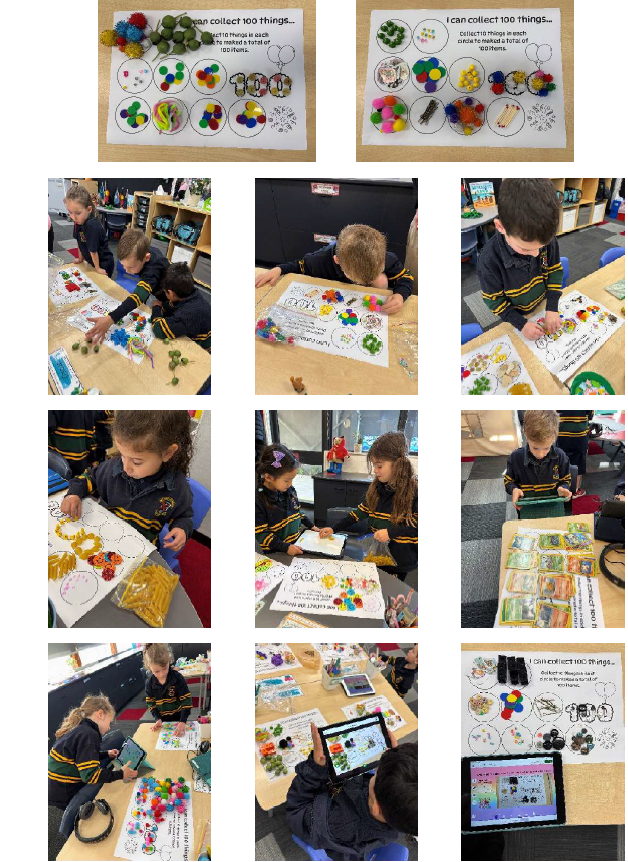
To bring this theory to life, our Preps explored what 100 looks like in a variety of visualforms throughout the week.One of their favourite challenges involved a collaborative sharing activity. Students wereasked to count out exactly 10 small items of their own to share with a friend. They thenswapped collections around the room until every child had 10 different lots of 10 items arranged on their maths boards.
Seeing 100 items broken up into neat, varied groups of 10 made the abstract number"100" completely tangible. To lock in their learning, the students recorded videos ofthemselves proudly skip counting by 10s to explain their work.
Fostering a Positive "Maths Mindset"
When teachers, students, and parents all comprehend the rationale behind practical, inquiry-based maths, we see a fantastic shift in how students view their own capabilities. As teachers witness these positive responses and "lightbulb" moments inthe classroom, their own beliefs evolve—and we want to bring that same confidence into your home!
Instead of overwhelming you with ideas, we will introduce just one simple strategy each week that families can put into practice together to help overcome maths anxiety.
Weekly Mindset Strategy: Praise the Process, Not Speed
Mathematics is about deep exploration, spotting patterns, and playing with big ideas—itis never a race. When your child is working through a maths problem at home, focusyour praise on their persistence, curiosity, and strategy rather than how fast they got the answer. Try shifting the conversation with phrases like:
"I love the way you tried a different strategy when you got stuck."
- "Tell me how you figured that out, your thinking is really interesting!"
By taking the pressure off speed and correctness, we show children that mistakes arejust part of the learning journey.
Let's keep the mathematical conversations going both in the classroom and at home!
Warm regards,
Charlotte Spence
Classroom Teacher (Prep CS) and Mathematics Leader