Term 3 Learning Summary
English
This term, students will explore how stories and information can help us understand different experiences, perspectives and moments in history. Through a range of engaging texts, students will develop their ability to think critically about what they read, communicate their ideas effectively, and create texts for a variety of purposes and audiences.
In Reading, students will explore a diverse collection of texts that highlight themes of identity, culture, resilience, migration and belonging. Through the factual recount Dirrarn by Carl Merrison and Hakea Hustler, students will learn about the importance of Country, community and First Nations perspectives. Through studying Waves by Donna Rawlins, students will investigate the experiences of migration and settlement through a narrative non-fiction lens, examining how real life events can be presented through storytelling. Students will also study Tom Appleby Convict Boy by Jackie French, a historical fiction novel that provides insight into Australia's colonial past and the challenges faced by those transported to the colonies.
As they read, students will analyse characters, settings and significant events, while making connections between texts and the wider world. They will examine how authors use descriptive language, figurative devices and historical detail to shape readers' understanding and evoke responses. Students will also compare how information is communicated across different genres and consider how an author's purpose influences the choices they make.
In Writing, students will experiment with a range of text forms, including factual recounts, narrative non-fiction, information reports and persuasive speeches. They will learn how writers organise ideas effectively, select precise vocabulary and vary sentence structures to enhance meaning. Students will continue to build their understanding of grammar using complex sentences, subordinating conjunctions, direct speech and relative clauses. They will also refine their editing skills by revising their work for clarity, accuracy and impact.
In Speaking and Listening, students will engage in paired reading, collaborative discussions and oral presentations that support the development of effective communication skills. Through paired reading, students will practise reading with fluency, expression and accuracy while discussing key ideas, vocabulary and themes from texts. They will be encouraged to listen actively, ask relevant questions and contribute thoughtfully to discussions. Students will also develop their ability to explain their thinking, justify opinions using evidence from texts and adapt their language for different audiences and purposes. Throughout the term, students will have opportunities to develop and practise speech writing and presentation skills in preparation for the leadership positions they may apply for in Term Four. These experiences will help students build confidence as respectful speakers, attentive listeners and effective communicators.
Key Vocabulary:
Numb
Teem
Generation
Unkept
Vulnerable
Remnants
Abrupt
Resentfully
Convicts
Sinister
Fleeting
Malevolent
Spelling/Grammar
In Spelling this term, students will explore suffixes of ‘ible’ and ‘ise’ and the prefixes of ‘semi’, ‘multi’, ‘inter’ and ‘trans’. They will also learn various Latin and Greek such as the ‘ven/vent’, ‘scrib/script’, ‘graph/gram’, ‘spec/spect/spic’ and ‘dic/dict’. In Grammar, they will continue to deepen their knowledge of different sentence types, simple, compound and complex sentences, learning how to differentiate and create them. They will also explore the concept of direct speech and relative clause.
How can you support your child’s English learning at home?
Ask your child to share their insights from the class novel.
Identify words with suffixes, prefixes, Latin and Greek roots from our weekly focus to continue expanding their vocabulary.
Ask your child to read aloud to practice their fluency and accuracy.
Identify simple, compound and complex sentences from their daily reading text.
Mathematics
This term, students will continue to build their mathematical understanding across the Number, Algebra, Measurement and Space strands.
Students will explore patterns and algebraic thinking by identifying, describing and creating number patterns, as well as investigating how algorithms can be used to generate and compare number sets.
In Number, students will develop their understanding of fractions by ordering, adding and subtracting fractions and mixed numerals with unrelated denominators. They will also extend their knowledge of decimals by multiplying and dividing whole numbers and decimal fractions using powers of ten.
In Measurement, students will investigate angles, including complementary, supplementary and vertically opposite angles, and apply their understanding to solve problems involving unknown angles. They will also convert between units of length, mass and capacity and use these skills in practical problem-solving situations.
In Space, students will work with coordinates in all four quadrants of the Cartesian plane and explore transformations, geometric patterns and tessellations.
Throughout the term, students will apply their mathematical thinking, reasoning and problem-solving skills through rich tasks and real-world investigations.
Key Vocabulary:
Patterns
pattern
rule
sequence
term
increase / decrease
algorithm
input / output
number set
Fractions
numerator
denominator
mixed numeral
improper fraction
equivalent fraction
simplify
common denominator
unlike denominators
add / subtract fractions
Decimals
decimal
place value
tenths / hundredths / thousandths
multiply / divide
powers of ten
equivalent
scale
Angles
angle
acute / obtuse / right angle
complementary
supplementary
vertically opposite
degrees (°)
intersecting lines
vertex
Measurement
convert / conversion
metric system
length / mass / capacity
millimetre, centimetre, metre, kilometre
gram, kilogram
millilitre, litre
equivalent measures
Location & Transformation
coordinate
Cartesian plane
x-axis / y-axis
quadrant
translation
reflection
rotation
tessellation
transformation
ordered pair
How can you support your child’s Mathematics learning at home?
Talk maths daily: Encourage children to notice patterns, time, money and measurement in everyday situations such as shopping, cooking and around the home.
Hands-on practice: Use real objects for measuring, sharing food for fractions, and comparing lengths or capacities to build practical understanding.
Draw and model: Support learning by drawing number patterns, fraction models, coordinate grids and simple transformations using paper and pencil.
Digital practice: Use short sessions on maths games or apps to strengthen fluency with decimals, fractions and number skills in an engaging way.
Inquiry
Summary of Learning:
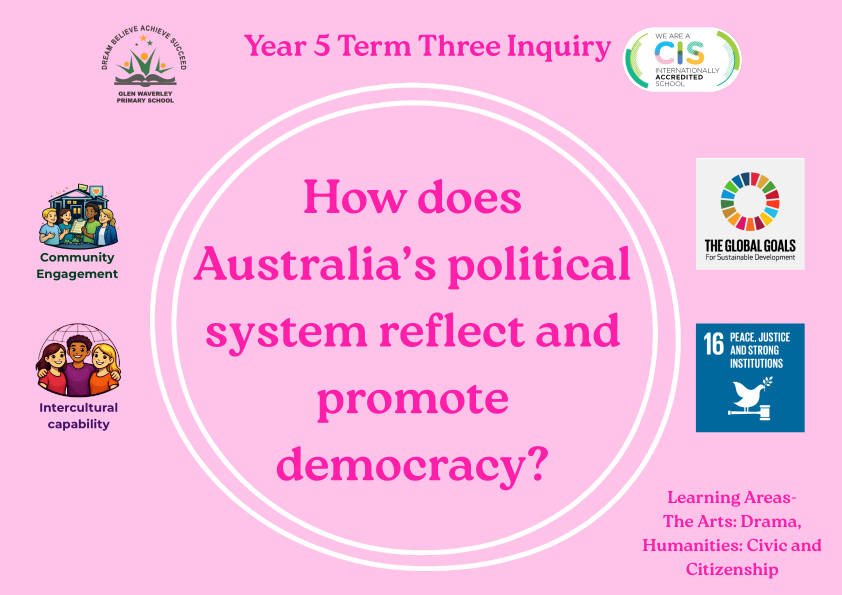
In Term 3 the Year Fives will be exploring Australia’s political system and the roles that the three levels of government play in shaping our country. Students will investigate the structures, responsibilities and parties at the federal, state and local government levels. They will explore the foundations of democracy, its history and the process of passing laws. Students will explore a variety of contemporary case studies and examine how their own participation in the democratic process could impact their community.
Key Vocabulary:
Constitution, Parliament, Democracy, Government, Electorate, Contemporary, Senate, Representative, Monarch, Amendment, Bipartisan, Judiciary, Legislation, Petition, Vote of no confidence, Civil, Declaration, Cabinet, Liberal, Labour, Westminster.
How can you support your child’s Inquiry learning at home?
Read local and national newsletters together and discuss any issues that affect you
Research who your local member of parliament is
Compare the political system between Australia and your home country/other country
Wellbeing
The Resilience Project
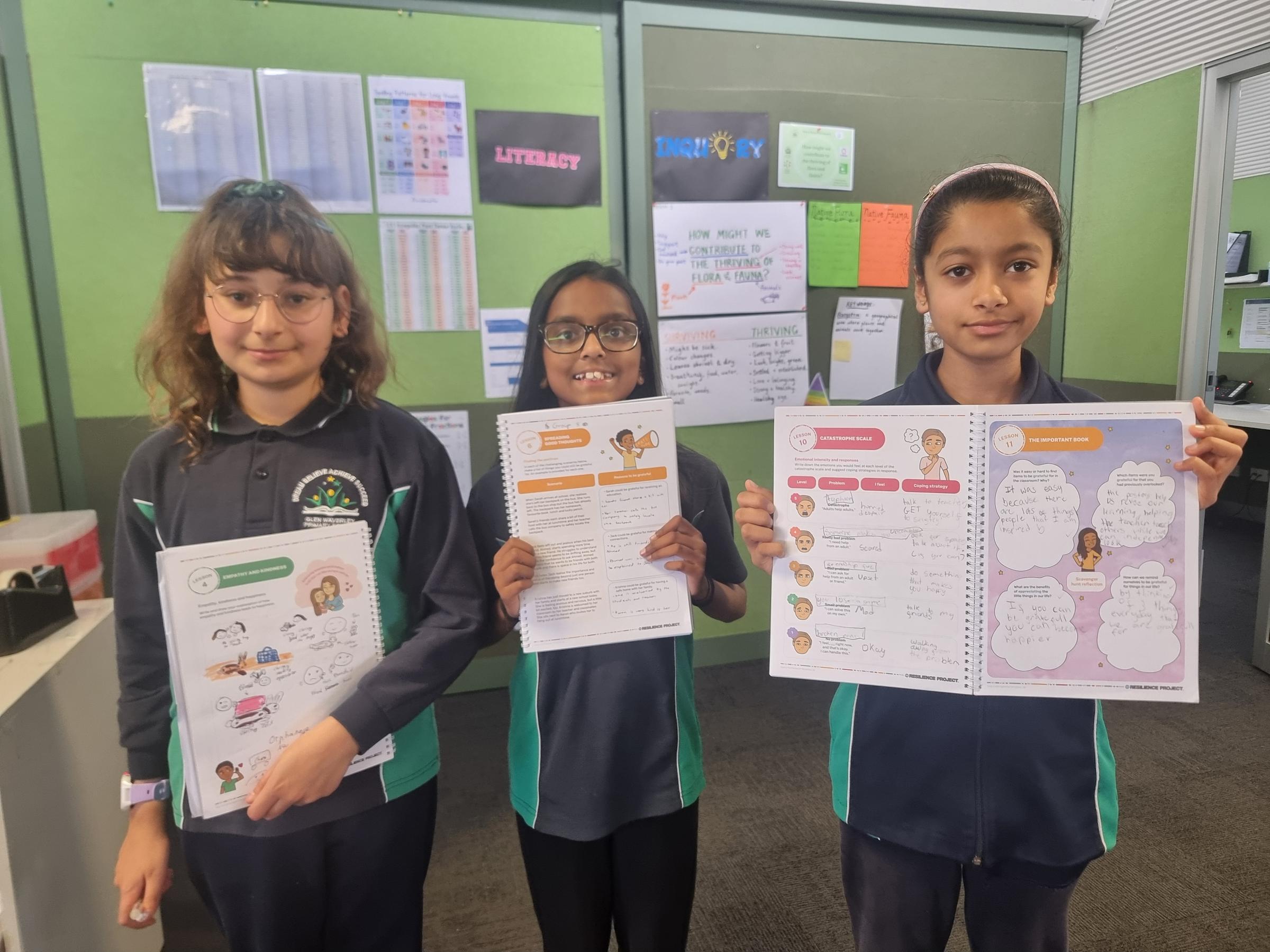
This term, students will continue to develop their Gratitude, Empathy, Mindfulness (GEM) and Emotional Literacy through The Resilience Project. Students will engage in a variety of opportunities to explore and practise each aspect, which will equip them with strategies to enhance their resilience and wellbeing. For example, students will practise being grateful for small things around them, mindful of focusing on the present moment and noticing and naming their emotions. Through interactive lessons, discussions, and reflective exercises, students will continue to deepen their understanding of self and others.
Cyber Safety Project
Through the Cyber Safety Project, this term, students will deepen their understanding of empathy online. As they work through each lesson they will investiage how they can help others navigate the online world safely, communicate with kindness and care as well as ensure they are standing up for others when they see bullying. Students will combine these skills and reflect on how they contribute to create healthy online environments and positive conversations.
Key Vocabulary:
Gratitude
Empathy
Mindfulness
Emotions
Glimmer
Present
Upstander
Bystander
Digital Citizen
Responsibility
Integrity
How can you support your child’s Wellbeing learning at home?
Discuss some of the online spaces your child uses already and how they are contributing to a healthy environment.
Ask your child what they are grateful for within their home. Make list together.
Write a letter of gratitude to someone you know.
We encourage families to continue conversations at home around GEM principles and Cyber Safety. Our families have access to the Resilience Project Home - TRP@HOME portal along with the Cyber Safety Project home Resources - Cyber Safety Project. Working together supports learners in applying these strategies beyond the classroom and helps strengthen their wellbeing across all aspects of their lives.
Term 3 Learning Summary
English
This term, students will explore how stories and information can help us understand different experiences, perspectives and moments in history. Through a range of engaging texts, students will develop their ability to think critically about what they read, communicate their ideas effectively, and create texts for a variety of purposes and audiences.
In Reading, students will explore a diverse collection of texts that highlight themes of identity, culture, resilience, migration and belonging. Through the factual recount Dirrarn by Carl Merrison and Hakea Hustler, students will learn about the importance of Country, community and First Nations perspectives. Through studying Waves by Donna Rawlins, students will investigate the experiences of migration and settlement through a narrative non-fiction lens, examining how real life events can be presented through storytelling. Students will also study Tom Appleby Convict Boy by Jackie French, a historical fiction novel that provides insight into Australia's colonial past and the challenges faced by those transported to the colonies.
As they read, students will analyse characters, settings and significant events, while making connections between texts and the wider world. They will examine how authors use descriptive language, figurative devices and historical detail to shape readers' understanding and evoke responses. Students will also compare how information is communicated across different genres and consider how an author's purpose influences the choices they make.
In Writing, students will experiment with a range of text forms, including factual recounts, narrative non-fiction, information reports and persuasive speeches. They will learn how writers organise ideas effectively, select precise vocabulary and vary sentence structures to enhance meaning. Students will continue to build their understanding of grammar using complex sentences, subordinating conjunctions, direct speech and relative clauses. They will also refine their editing skills by revising their work for clarity, accuracy and impact.
In Speaking and Listening, students will engage in paired reading, collaborative discussions and oral presentations that support the development of effective communication skills. Through paired reading, students will practise reading with fluency, expression and accuracy while discussing key ideas, vocabulary and themes from texts. They will be encouraged to listen actively, ask relevant questions and contribute thoughtfully to discussions. Students will also develop their ability to explain their thinking, justify opinions using evidence from texts and adapt their language for different audiences and purposes. Throughout the term, students will have opportunities to develop and practise speech writing and presentation skills in preparation for the leadership positions they may apply for in Term Four. These experiences will help students build confidence as respectful speakers, attentive listeners and effective communicators.
Key Vocabulary:
Numb
Teem
Generation
Unkept
Vulnerable
Remnants
Abrupt
Resentfully
Convicts
Sinister
Fleeting
Malevolent
Spelling/Grammar
In Spelling this term, students will explore suffixes of ‘ible’ and ‘ise’ and the prefixes of ‘semi’, ‘multi’, ‘inter’ and ‘trans’. They will also learn various Latin and Greek such as the ‘ven/vent’, ‘scrib/script’, ‘graph/gram’, ‘spec/spect/spic’ and ‘dic/dict’. In Grammar, they will continue to deepen their knowledge of different sentence types, simple, compound and complex sentences, learning how to differentiate and create them. They will also explore the concept of direct speech and relative clause.
How can you support your child’s English learning at home?
Ask your child to share their insights from the class novel.
Identify words with suffixes, prefixes, Latin and Greek roots from our weekly focus to continue expanding their vocabulary.
Ask your child to read aloud to practice their fluency and accuracy.
Identify simple, compound and complex sentences from their daily reading text.
Mathematics
This term, students will continue to build their mathematical understanding across the Number, Algebra, Measurement and Space strands.
Students will explore patterns and algebraic thinking by identifying, describing and creating number patterns, as well as investigating how algorithms can be used to generate and compare number sets.
In Number, students will develop their understanding of fractions by ordering, adding and subtracting fractions and mixed numerals with unrelated denominators. They will also extend their knowledge of decimals by multiplying and dividing whole numbers and decimal fractions using powers of ten.
In Measurement, students will investigate angles, including complementary, supplementary and vertically opposite angles, and apply their understanding to solve problems involving unknown angles. They will also convert between units of length, mass and capacity and use these skills in practical problem-solving situations.
In Space, students will work with coordinates in all four quadrants of the Cartesian plane and explore transformations, geometric patterns and tessellations.
Throughout the term, students will apply their mathematical thinking, reasoning and problem-solving skills through rich tasks and real-world investigations.
Key Vocabulary:
Patterns
pattern
rule
sequence
term
increase / decrease
algorithm
input / output
number set
Fractions
numerator
denominator
mixed numeral
improper fraction
equivalent fraction
simplify
common denominator
unlike denominators
add / subtract fractions
Decimals
decimal
place value
tenths / hundredths / thousandths
multiply / divide
powers of ten
equivalent
scale
Angles
angle
acute / obtuse / right angle
complementary
supplementary
vertically opposite
degrees (°)
intersecting lines
vertex
Measurement
convert / conversion
metric system
length / mass / capacity
millimetre, centimetre, metre, kilometre
gram, kilogram
millilitre, litre
equivalent measures
Location & Transformation
coordinate
Cartesian plane
x-axis / y-axis
quadrant
translation
reflection
rotation
tessellation
transformation
ordered pair
How can you support your child’s Mathematics learning at home?
Talk maths daily: Encourage children to notice patterns, time, money and measurement in everyday situations such as shopping, cooking and around the home.
Hands-on practice: Use real objects for measuring, sharing food for fractions, and comparing lengths or capacities to build practical understanding.
Draw and model: Support learning by drawing number patterns, fraction models, coordinate grids and simple transformations using paper and pencil.
Digital practice: Use short sessions on maths games or apps to strengthen fluency with decimals, fractions and number skills in an engaging way.
Inquiry
Summary of Learning:
In Term 3 the Year Fives will be exploring Australia’s political system and the roles that the three levels of government play in shaping our country. Students will investigate the structures, responsibilities and parties at the federal, state and local government levels. They will explore the foundations of democracy, its history and the process of passing laws. Students will explore a variety of contemporary case studies and examine how their own participation in the democratic process could impact their community.
Key Vocabulary:
Constitution, Parliament, Democracy, Government, Electorate, Contemporary, Senate, Representative, Monarch, Amendment, Bipartisan, Judiciary, Legislation, Petition, Vote of no confidence, Civil, Declaration, Cabinet, Liberal, Labour, Westminster.
How can you support your child’s Inquiry learning at home?
Read local and national newsletters together and discuss any issues that affect you
Research who your local member of parliament is
Compare the political system between Australia and your home country/other country
Wellbeing
The Resilience Project
This term, students will continue to develop their Gratitude, Empathy, Mindfulness (GEM) and Emotional Literacy through The Resilience Project. Students will engage in a variety of opportunities to explore and practise each aspect, which will equip them with strategies to enhance their resilience and wellbeing. For example, students will practise being grateful for small things around them, mindful of focusing on the present moment and noticing and naming their emotions. Through interactive lessons, discussions, and reflective exercises, students will continue to deepen their understanding of self and others.
Cyber Safety Project
Through the Cyber Safety Project, this term, students will deepen their understanding of empathy online. As they work through each lesson they will investiage how they can help others navigate the online world safely, communicate with kindness and care as well as ensure they are standing up for others when they see bullying. Students will combine these skills and reflect on how they contribute to create healthy online environments and positive conversations.
Key Vocabulary:
Gratitude
Empathy
Mindfulness
Emotions
Glimmer
Present
Upstander
Bystander
Digital Citizen
Responsibility
Integrity
How can you support your child’s Wellbeing learning at home?
Discuss some of the online spaces your child uses already and how they are contributing to a healthy environment.
Ask your child what they are grateful for within their home. Make list together.
Write a letter of gratitude to someone you know.
We encourage families to continue conversations at home around GEM principles and Cyber Safety. Our families have access to the Resilience Project Home - TRP@HOME portal along with the Cyber Safety Project home Resources - Cyber Safety Project. Working together supports learners in applying these strategies beyond the classroom and helps strengthen their wellbeing across all aspects of their lives.
Term 3 Learning Summary
English
This term, students will explore how stories and information can help us understand different experiences, perspectives and moments in history. Through a range of engaging texts, students will develop their ability to think critically about what they read, communicate their ideas effectively, and create texts for a variety of purposes and audiences.
In Reading, students will explore a diverse collection of texts that highlight themes of identity, culture, resilience, migration and belonging. Through the factual recount Dirrarn by Carl Merrison and Hakea Hustler, students will learn about the importance of Country, community and First Nations perspectives. Through studying Waves by Donna Rawlins, students will investigate the experiences of migration and settlement through a narrative non-fiction lens, examining how real life events can be presented through storytelling. Students will also study Tom Appleby Convict Boy by Jackie French, a historical fiction novel that provides insight into Australia's colonial past and the challenges faced by those transported to the colonies.
As they read, students will analyse characters, settings and significant events, while making connections between texts and the wider world. They will examine how authors use descriptive language, figurative devices and historical detail to shape readers' understanding and evoke responses. Students will also compare how information is communicated across different genres and consider how an author's purpose influences the choices they make.
In Writing, students will experiment with a range of text forms, including factual recounts, narrative non-fiction, information reports and persuasive speeches. They will learn how writers organise ideas effectively, select precise vocabulary and vary sentence structures to enhance meaning. Students will continue to build their understanding of grammar using complex sentences, subordinating conjunctions, direct speech and relative clauses. They will also refine their editing skills by revising their work for clarity, accuracy and impact.
In Speaking and Listening, students will engage in paired reading, collaborative discussions and oral presentations that support the development of effective communication skills. Through paired reading, students will practise reading with fluency, expression and accuracy while discussing key ideas, vocabulary and themes from texts. They will be encouraged to listen actively, ask relevant questions and contribute thoughtfully to discussions. Students will also develop their ability to explain their thinking, justify opinions using evidence from texts and adapt their language for different audiences and purposes. Throughout the term, students will have opportunities to develop and practise speech writing and presentation skills in preparation for the leadership positions they may apply for in Term Four. These experiences will help students build confidence as respectful speakers, attentive listeners and effective communicators.
Key Vocabulary:
Numb
Teem
Generation
Unkept
Vulnerable
Remnants
Abrupt
Resentfully
Convicts
Sinister
Fleeting
Malevolent
Spelling/Grammar
In Spelling this term, students will explore suffixes of ‘ible’ and ‘ise’ and the prefixes of ‘semi’, ‘multi’, ‘inter’ and ‘trans’. They will also learn various Latin and Greek such as the ‘ven/vent’, ‘scrib/script’, ‘graph/gram’, ‘spec/spect/spic’ and ‘dic/dict’. In Grammar, they will continue to deepen their knowledge of different sentence types, simple, compound and complex sentences, learning how to differentiate and create them. They will also explore the concept of direct speech and relative clause.
How can you support your child’s English learning at home?
Ask your child to share their insights from the class novel.
Identify words with suffixes, prefixes, Latin and Greek roots from our weekly focus to continue expanding their vocabulary.
Ask your child to read aloud to practice their fluency and accuracy.
Identify simple, compound and complex sentences from their daily reading text.
Mathematics
This term, students will continue to build their mathematical understanding across the Number, Algebra, Measurement and Space strands.
Students will explore patterns and algebraic thinking by identifying, describing and creating number patterns, as well as investigating how algorithms can be used to generate and compare number sets.
In Number, students will develop their understanding of fractions by ordering, adding and subtracting fractions and mixed numerals with unrelated denominators. They will also extend their knowledge of decimals by multiplying and dividing whole numbers and decimal fractions using powers of ten.
In Measurement, students will investigate angles, including complementary, supplementary and vertically opposite angles, and apply their understanding to solve problems involving unknown angles. They will also convert between units of length, mass and capacity and use these skills in practical problem-solving situations.
In Space, students will work with coordinates in all four quadrants of the Cartesian plane and explore transformations, geometric patterns and tessellations.
Throughout the term, students will apply their mathematical thinking, reasoning and problem-solving skills through rich tasks and real-world investigations.
Key Vocabulary:
Patterns
pattern
rule
sequence
term
increase / decrease
algorithm
input / output
number set
Fractions
numerator
denominator
mixed numeral
improper fraction
equivalent fraction
simplify
common denominator
unlike denominators
add / subtract fractions
Decimals
decimal
place value
tenths / hundredths / thousandths
multiply / divide
powers of ten
equivalent
scale
Angles
angle
acute / obtuse / right angle
complementary
supplementary
vertically opposite
degrees (°)
intersecting lines
vertex
Measurement
convert / conversion
metric system
length / mass / capacity
millimetre, centimetre, metre, kilometre
gram, kilogram
millilitre, litre
equivalent measures
Location & Transformation
coordinate
Cartesian plane
x-axis / y-axis
quadrant
translation
reflection
rotation
tessellation
transformation
ordered pair
How can you support your child’s Mathematics learning at home?
Talk maths daily: Encourage children to notice patterns, time, money and measurement in everyday situations such as shopping, cooking and around the home.
Hands-on practice: Use real objects for measuring, sharing food for fractions, and comparing lengths or capacities to build practical understanding.
Draw and model: Support learning by drawing number patterns, fraction models, coordinate grids and simple transformations using paper and pencil.
Digital practice: Use short sessions on maths games or apps to strengthen fluency with decimals, fractions and number skills in an engaging way.
Inquiry
Summary of Learning:
In Term 3 the Year Fives will be exploring Australia’s political system and the roles that the three levels of government play in shaping our country. Students will investigate the structures, responsibilities and parties at the federal, state and local government levels. They will explore the foundations of democracy, its history and the process of passing laws. Students will explore a variety of contemporary case studies and examine how their own participation in the democratic process could impact their community.
Key Vocabulary:
Constitution, Parliament, Democracy, Government, Electorate, Contemporary, Senate, Representative, Monarch, Amendment, Bipartisan, Judiciary, Legislation, Petition, Vote of no confidence, Civil, Declaration, Cabinet, Liberal, Labour, Westminster.
How can you support your child’s Inquiry learning at home?
Read local and national newsletters together and discuss any issues that affect you
Research who your local member of parliament is
Compare the political system between Australia and your home country/other country
Wellbeing
The Resilience Project
This term, students will continue to develop their Gratitude, Empathy, Mindfulness (GEM) and Emotional Literacy through The Resilience Project. Students will engage in a variety of opportunities to explore and practise each aspect, which will equip them with strategies to enhance their resilience and wellbeing. For example, students will practise being grateful for small things around them, mindful of focusing on the present moment and noticing and naming their emotions. Through interactive lessons, discussions, and reflective exercises, students will continue to deepen their understanding of self and others.
Cyber Safety Project
Through the Cyber Safety Project, this term, students will deepen their understanding of empathy online. As they work through each lesson they will investiage how they can help others navigate the online world safely, communicate with kindness and care as well as ensure they are standing up for others when they see bullying. Students will combine these skills and reflect on how they contribute to create healthy online environments and positive conversations.
Key Vocabulary:
Gratitude
Empathy
Mindfulness
Emotions
Glimmer
Present
Upstander
Bystander
Digital Citizen
Responsibility
Integrity
How can you support your child’s Wellbeing learning at home?
Discuss some of the online spaces your child uses already and how they are contributing to a healthy environment.
Ask your child what they are grateful for within their home. Make list together.
Write a letter of gratitude to someone you know.
We encourage families to continue conversations at home around GEM principles and Cyber Safety. Our families have access to the Resilience Project Home - TRP@HOME portal along with the Cyber Safety Project home Resources - Cyber Safety Project. Working together supports learners in applying these strategies beyond the classroom and helps strengthen their wellbeing across all aspects of their lives.
Term 3 Learning Summary