
Maths Facts Fluency
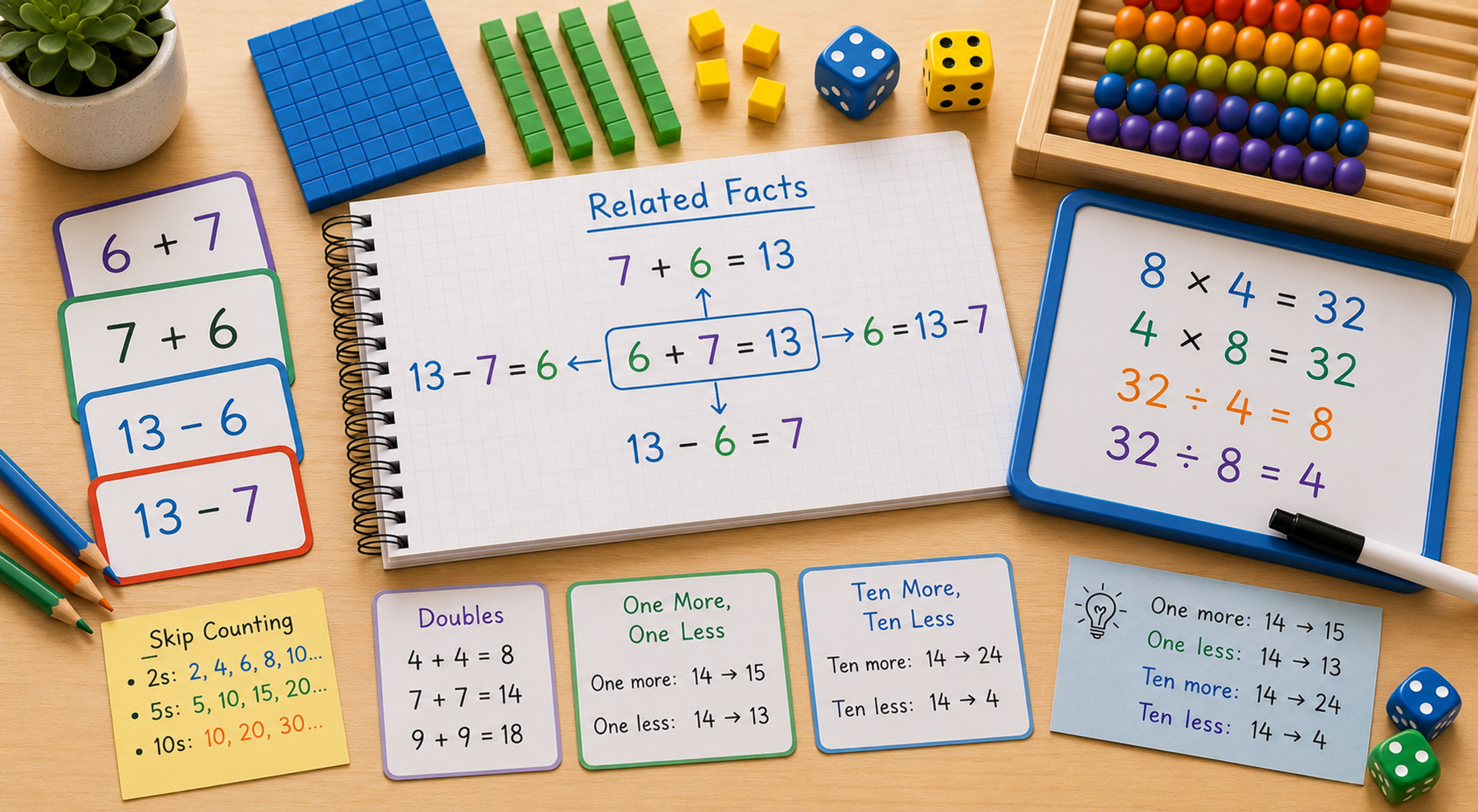
Why Fact Fluency Matters in Mathematics
During our maths lessons, students spend a small amount of time each day developing fact fluency as part of their mathematics learning. Fact fluency is the ability to accurately and efficiently recall basic number facts, including addition, subtraction, multiplication and division.
While this may seem like a simple skill, it has a significant impact on students' success in mathematics. As mathematical concepts become more complex, students are required to hold and process increasing amounts of information. When basic number facts can be recalled automatically, students are able to devote more of their thinking to solving problems and understanding new concepts, rather than working out simple calculations.
Educational experts, including Dr Brian Poncy and Brad Nguyen, details this as reducing the demands placed on working memory. As our working memory has a limited capacity, students who have fluent recall of basic facts have more mental capacity available for learning. This allows them to engage more confidently with new or challenging mathematical tasks.
Importantly, fact fluency is not about memorisation without understanding. Our teachers support students by first developing strong number knowledge through explicit teaching. Once these concepts are understood, regular practice helps strengthen retrieval so that basic facts become automatic. It is this combination that supports long-term success in mathematics.
Tips for Building Fluency at Home
Families play an important role in supporting fact fluency. Just five minutes of regular practice several times each week can make a difference. Below are some ways to reinforce these skills at home.
- Practise recognising and naming numbers.
- Practise writing numerals correctly and neatly.
- Count forwards and backwards from different starting numbers.
- Instantly recognise small collections without counting (subitising).
- Build confidence with number facts to 5.
- Build confidence with number facts to 10.
- Build confidence with number facts to 20.
- Practise doubles facts (e.g. 4 + 4, 7 + 7).
- Practise near doubles (e.g. 4 + 5, 7 + 8).
- Recall one more and one less than a given number.
- Recall ten more and ten less than a given number.
- Skip count forwards and backwards by 2s.
- Skip count forwards and backwards by 5s.
- Skip count forwards and backwards by 10s.
- Skip count forwards and backwards by 3s, 4s, 6s, 7s, 8s and 9s.
- Practise multiplication facts one times table at a time.
- Practise the related division facts for each multiplication fact family.
- Read, write and compare larger numbers.
- Solve simple mental addition and subtraction problems.
- Estimate answers before calculating.
- Explain different mental strategies for solving the same problem.
A Few Tips
- Spend just 5–10 minutes practising several times each week.
- Focus on one skill at a time until it becomes quick and accurate before moving on.
- Continue revisiting previously learnt skills to keep them automatic.
- Make practice enjoyable by using cards, dice, board games or everyday situations such as shopping, cooking and travelling.
Dean Butler
Maths Leader