Principal's Update
Per Vias Rectas
Principal's Update
Per Vias Rectas
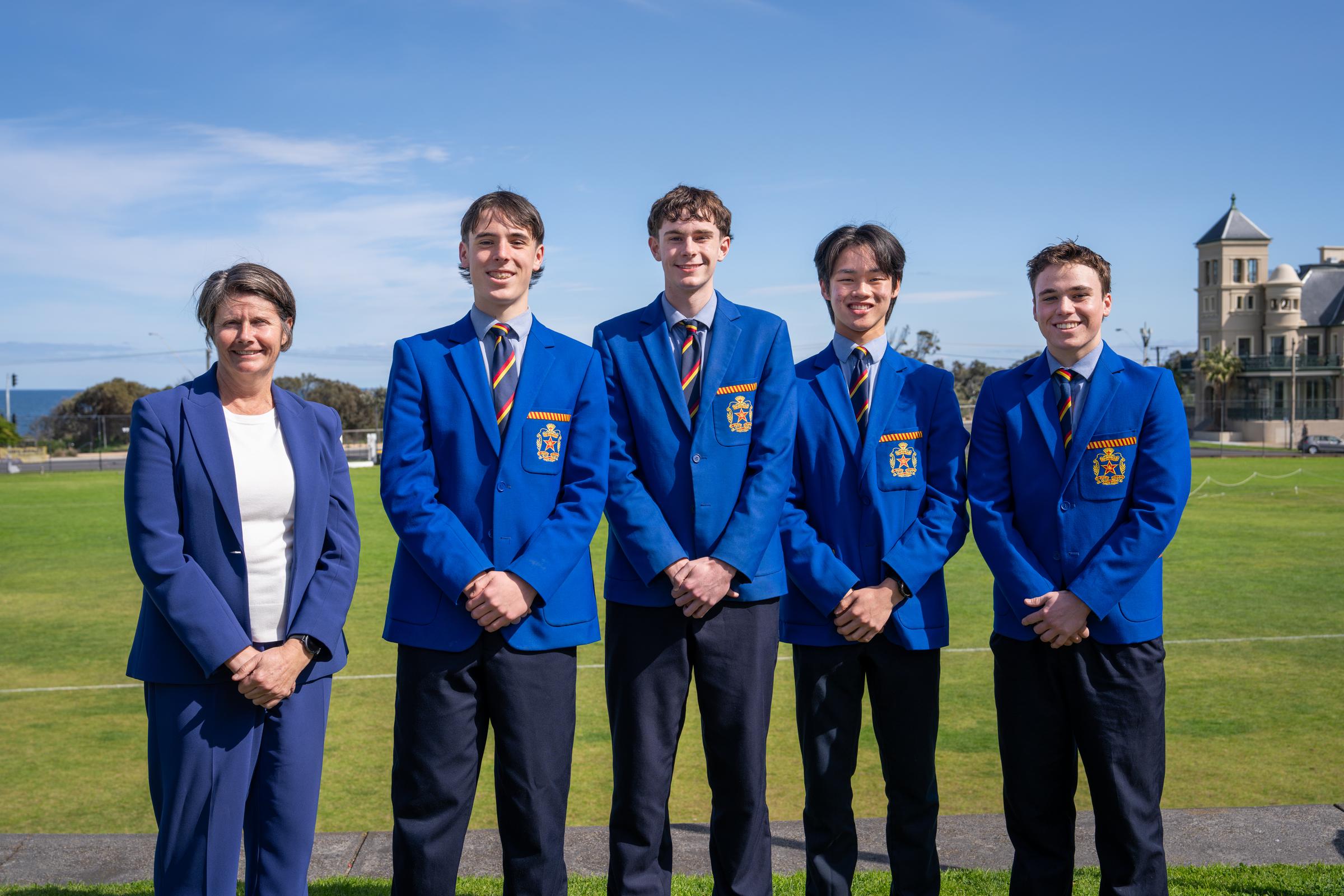
Following a rigorous selection process, I am proud to announce our College leaders for 2027.
Jacob – College Captain
William – College Vice-Captain
Beau – College Vice-Captain
Aaron – College Vice-Captain
Leadership at our College is not about status or prestige; rather, it is about service, responsibility and the ability to positively influence those around us. After speaking with the elected leaders, I have the utmost confidence that our College Captain and Vice-Captains will lead with humility, courage and compassion as they represent the student body throughout 2027 and leave their mark on the great tradition of student leadership at St Bede’s College.
I would also like to acknowledge and thank every student who nominated for a leadership position. Putting oneself forward for student leadership requires courage, confidence and a genuine desire to serve the College community. Every student who participated in the process should be proud of their willingness to step forward and lead.
We look forward to sharing further leadership announcements in the coming weeks.
All in attendance at our annual Celebration of the Generations event, cohosted by our Old Collegians Association.Grandparents, parents, students and other family members gathered as we recognised 39 Year 7 students whose fathers and/or grandfathers previously attended St Bede’s College. Three of our students are 3rd generation - Ashton, Casper and Sebastian.
Team Omega Racing, has joined our other teams in qualifying for the 2026 State Finals of STEM Racing. Good signs for our future in this competition that a Year 7 team of Sam, Jack, Leo, Jake and Liam has qualified in the Cadet Class. Their secret: clear roles and non-stop teamwork.
To student Jack, who responded to his grandfather's MND diagnosis and walked 400,000 steps in 7 days to raise nearly $16,000 for FightMND spoke to local primary schools about his story, inspiring young students that they too have the power to turn great personal challenges into wonderful opportunities.
To our Librarians and support staff on the conduct and energy of our Beda Reada Book Weeks Festival. A great range of activities saw the community and students eagerly involved in a community trivia night, author visits, House trivia, pop-up book shop, chess, quidditch and other games.
Congratulations to Joel, our student who reached the final of the 2026 Parliamentary Prize Competition. Joel’s submission centred on accessibility across Melbourne’s tram network, the world’s largest.
Thank you to the fathers who, with their sons, attended our Father’s and Carer's Mornings at our two campuses. The attendance was excellent. The student-teacher relationship in a Lasallian school is modelled on the special role and relationship a father and mother have with their children. St John Baptist De La Salle understood the special role of a father through his writings on God the Father. He describes God the Father very much as he saw his own father and the notion of fatherhood—wisdom, patience, teacher, presence and companion. I hope that all fathers and father figures suitably enjoyed Father’s Day last weekend.
With our Year 12 students approaching an important signpost in their final year, the Trial VCE Examinations, we trust that each student prepares diligently for this practice-run and continues to focus on achieving their personal best. The coming weeks provide the opportunity for achieving a considerable jump in Grades, and our College is here to support them alongside their families.
Best wishes to our ACC Cross Country team and its coaches, who now preparing for the ACC Carnival at the end of Term 3.
As an accredited member of the Council of International Schools, St Bede’s College is part of a global community comprising 1,560 schools and universities across 121 countries.
The community surveys from parents, students and staff provide us with feedback that is crucial in shaping the future of our College community, helping us identify strengths and areas for improvement against international standards. We now have 6 years of community feedback using this survey instrument. The 2026 surveys were completed by an increased number of respondents from each constituency and continued the trend of very high satisfaction levels with the College’s operations. A summary of responses is provided below.
Survey Domains | Positive Response % | |||
Parents 332 respondents | Students 1510 respondents | Teaching Staff 129 respondents | Support Staff 59 respondents | |
| Purpose and Direction | 91.72% | 88.73% | 86.15% | 93.77% |
| Governance, Ownership and Leadership | 91.62% | 91.30% | 84.73% | 93.20% |
| Curriculum | 89.22% | 78.13% | 84.64% | 83.70% |
| Teaching and Assessing for Learning | 85.19% | 85.63% | 86.57% | 71.10% |
| Wellbeing | 91.11% | 81.41% | 95.35% | 98.54% |
| Staffing | 88.80% | 86.90% | 90.42% | 86.36% |
| Premises, facilities, systems, services | 90.24% | 86.06% | 89.95% | 95.82% |
| Community and Home Partnerships | 83.13% | 88.50% | 92.28% | 86.50% |
| Catholic and Lasallian Identity | 91.70% | 88.10% | 97.25% | 99.15% |
| Positive response % for all survey items—2026 | 89.19% | 86.08% | 89.70% | 89.79% |
| Positive response % for all survey items—2025 | 87.01% | 85.40% | 87.95% | 87.60% |
Using the responses that were less than “75% positive” as a guide, we may gain some insight into suggested areas for growth. It should also be realised that sometimes a response is less than “75% positive”, because of the large number of respondents marking it as “not relevant”.
Parents suggest that school effectiveness could be improved by:
Engaging with families on how best to improve their son’s language development.
Students suggest that school effectiveness could be improved by:
Teaching Staff suggest that school effectiveness could be improved by:
The school's curriculum provides students with opportunities to learn about their
ethnic/cultural heritage.
Support Staff suggest that school effectiveness could be improved by:
Matters arising from these community surveys will be considered for inclusion in the next set of College Annual Action Plans. We thank our students, families and staff for their contributions.
In 2027, we intended to use a different survey instrument; one more commonly used across Melbourne Catholic Schools and which I believe would be of better value to us given our similar context.
The surging role of Artificial Intelligence in work and in education is increasingly being debated in schools, in politics and in the general community. Recently in NSW, a pause was placed on all take-home assessments which form a significant part of their VCE assessment. This pause is to enable a NSW State Government review into the impact of AI on student learning.
AI is now part of the world in which our students are growing up, learning and will work in. AI can be a useful tool when it supports learning. But it should never replace the thinking, drafting, problem-solving and reflection that students need to do for themselves, increasingly so as the move into higher education. The learning process matters, as it is through sustained effort, challenge and reflection that students develop a deeper, long-term understanding. The process of teaching and learning ideally revolves around explicit teaching, active engagement, feedback, and the development of independent learners who can think critically and apply their knowledge with integrity.
If a boy is using AI to help clarify ideas, organise their thinking and improve their understanding, then it is supporting their learning. If it is being used as a shortcut to eliminate effort, then understanding does not occur. Learning does not occur simply by receiving answers. It happens when students analyse, question, evaluate, create, revise, and solve problems. The brain develops through active engagement, not passive consumption. Nothing can do our thinking for us.
Pope Leo XIV, in Magnifica Humanitas, reminds us that technology should always serve the human person and the common good. As technology becomes more powerful, we must remain committed to what is uniquely human. This is as important in education as in any other facet of our lives. It should never become a substitute for personal intellectual effort. While technology can help students learn, using it merely to get an assignment out of the way may produce finished work without producing genuine understanding or contributing to learning.
The greatest risk of AI in education (and in so many fields in which it is and will be used) is not cheating, but passivity. It can allow convenience to replace curiosity and answers to replace thinking.
Feast Day - 2 September
One of our College House Patrons, Saint Solomon (born Guillaume-Nicolas-Louis) Leclerq (1745-1792), was born in France. At the age of 22 he joined John Baptist de La Salle’s Brothers of the Christian Schools. A rather shy person, he became a gentle but firm teacher. In time, he moved into administrative roles within the Brothers’ congregation during the period of the French Revolution.
Shortly after the Revolutionary Government had ordered the Brothers to disband, Solomon was arrested and then imprisoned after refusing to take an oath of allegiance to the revolutionary government. Along with a group of priests and bishops, he was butchered by the Revolutionaries in 1792. Solomon was the first of the De La Salle Brothers to die a martyr. Pope Francis declared Solomon to be a Saint in 2016.
Per Vias Rectas
Deb Frizza
Principal