
Year 8 Studies
8 English
Semester One
Students’ creative responses provide opportunities to experiment with imaginative writing and explore a range of literary devices. Students develop their own creative pieces in response to a variety of images and stimuli, strengthening their ability to craft engaging narratives. Students also study contemporary media issues and apply analytical skills to examine the structure of arguments through the identification of persuasive techniques and language. In preparation for the Public Speaking Competition, students complete a written speech and further develop their verbal presentation and public speaking skills.
Semester Two
Students study a range of texts with an emphasis on understanding key features, author intent and the ways meaning is created for audiences. The study of a novel forms the basis of an analytical text response, where students examine themes, characters, setting and author viewpoints while learning how literary devices and language choices shape meaning and engage readers.
Students also analyse visual and film texts, exploring how techniques such as camera angles, lighting, sound, symbolism and editing contribute to storytelling and audience response. A strong literacy focus is maintained throughout the course through vocabulary development, wide reading, grammar, spelling and structured writing activities.
Assessment
A range of writing forms including: essay, short answer questions; creative responses and oral presentation.
8 Maths
Semester One
Students use statistics to distinguish between populations and samples, carry out statistical investigations and display and analyse results using a variety of statistical graphs and calculations. They further develop fluency in working with positive and negative numbers and use the four operations to evaluate questions using integers. They also study measurement and further develop their understanding of perimeter, circumference, area, surface area and volume. Students continue to develop their understanding of algebra by learning techniques of expansion, factorisation, substitution and solving equations. Throughout all topics students applied their knowledge to solve a variety of problems in different contexts.
Semester Two
Students are introduced to Pythagoras’ theorem to solve a variety of problems involving the side lengths of right-angled triangles. Students revise their whole number and fraction operations and apply these to more challenging worded problems. They develop their understanding of probability through use of two-way tables, Venn diagrams and tree diagrams and calculate experimental, theoretical and expected probability of events. Students study the topic of geometry which includes the consideration of angles, transformations, similar and congruent shapes. They also explore how to plot and sketch linear graphs. They continue to strengthen number skills by revising operations with decimal numbers and they explore financial mathematics by considering percentage increase and decrease, discounts and mark-ups and profit and loss.
Assessment
Students will complete three CAT tasks per semester covering the Victorian Curriculum 2.0 areas of Number, Algebra, Measurement, Space, Statistics and Probability. In addition to CAT tasks, students will complete additional tasks as both formative and summative assessment. CAT structures will vary between topic tests, problem solving/modelling tasks, collaborative investigation tasks that all require the application of the mathematical content studied.
Science
Semester One
Students spend time studying living systems, where the students analyse the relationship between structure and function at cell, organ and body system levels. Students will study electrical circuits and how they transfer energy when current flows and can be designed for diverse purposes using different components. Throughout the semester students engage in a variety of practical tasks to develop key science skills.
Semester Two
They conduct multiple experiments throughout the chemistry topic, to aid in their understanding of physical and chemical change and investigate where they can observe these in everyday life. They consider the many ways that one form of energy can transform into another and how energy efficiency can be calculated. Students will explore the theory of plate tectonics and how the movement of Earth’s plates shapes the planet. They will investigate how tectonic activity causes events such as earthquakes, volcanoes and mountain formation, and how it helps explain patterns in fossils and living organisms around the world. Students also recognise that sedimentary, igneous and metamorphic rocks contain minerals and are formed by processes that occur within Earth over a variety of timescales.
Assessment
Students will complete two common assessment tasks (CAT) in each semester. In each semester students will undertake a scientific investigation as well as a variety of tasks which may include topic tests or a research project.
Humanities
Semester One
Students will commence their study in Humanities by exploring the role of civics and citizenship on both a national and international level – tracing the rise of democracy to modern day legislation, voting and freedom of speech. In this, students will be undertaking mock trials and creating laws to introduce into Australian Parliament. Following this, students will undertake a historical study of Medieval Europe and Shogunate Japan. Students will identify and explain patterns of change over time; considering how these societies differed through the use and evaluation of sources. In doing this, students will be interrogating sources, engaging in interactive activities and roleplays, undertaking case studies and research tasks.
Semester Two
During the second semester, students will identify the different Australian landscapes and landforms; using a selected landscape or landform as the focus of their studies. Students will explore the impact of tourism on the landforms with consideration of the impact on Indigenous cultural sites. Following this, students will undertake a unit on business and economics wherein they will look into consumerism, work practices and the role of businesses.
Assessment
Students will complete two common assessment tasks (CAT) in each semester. In Semester One, students will undertake a group presentation and a source analysis. In Semester Two, students will be writing a geographical report and undertaking a business analysis.
Language - French
Semester One
Students learn to discuss school, birthdays and future activities. They continue to build their vocabulary, as well as learning to apply rules of grammar such as verb conjugation. Students practise their reading and listening comprehension skills by working with short texts. They extend their writing skills from sentences to paragraphs. They practise their speaking skills, focusing on communication and comprehension.
Semester Two
Students learn to discuss daily activities, clothes and physical appearance. They continue to extend their vocabulary, along with understanding rules of grammar such as adjectival agreement. Students further develop speaking, reading and listening skills. Students also deepen their cultural awareness of France and the French-speaking world.
Assessment
Students complete one Common Assessment Task (CAT) each term. CATs include speaking tasks (such as oral presentations, videos or roleplays), writing tasks, and listening and reading comprehension tests.
Language - Japanese
Semester One
Students build their skills in reading and writing of the basic hiragana script. They extend their range of vocabulary through the topics of cities and towns, weekly schedules, and Japanese food. They complete various communicative tasks around these topics. Students further develop reading and listening skills to interpret and respond to texts, and begin to write longer passages of text using the structures modelled in the textbook. Students learn additional kanji and implement these in writing and reading tasks.
Semester Two
Students are introduced to grammar and vocabulary relating to time, daily life and routine, school subjects, timetables, and activities. Students consolidate key skills involving reading, writing, listening, and speaking. They develop a deeper understanding of Japanese language and culture through classroom discussion and activities, tests, and project tasks.
Assessment
Students complete two Common Assessment Tasks (CAT) each semester. CATs include writing tasks, research tasks, and listening and reading comprehension tests.
Health & Physical Education
Semester One
Health and Physical Education aims to promote a healthy and active lifestyle now and in the future.
Physical Education classes focus on the important role physical activity, sport and recreation need to play in the lives of all Australians in meeting the Physical Activity and Sedentary Behaviour Guidelines, providing opportunities for students to be challenged, achieve personal growth, enjoyment, and personal fitness. Students are exposed to a variety of sports/activities in practical sessions including athletics, softball, outdoor education, AFL and fitness.
In Health Education, students learn how to take positive action to enhance their own and others’ health, safety, and wellbeing. Students examine the physical, social, emotional, mental, and spiritual dimensions of health and wellbeing, demonstrating a range of health seeking strategies that will support them to access and evaluate health information and services. Semester One health content explores the topics 'Body & Mind' and 'Respectful Relationships'.
Semester Two
Students are exposed to a variety of sports/activities in practical sessions during semester two including basketball, gymnastics, badminton and dance.
In Health Education, students learn how to take positive action to enhance their own and others’ health, safety and wellbeing. Students examine the physical, social, emotional, mental, and spiritual dimensions of health and wellbeing, demonstrating a range of health seeking strategies that will support them to access and evaluate health information and services. Semester Two health content explores the topics 'Youth Health' and 'Safety'.
Assessment
Physical activity and movement skills: Students will be assessed on their practical execution of skills and movement, their participation, application of individual and team strategies, ability to work in a team, understanding of rules and leadership.
Health Education application: Students will complete one Health CAT each semester.
Music
Semester One
Students use their knowledge of the elements of music to investigate a period of time in music history and the styles of music present. They analyse pieces of music in these styles, investigating the structure and meaning, and how the elements of music have been manipulated to achieve the intended emotion. They use musical instruments to learn and rehearse a range of musical pieces in preparation for class performances, demonstrating technical and expressive skills. Students continue to develop music literacy skills that allow them tom communicate musical intentions to an audience.
Students in the Ensemble Class undertake these skills through the learning of their chosen musical instrument, either orchestral strings or band instruments.
Semester Two
Students investigate the effect of music in film. They analyse the use of the elements of music in film scores and the effect they have on mood. Students use music technology to plan, compose and record a film score that includes music and foley and an intended mood. Students work in groups to analyse a contemporary genre and form bands that rehearse and present a performance in their chosen genre.
Assessment
Keyboard Skills: Students will learn to play a melody and accompaniment on the keyboard. Students will learn a new piece that they have not played before. Students in an Ensemble class will be assessed on a piece they have prepared on their chosen instrument.
Music Styles: Students will research and compare two periods of time in music history.
Film Music Soundtrack: Students will compose and record a soundtrack to a selected excerpt of a film.
Rock Band: Students work in groups to form their own bands. Each band chooses their own genre to study for the unit. Components include analysis of a song, and explanation/discussion about the genre, band rehearsals and a performance of a chosen song.
Product Design – Wood
Semesterly
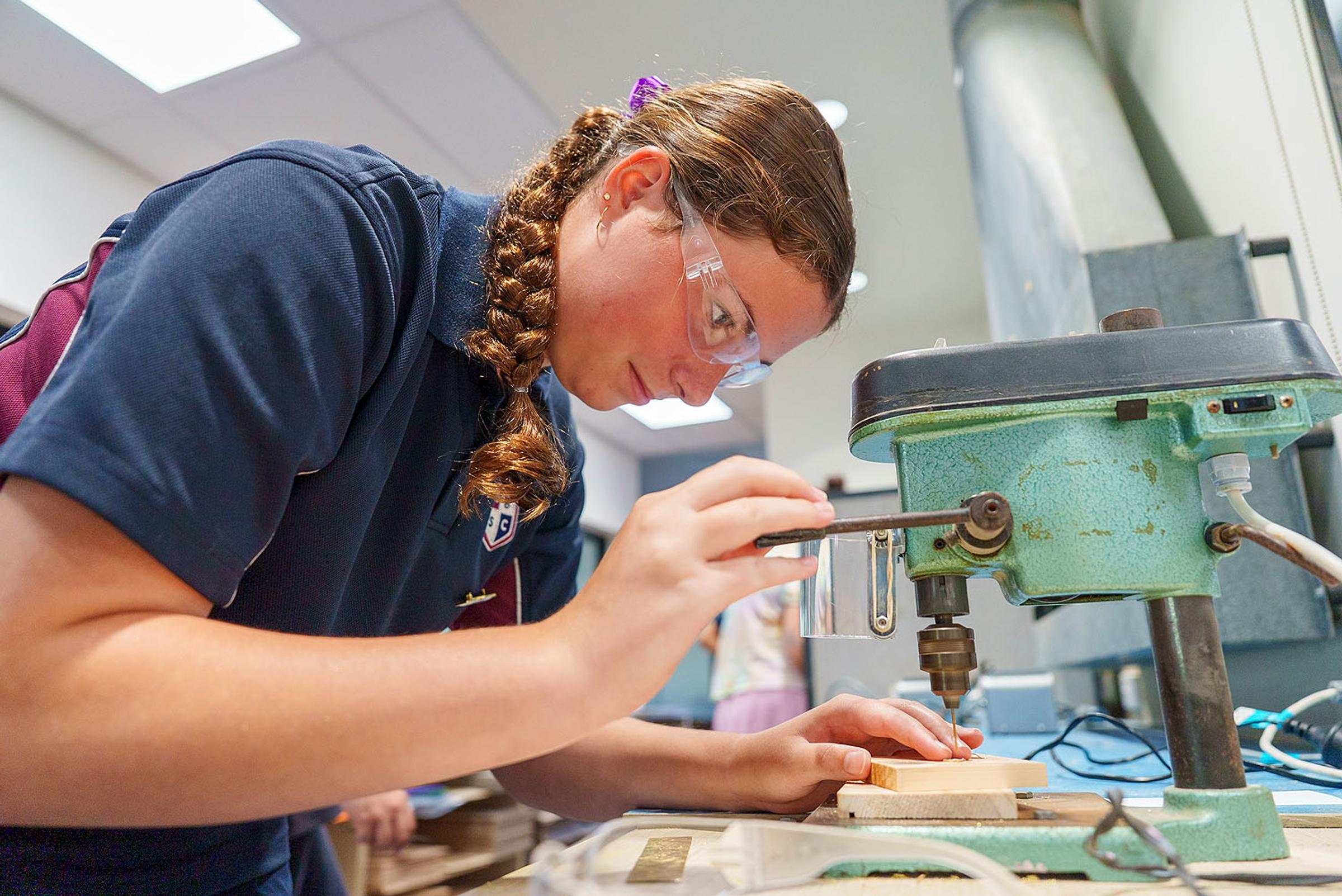
In this unit the students develop skills in researching, designing and producing wooden products. Students learn and follow the design process to make several woodwork pieces, and they document their design processes in their visual diaries.
Assessment
Device Stand: Students research, design and create a Device Stand for either a phone or tablet. Students learn about the technology rooms, safety, machinery and equipment.
Wooden Box: Students research, design and create a Wooden Box for a purpose of their choosing. Students learn about the technology rooms, safety, machinery, techniques and equipment.
Food
Semesterly
Students learn about safety and hygiene, the correct procedure on how to safely turn on an oven and stove top, being able to read and follow a recipe, work flow and time management, and the correct use and name of equipment. They study food waste and sustainable food practices, Australian Guide to Healthy Eating, as well as an exploration of allergies/intolerances and various dietary preferences such as vegetarianism.
Assessment
Students learn how to use the design process to design and make a healthy meal.
Students are assessed on the knowledge of hygiene practices, safety protocols, and the Australian Guide to Healthy Eating. These assessments will evaluate students’ understanding of theoretical concepts, terminology and best practices.
Drama
Students refine their acting skills using facial expressions, voice, gesture and movement to create character. They participate in workshops exploring characterisation, script interpretation and production design. Students work collaboratively to develop an interpretation of a script. In their performance the students will focus on maintaining commitment to character and communicating the meaning of the script through the application of production roles such as lighting, sound and costume. The semester’s learning culminates in a performance to an audience of their peers.
Assessment
Drama Performance: Students use their knowledge of the elements of drama to interpret a script, develop character, rehearse, and perform a play to an audience of their peers. Students design and execute production elements such as costumes and props to enhance their final performance. Students will demonstrate their knowledge of drama terminology and elements when evaluating their performance work.
Art
This unit involves the study of the art elements and principles, the art and design process and the production of final artworks. Students focus on a range of visual arts practices such as drawing, printmaking, sculpture and painting processes across the semester.
Assessment
Students focus on a range of visual arts practices such as printmaking, drawing, sculpture and painting processes. Students document their creative process in a visual diary and are required to do two CATs during the semester