Octavia
Year 6









 Aitken Hill Primary School
Octavia
Year 6
Dear Parents and Carers,
Welcome back to our final term of Grade 6! It is hard to believe that we are already approaching the end of primary school. What an exciting and memorable year it has been! We have returned from a wonderful camp, where students created lasting memories, challenged themselves, strengthened friendships and shared plenty of laughs. As we begin our final term together, we look forward to celebrating how far everyone has come and making the most of these last few weeks of primary school. There are still so many exciting experiences, special moments and milestones ahead of us. Let's make this final term one to remember and finish our primary school journey on a high note!
Reading
During the first part of the term, students explored a range of literary and historical texts connected to our Inquiry topic of Australian History, including Eureka, Matthew Flinders and Took the Children Away. They examined how historical, cultural and social contexts influenced characters' actions, decisions and experiences, developing a deeper understanding of how people's lives were shaped by the time periods and societies in which they lived. Students supported their interpretations with evidence from the texts and shared and justified their thinking during class discussions.
Students also investigated how authors used language to communicate ideas and influence readers. They distinguished between objective and subjective language by identifying facts, opinions and personal viewpoints. They explored how carefully selected verbs created vivid imagery, conveyed emotions and built tension and considered how alternative word choices could change the meaning or impact of a sentence. Students further examined authors' individual writing styles, identifying how descriptive vocabulary, language features and historical details contributed to engaging and meaningful texts.
A key focus was developing students' ability to think critically about what they read. They evaluated authors' ideas and arguments, identified supporting evidence and considered whether the information presented was convincing. Students justified their opinions using examples from the texts and discussed how additional evidence could strengthen an argument. These learning experiences supported students in becoming more thoughtful, analytical and confident readers.
Writing / Spelling
In Writing, Grade 6 students have been exploring historical narratives, focusing on using accurate vocabulary and historical details to create realistic stories. Students researched an event from history, learning about important facts, daily life and the experiences of people living during that time. They then used their research to write fictional narratives that included accurate historical information. Through this process, students have been developing their ability to combine facts with imagination, helping readers understand what it might have been like to live through different periods in history.
Maths
In Mathematics, Grade 6 students have been exploring positive and negative integers, transformations and decimal numbers. Students practised locating, counting and comparing integers on number lines, including moving across zero and using greater than and less than symbols. They also applied their understanding of integers to real-world situations involving profit and loss.
Students then investigated geometric transformations, including translations (slides), reflections (flips) and rotations (turns). They explored how shapes can move and change position while keeping their size and shape, as well as combining transformations and identifying lines of symmetry.
More recently, students have been strengthening their understanding of decimals, focusing on place value up to thousandths. They have practised accurately adding decimals, regrouping when needed and using estimation to check their answers. Students have also applied these skills to real-world problems, developing their confidence in selecting strategies and explaining their mathematical thinking.
Inquiry
Students have been exploring Australia’s history during the 1800s. They investigated why British colonies were established and how colonisation affected different groups of people and the environment. Working together, students researched significant historical events, placed them in chronological order on a classroom timeline and are now bringing history to life through their own illustrations. Along the way, they have been developing their research skills, using historical evidence, making connections between events and exploring how Australia changed over time.
SEL
They have also been learning about how to get along with others, show kindness and look after their wellbeing. They explored fairness, respect and how friends, media and peer pressure can influence our choices. Students also practised understanding how others might feel, giving people the benefit of the doubt and finding ways to rest and move their bodies mindfully. These lessons help students build stronger friendships, make positive choices and develop a better understanding of themselves and others.
Reading
During the first seven weeks of Term 3, Year 6 students explored a poetry unit using a range of rich texts, including Sister Heart, The Best Part of Me, A New School Year, Change Sings and Hope is the Thing. Students developed their reading comprehension and analysed how authors carefully use language and literary techniques to communicate ideas, emotions and themes.
Students focused on five key curriculum areas:
Making connections: Students made text-to-self, text-to-text and text-to-world connections to deepen their understanding of characters, events and themes. They identified evidence from texts and explained how their connections helped them interpret ideas and make meaning from what they read.
Cohesion and repetition: Students investigated how authors use repeated words, phrases, text structures and language features to connect ideas and strengthen meaning. They considered why an author might repeat particular language and how this contributed to the overall message of a text.
Vivid vocabulary and figurative language: Students identified and analysed features such as similes, metaphors, personification, hyperboles, alliteration and descriptive language. Using Sister Heart, students explored both the literal and deeper meanings of language choices and considered how these techniques communicated themes such as identity, belonging, loss and hope.
Sound and imagery: Students examined how authors use sound devices and sensory imagery to create pictures in the reader's mind and evoke emotion. They selected examples from poetry and their independent reading books and explained how the language helped them understand characters, settings, feelings and themes.
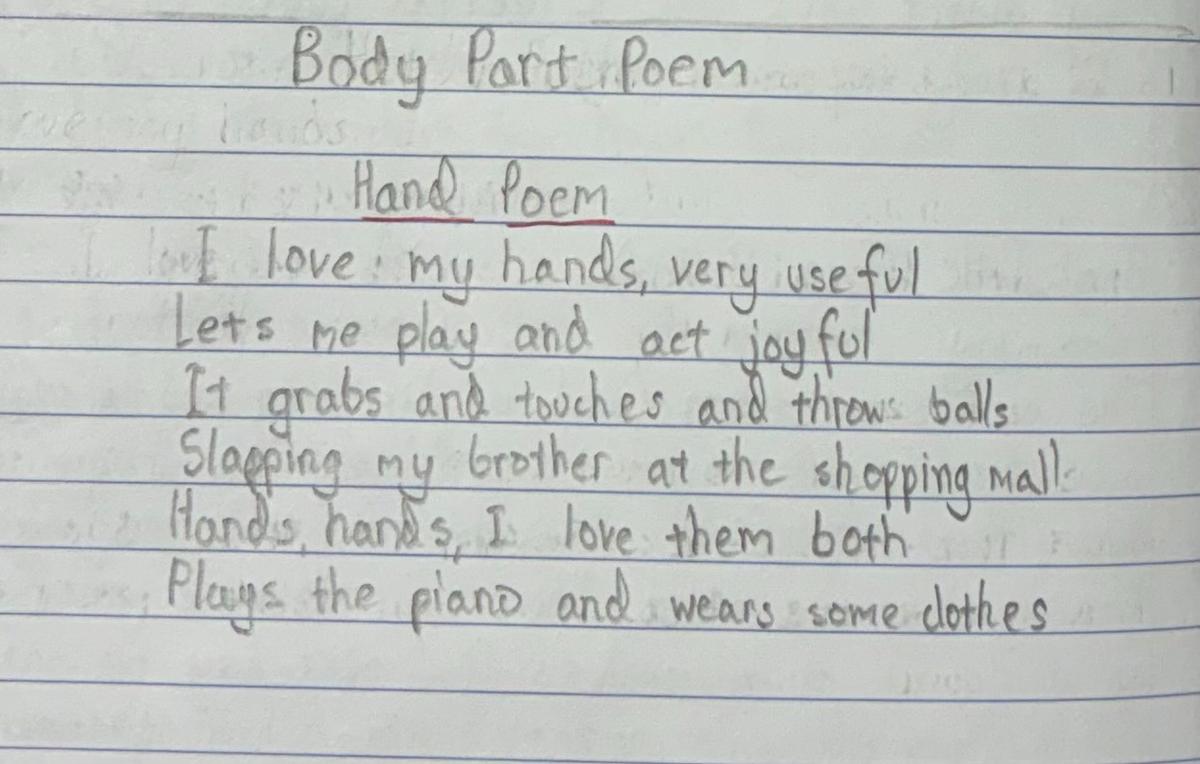
Adapting ideas and text structures: Students explored how authors are often inspired by ideas they encounter in books, poems and stories. They examined how authors can keep a similar idea or text structure while changing the character, setting, situation or message to create something new. Students considered what ideas were kept from an original text, what was changed, how repeated phrases connected different parts of a poem and what feelings were created through vocabulary choices. After exploring The Best Part of Me, students adapted its central idea and structure to create their own poem about a body part that was meaningful to them. They experimented with repetition, similes, metaphors, imagery and vocabulary to communicate a clear personal message.
Throughout the unit, students were encouraged to support their thinking with evidence from the text, explain their ideas in detail and consider how an author's language choices influence the reader.
Writing / Spelling
This term, students have been developing their skills in information report writing. In Week 1, students explored the structure, features and purpose of an information report by analysing a model text about the electoral system. They identified and labelled the different sections before brainstorming possible topics for their own reports.
In Week 2, students began drafting their reports by writing an introduction, selecting three subheadings and developing paragraphs using topic sentences and technical vocabulary. During Week 3, students revised their drafts by replacing weak vocabulary and verbs and experimenting with complex sentences to make their writing more detailed and engaging.
In Week 4, students continued editing and improving their work by examining how published authors write and applying some of these techniques to their own reports. In Week 5, students began publishing their final pieces in a format of their choice, including digital presentations and pamphlets.
To conclude the unit, students created cue cards and prepared to present their information reports to their peers. They completed a final self-edit and peer edit using agreed success criteria before presenting their work. During the presentations, classmates provided feedback, asked questions and shared something new they had learned from each report.
Students have now begun exploring poetry and different types of poems. So far, they have investigated the structure, features and purpose of limerick poems and used this knowledge to plan and write their own limericks.
Students have now started learning about cinquain poems, focusing on how their specific structure and carefully chosen vocabulary can be used to create meaning and imagery. Over the coming lessons, students will continue experimenting with different poetic forms and language features as they develop their own poetry.
Maths
It has been a busy term in Year 6 Maths!
We started the term by looking at number patterns. Students worked out what came next in a pattern and explained the rule being used. We also explored Pascal’s Triangle, looking for patterns in the numbers, rows and shapes. Students then made some of their own patterns for other students to solve.
We also learnt about BEDMAS, which helps us know what order to use when a maths problem has more than one type of calculation. Students used BEDMAS to solve problems and even worked out secret code words.
Our work on chance included looking at how likely different events are. Students used tables and other ways to show chance, and talked about how the rules of a game can make it fair or unfair.
We then worked with fractions and percentages. Students learnt how to find a fraction of a whole amount and used different ways to check that their answers made sense.
Another big focus has been angles. Students learnt to name different types of angles, estimate their size and measure them with a protractor. We searched for angles around the classroom and school, and used what we know about 90°, 180° and 360° to find missing angles.
Students also used supermarket catalogues to practise budgeting and saving money. They planned shopping budgets, compared sale and normal prices, and worked out how much money could be saved over several weeks.
Most recently, we have been learning about area. Students have measured rectangles, learnt why area is measured in square units, and used length × width. We have now started finding the area of larger shapes made from several rectangles.
Inquiry
In Inquiry this term we have been focusing on Civic and Citizenship topic. We have learnt new words and the meaning of them. Some terminology we have learnt are Australian Democratic, Democracy, Strengths of Democracy, Weaknesses of Democracy, Vote, Equal vote, Preferential vote, Voting Ballot, Federal government/parliament, State government/parliament, Local government/parliament, Councillor, Premier, Mayor, Prime Minister, Advertising, Presentation, Voting and Census. Please ask us some words and we can explain the meaning to you.
SEL
In SEL this term we have learnt topics that have covered terminology relating to feeling/emotions, where to seek help from peers, safe parents/adults and services.
We talked about how positive words have an impact, investigated my ikigai, recognised unhelpful thoughts, inner dialogue, and strategies to transform negative thoughts. We continue to master our skills for Physical and Mental Wellbeing.
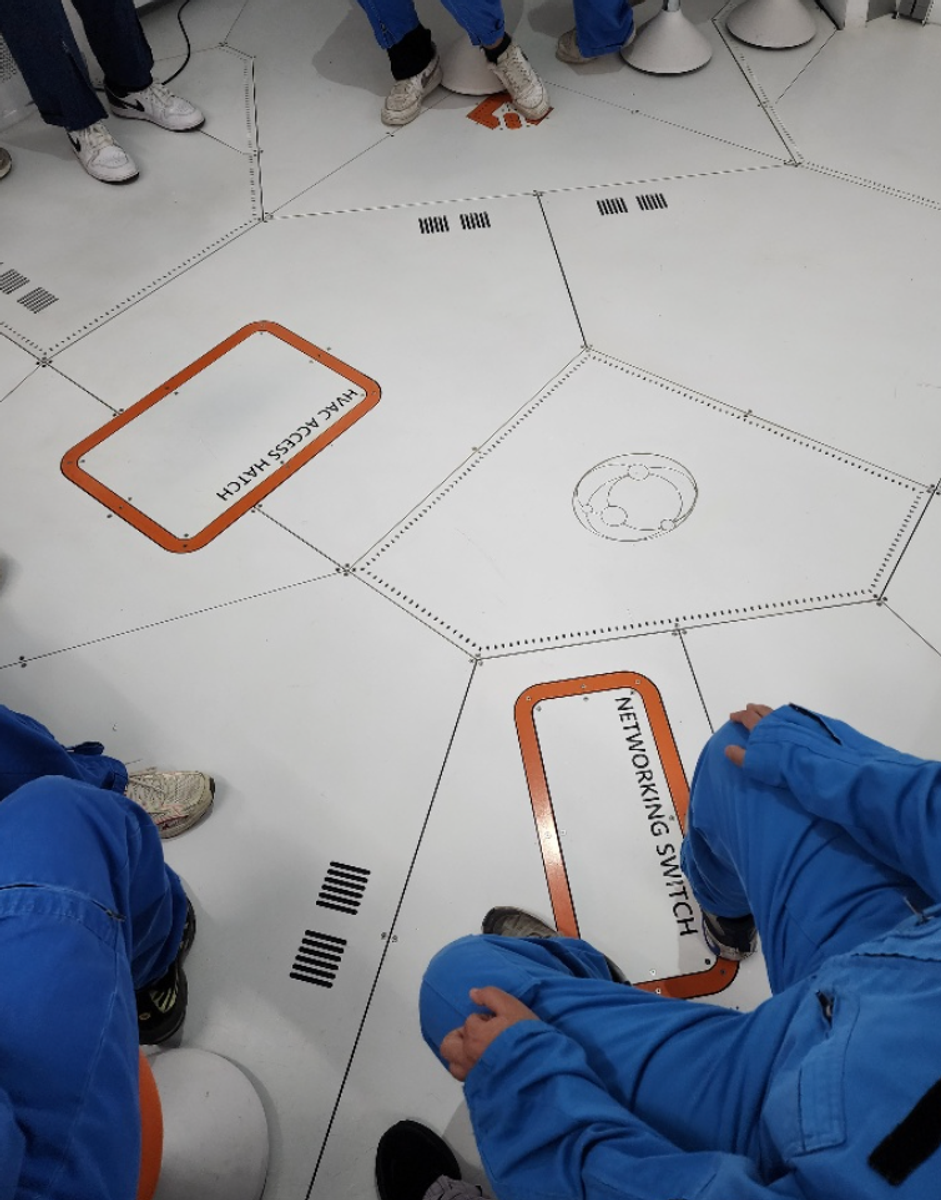
Space Excursion, Melbourne Symphony Orchestra Incursion and Book Week Incursion
Important Information