
Term 4 Learning Summary
English
Summary of Learning:
This term, students will continue to explore how stories and information can help us understand different experiences, perspectives and moments in history. Through a range of engaging texts, students will develop their ability to think critically about what they read, communicate their ideas effectively, and create texts for a variety of purposes and audiences.
In Reading, students will explore two engaging novels, The Grandest Bookshop in the World by Amelia Mellor and The Last Bear by Hannah Gold. Through these stories, students will develop their reading skills by exploring characters, settings, important events and themes. Students will also build their vocabulary and observe how authors build their characters, settings, and emotions for the reader.
In Writing, students will start the term with the Application Writing where they will learn about the skill of writing to a list of success criteria. They will learn to apply the STAR (Situation, Task, Action, Result) structure in their paragraph and making editorial choices based on an agreed rubric. To finish the term, they will consolidate their skills in Narrative writing. Students will plan, draft and edit their own narratives and will also use ideas and techniques from the novels they are reading to inspire and improve their own writing.
Key Vocabulary:
- Dubiously
- Remnants
- Arduous
- Diligently
- Coaxed
- Implored
- Dispersed
- Attuned
- Dilapidated
- Quavered
- Deliberated
- Jaunty
- Malevolent
- Cacophony
- Audacity
Spelling/Grammar
In Spelling this term, students will explore the etymology of various Latin and Greek root words, including clud/clus/clos, mit/miss, cent, milli, meter/metr, and terr/terra/geo. In Grammar, students will continue to deepen their understanding of different sentence types, appositives, and the use of punctuation such as colons, semicolons and commas. They will also explore how to strengthen their writing by upgrading nouns and verbs, using a range of connectives, and incorporating conjunctive adverbs.
How can you support your child’s English learning at home?
- Ask your child to share their insights from the class novel.
- Identify words with suffixes, prefixes, Latin and Greek roots from our weekly focus to continue expanding their vocabulary.
- Ask your child to read aloud to practise their fluency and accuracy.
- Identify simple, compound and complex sentences from their daily reading text.
Mathematics
Summary of Learning:
In Term 4, students will develop their ability to locate points in the four quadrants of the Cartesian plane and plot coordinates with both positive and negative integers. They will explore the transformation of shapes and how coordinates are affected by these movements. Students will use meaningful and specific questioning to gather and analyse data. They will build their capacity for interpreting graphical displays and understanding how bias affects statistical investigations. They then develop their understanding of percentage discounts and build their skills in converting between percentages, decimals and fractions.
Key Vocabulary:
- Statistical Investigation
- Nominal Data
- Ordinal Data
- Discrete Data/Variable
- Continuous Data
- Primary and Secondary Data
- Numerator
- Denominator
- Percentage Discount
- Cartesian Plane
- Quadrant
- x-axis / y-axis
How can you support your child’s Mathematics learning at home?
- Take your child to a local shopping centre and identify different discounts they can see around them including percentages and fractions. Practice calculating what the new cost of items will be.
- Count the type or colour of vehicles that drive past your home over a set period then analyse the information. Ask them want they can observe from the data they have collected and how they could represent it more clearly.
- Play a game of battleships at home with your child. Practice correctly identifying and naming specific coordinates.
Inquiry
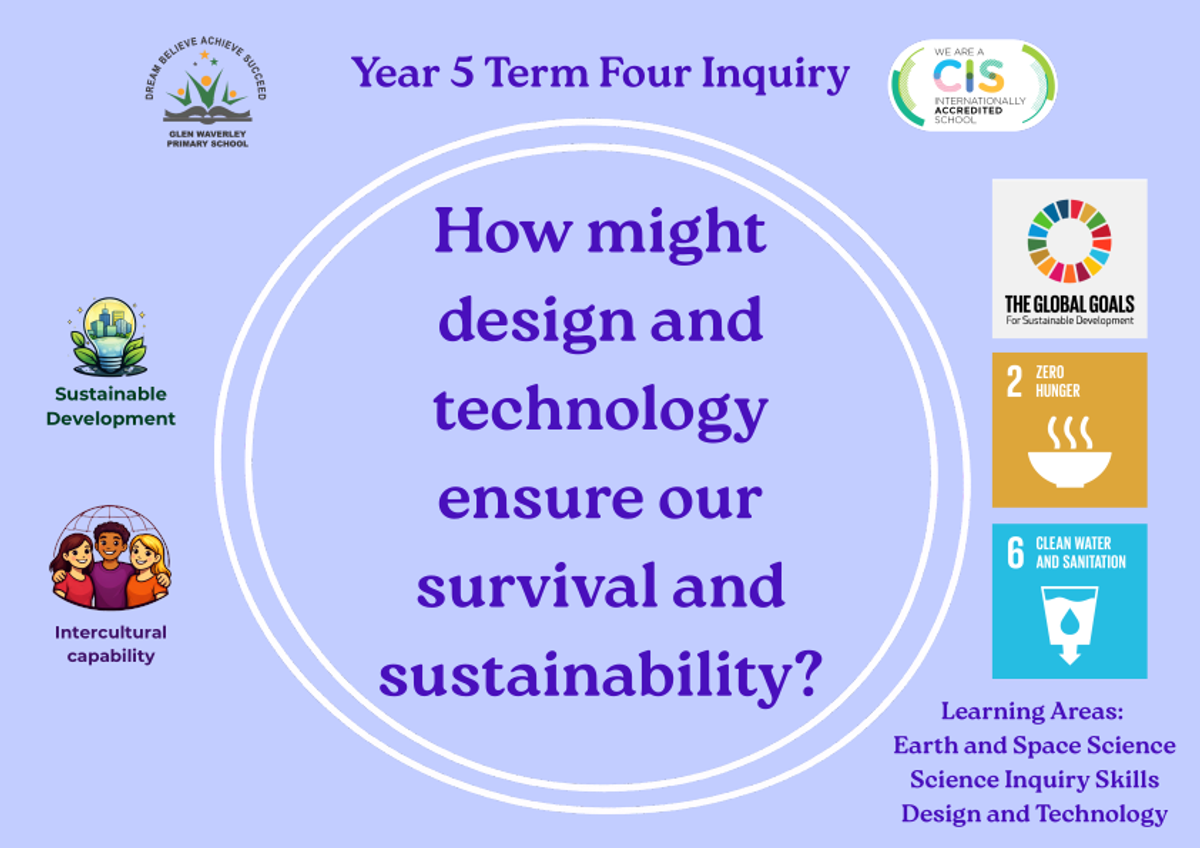
This term, students will investigate the question: ‘How can design and technology ensure our survival and sustainability?’ Through this inquiry, students will explore the relationship between humans, technology and the environment, considering how thoughtful and ethical design can help address challenges facing people and our planet.
Students will begin by unpacking key concepts such as sustainability and ethics, considering the different purposes of technology and whether it is designed primarily for convenience or to genuinely support people and the environment. They will then turn their attention to space science, exploring the conditions that allow life to exist on Earth and considering whether life could be sustained elsewhere in the universe. Our Cosmo Dome incursion in Week 4 will provide an engaging opportunity for students to extend this learning through an immersive space experience.
Students will then develop their understanding of design and engineering through a range of collaborative challenges, including constructing bridges and towers using limited materials. These experiences will encourage students to test ideas, solve problems, work collaboratively and consider how ethical decisions can influence the design process.
In the final stage of the inquiry, students will transfer their learning to authentic design challenges. They will explore how technology and design could be used to improve sustainability, support human survival and sustain life in environments beyond Earth. This may include designing a habitat on Mars, developing a vessel that enables humans to survive or travel safely, creating a Planet B Survival Kit, and proposing technology-based solutions to help a planet facing environmental decline.
Throughout the unit, students will be encouraged to think creatively and critically about the role of design and technology in our future, while considering the ethical, environmental and human consequences of the solutions we create.
How can you support your child’s Inquiry learning at home?
- Talk about sustainability: Discuss simple ways your family can reduce waste, save energy and water, and make more sustainable choices at home.
- Explore technology: Encourage your child to notice how technology is used in everyday life and discuss whether it helps people, the environment, or both.
- Ask “What if?” questions: Talk about what humans would need to survive on another planet, such as Mars. What would we need for food, water, shelter and safety?
- Look at design in everyday life: Encourage your child to notice how objects, buildings and transport have been designed to solve problems or make life easier.
- Encourage creative thinking: Ask your child to suggest a design or technological solution to an environmental or human challenge. There may be more than one possible solution!
- Discuss ethical choices: Ask questions such as, “Who might benefit from this technology?”, “Could it have any negative effects?” and “Is there a more sustainable way to solve the problem?”
Wellbeing
The Resilience Project
In The Resilience Project, we will continue to build our understanding of Gratitude, Empathy and Mindfulness (GEM), with a particular focus on developing our emotional literacy and personal strengths. We will learn to recognise and understand different emotions, identify how emotions can influence our thoughts and actions, and explore strategies to manage our reactions in challenging situations. We will practise using Positive Self-Talk to respond to setbacks, manage unhelpful thoughts and build a more positive and resilient mindset.
We will also explore how gratitude and empathy can strengthen our relationships and support our wellbeing. Through mindful meditation and practical mindfulness activities, we will develop strategies to become more aware of our thoughts, feelings and surroundings and learn how being present can help us respond thoughtfully rather than react impulsively. These experiences will support us to recognise and use our personal strengths while developing greater self-awareness, resilience and positive connections with others.
Cyber Safety Project
In Cybersafety, we will focus on strengths and positive digital identity, exploring how our individual strengths and values can influence the way we communicate, interact and make decisions online. We will learn how Respect, Integrity, Initiative and Global Empathy can guide responsible and safe online behaviour, including showing empathy towards others, making thoughtful choices, speaking up when something does not feel right and considering how our online actions can affect others. We will explore what it means to be an upstander online and how we can use our strengths to respond positively when we see something unfair, unkind or unsafe.
We will also investigate digital habits and how our use of technology can sometimes interfere with our everyday lives, learning strategies to recognise these habits and make positive changes. We will explore how emotional strengths can help us manage online pressures and reactions, including fear of missing out (FOMO), and develop strategies to make confident, balanced and responsible choices. Through these experiences, we will build our understanding of how our strengths can support us to become respectful, responsible and empathetic digital citizens.
Key Vocabulary:
The Resilience Project (TRP)-
Gratitude: noticing and appreciating the positive things in our lives
Empathy: understanding and caring about how others may be feeling
Mindfulness: being present and aware of our thoughts, feelings and surroundings
Emotional literacy: recognising, understanding and communicating our emotions
Resilience: using strategies and strengths to manage challenges and bounce back
Cybersafety -
Digital identity: how we represent ourselves through our online actions and interactions
Upstander: someone who takes positive action when they see something unsafe, unfair or unkind online
Digital citizen: someone who uses technology safely, responsibly and respectfully
Digital habits: patterns in the way we use technology and digital devices
FOMO (Fear of Missing Out): the worry that we are missing something when we are not included or connected online
How can you support your child’s Wellbeing learning at home?
- Recognise strengths: Encourage your child to identify their strengths and celebrate the qualities they bring to their family, friendships and learning.
- Practise our values: Talk about how Respect, Integrity, Initiative and Global Empathy can guide everyday choices and interactions.
- Build resilience: Encourage your child to see challenges as opportunities to learn, persevere and grow.
- Encourage reflection: Ask your child to reflect on how they are feeling, what is going well and what they could do differently next time.
- Promote positive relationships: Encourage open conversations about friendships, kindness and how our words and actions can make others feel.
We encourage families to continue conversations at home around GEM principles and Cyber Safety. Our families have access to the Resilience Project Home - TRP@HOME portal along with the Cyber Safety Project home Resources - Cyber Safety Project. Working together supports learners in applying these strategies beyond the classroom and helps strengthen their wellbeing across all aspects of their lives.