Assistant Principals' Report

Hello and welcome to our newsletter item for this week.
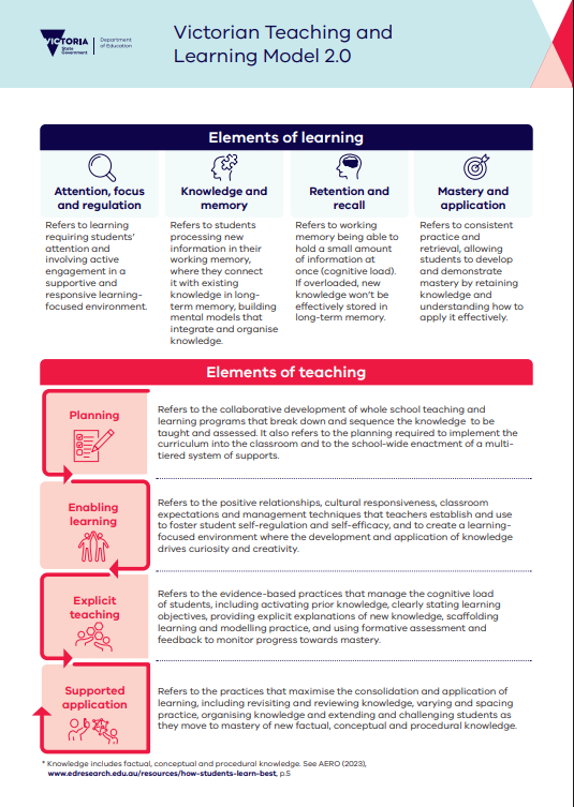
Victorian Teaching and Learning Model 2.0
As mentioned in previous newsletter articles, the Victorian Teaching and Learning Model (VTLM 2.0) provides an emphasis on the evidence about how students learn as the basis for effective teaching. It provides increased clarity for school staff about the elements of teaching that have the strongest evidence base. Throughout the last few years, staff at Heidelberg Primary School have been implementing, monitoring and embedding the VTLM 2.0 elements including evidence based and effective classroom practices.
For further parent and carer information on the VTLM 2.0, please read https:
//www.academy.vic.gov.au/resources/helping-every-child-succeed-vtlm-20
This week, we would like to focus on the element of learning, Attention, Focus and Regulation and the element of teaching, Enabling Learning.
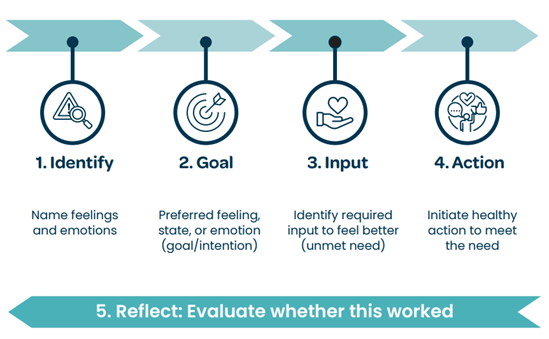
Our whole school learning programs and approaches to Respectful Relationships (RRRR), The Berry Street Education Model (BSEM) and School-Wide Positive Behaviour Support (SWPBS) contribute to shared understanding, consistent and explicit learning of emotional literacy, resilience, self-regulation and positive coping strategies.
5 steps to self-regulation
Brain breaks are useful for all students, as they help our working memory.
• We need working memory to learn – it involves the ability to keep information active in your mind for a short time and use it for further processing
• Working memory capacity is limited – it needs rest after processing
• Without rest, working memory is even more limited
• Students with language or information processing difficulties may have even more limited working memory capacity – brain breaks are essential for these students
At Heidelberg Primary School, we implement brain breaks as part of our regular routine. Teachers also monitor the attention, focus and regulation of students and respond by providing short and sharp (3-5 minute) breaks to re-engage the students to enable learning when required
Sensory tools for self-regulation, such as fidget tools like squeeze balls or key chains can help some students to develop the body-up regulation required to allow them to engage in their learning successfully. They promote movement and tactile input. Therefore, they can be great for students who struggle with attention, focus, and processing.
At Heidelberg Primary School, we support students to understand the purpose of fidget tools and explicitly teach expectations and routines for using fidget tools in the classroom to ensure they are being used effectively.
HPS Fidget Tools Expectations
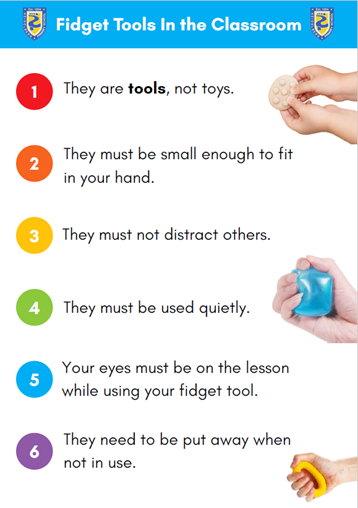
In the coming weeks, students will be reminded of self-regulation strategies and expectations for sensory tools such as fidget tools by their classroom teachers and support staff members.
Have a great weekend and week ahead.
Warm Regards,
Helen Thomas & Monique Rankin
Assistant Principals
Heidelberg Primary School