
Wellbeing
Mrs Mauriks
Wellbeing
Mrs Mauriks
Disagreements and friendship difficulties are a normal part of growing up. Whether it is a disagreement about the rules of a game, someone repeatedly interrupting, a problem sharing equipment, or an unkind comment, children need to learn practical ways to respond.
Across our school, students are being explicitly taught the High 5 Strategy. This gives children a simple set of steps they can use to manage everyday conflict calmly, safely and respectfully.
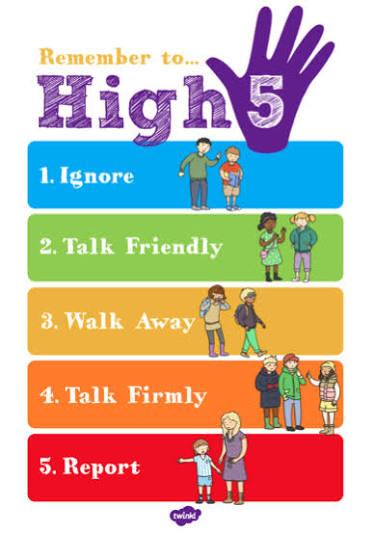
The five steps are:
Students will learn what each step looks and sounds like through class discussions, teacher modelling, role-play and real-life examples. They will also learn that not every situation requires the same response.
For our younger students, this may involve practising short phrases such as:
Teachers might act out familiar situations, such as two children wanting the same toy, someone changing the rules of a game, or a child standing too close. Students can then practise choosing an appropriate High 5 response.
As students move through the middle years, the examples become more complex. They may explore what to do when someone keeps excluding others from a game, makes an unkind joke, pushes in line, takes equipment without asking or repeatedly distracts them during learning. Students are encouraged to think about their tone of voice, body language and the difference between speaking firmly and speaking aggressively.
Our older students may apply the strategy to friendship-group disagreements, sport, group work, rumours, teasing and online interactions. They will discuss how to communicate assertively, when it is helpful to walk away, how to avoid escalating a situation, and how to give an adult clear information when reporting a concern.
An important part of the strategy is helping children understand the difference between reporting and simply trying to get someone into trouble. Reporting means seeking help because a problem has continued, someone may be unsafe, or the child has tried appropriate strategies and needs adult support.
Students are not expected to work through every step if the situation is serious. If someone is being hurt, threatened, persistently targeted or made to feel unsafe, they should move away and tell a trusted adult immediately. At school, the educators will continue to supervise, intervene and follow up concerns.
The strategy can also be used at home. When your child tells you about a disagreement, you might ask:
Families may also find the same language helpful when children are managing disagreements with siblings, cousins, teammates or friends. Using a consistent approach at school and at home helps children remember the steps and develop confidence in using them.
Learning to manage conflict takes time and practise. Our goal is not for children to handle every problem on their own, but to help them build a growing toolkit of calm, respectful responses while knowing that trusted adults are always available to help.
Mrs Róisín Mauriks
Learning Specialist - Wellbeing
roisin.mauriks@education.vic.gov.au
Ph: 5368 1072