Wellbeing News
Building Positive Behaviours Together
At Galilee, we explicitly teach and reinforce expected behaviours to help create a safe and respectful learning environment where every student can thrive. Every fortnight, we focus on one behaviour expectation across the school, giving students opportunities to learn, practise and apply these skills in the classroom, in the playground and throughout the school day.
So far this year, our whole-school expected behaviour focuses have included lining up, transitioning between tasks, keeping hands and feet safe, using kind words and taking care of and respecting shared spaces. By explicitly teaching these behaviours, we are helping students develop the social and emotional skills they need to learn and build positive relationships.
Respecting Others' Space, Boundaries and Privacy
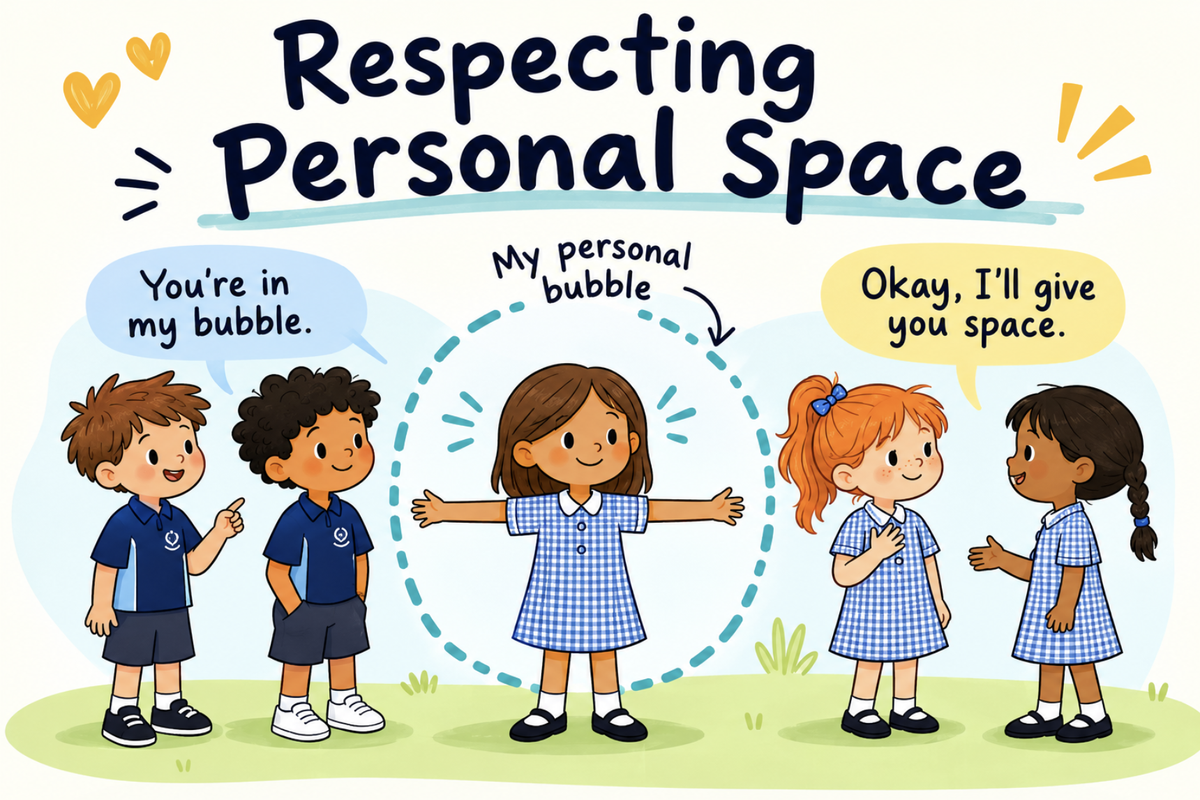
This fortnight, students are learning about respecting others' space, boundaries and privacy. Understanding personal space is an important part of helping everyone feel safe and comfortable.
Throughout the fortnight, students have been exploring what this looks like through class discussions, stories and everyday experiences. They are learning about their personal bubble and practising respectful language they can use in real-life situations, such as:
- "You're in my bubble."
- "Stop. I need space."
- "Please give me some space."
- "Okay, I'll give you space."
By explicitly teaching these skills, we are helping students recognise personal boundaries, communicate their needs respectfully and respond with respect when others ask for space.
How You Can Support at Home
Families play an important role in reinforcing these skills. You can support your child by noticing and praising moments when they demonstrate respect for others' space, for example:
- using gentle hands
- asking before joining a game
- giving siblings or friends room to play
- responding positively when someone asks for space.
You can also use the language of a "personal bubble" at home. Encourage your child to respectfully say, "You're in my bubble" or "I need some space," and model responding with, "Okay, I'll give you some space." Using the same language at home and at school helps children build confidence and develop respectful habits.
Reading together is a wonderful way to reinforce the concepts of personal space, respect and kindness. The following picture books might be beneficial:
- Personal Space Camp by Julia Cook
- Hands Are Not for Hitting by Martine Agassi
- Do Unto Otters by Laurie Keller
- My Body Belongs to Me by Jill Starishevsky
- Clark the Shark by Bruce Hale
These engaging stories provide great opportunities to talk with your child about respecting personal boundaries, using kind words and actions and helping everyone feel safe.
Thank you for partnering with us as we explicitly teach and reinforce these important social skills. By working together, we can help our students develop respectful behaviours that contribute to a school community where everyone feels respected.
NCCD
Every year, all schools in Australia participate in the Nationally Consistent Collection of Data on School Students with Disability (NCCD).
The Nationally Consistent Collection of Data on School Students with Disability (NCCD) takes place every year in August.
The NCCD is a collection that counts:
- the number of school students receiving an adjustment or ‘help’ due to disability
- the level of adjustment they are receiving to access education on the same basis as other students.
Students are included in the NCCD when they receive ongoing adjustments to support their learning because of disability. These adjustments enable students to participate in education on the same basis as students without disability. The NCCD uses the definition of disability outlined in the Disability Discrimination Act 1992 and the Disability Standards for Education 2005.
All information collected is de-identified before it is submitted and is protected by privacy legislation. No student's name or personal information is provided as part of the data collection
This information assists schools to:
· formally recognise the supports and adjustments provided to students with disability in schools
· consider how they can strengthen the support of students with disability in schools
· develop shared practices so that they can review their learning programs in order to improve educational outcomes for students with disability.