Term 3 Learning Summary
English
During Term Three, students will continue developing their understanding of various text types through Ochre Education’s English resources, aligned to the Victorian Curriculum 2.0. Through explicit teaching and regular opportunities to practice and apply new skills, students will continue to build their confidence and understanding in English.
In Reading and Viewing, students will engage in novel studies of a variety of texts, including Us Mob Walawurru and Free Diving. Through shared discussions, they continue building on their comprehension skills from Semester One, such as making predictions, summarising and responding thoughtfully to the text. These novels offer opportunities for students to explore Aboriginal and Torres Strait Islander histories, cultures and perspectives, while examining themes of identity, belonging and resilience.
In Writing, students will apply their understanding of a range of text types and experiment with authorial choices and language features to communicate new ideas and perspectives effectively. Students will craft their factual recounts and personal responses with clarity and research evidence to convey their message and to create meaning for their intended audience.
In Speaking and Listening, students will enhance their communication skills through meaningful discussions and shared reading experiences. They will refine their listening skills by comparing different perspectives and justifying their thinking using evidence from the text.
Key Vocabulary:
Factual recount, mob, referendum, personal response, appositives, adverbials, culture, identity
How can you support your child’s English learning at home?
- Encourage your child to read a variety of text types and genres.
- Talk about historical events, cultures and perspectives explored in class texts to deepen their understanding.
- Practice summarising texts and explaining the key message of class novels and texts read at home.
- Discuss characters, themes and key events within texts.
Mathematics
During Term Three in Mathematics, students will deepen their understanding of Number through an Exponents unit, learning to represent and evaluate numbers in exponent notation. They will strengthen their fluency around recalling powers of 2, 3, 5, and 10. Students will also develop an understanding of prime factorisation and its connection to the highest common factor and lowest common multiple; concepts they began exploring during an earlier Fractions unit. They will end the Exponents unit by learning to evaluate expressions containing exponents and the four operations.
Next, students will deepen their understanding of Algebra through an Equations unit, building upon their prior learning around pronumerals, variables, and simple algebraic expressions. During the unit, they will learn to solve and verify algebraic equations, through strategies such as substitution and manipulation of equations. Students will conclude the unit with a dive into the Cartesian plane and how it can be used to represent number sequences or patterns derived from equations.
Following this, students will begin their first Measurement subject of the year, through a Length unit that will focus on perimeter. They will learn strategies to effectively calculate the perimeter of a range of polygons and composite shapes, further solving problems involving unknown lengths. Students will conclude the unit by delving into the important features of a circle; the radius, diameter, circumference, and their relationship.
Lastly, Students will conclude the term with a combined Measurement and Space focus in an Angle Relationships unit. They will begin the unit by building an understanding of geometric language, notation, and conventions. Students will apply this knowledge to solve problems involving a range of angle relationships, such as complementary angles, supplementary angles and vertically opposite angles, and adjacent angles. They will extend their problem-solving by investigating angles formed when two or more lines are crossed by a transversal, including corresponding, alternative and consecutive interior and exterior angles.
Mathematics Key Vocabulary:
Exponent, prime factorisation, equation, substitution, Cartesian plane, perimeter, radius, diameter, circumference, angle, transversal.
How can you support your child’s Mathematics learning at home?
- Explore the use of exponents and powers in a range of contexts. For example, the powers of ten used to represent large numbers (e.g., speed of light) and small numbers (e.g. mass of elements).
- Relate length and perimeter to real-life situations, such as design, construction, and architecture. How do these fields use length, perimeter, and other measurement concepts?
- Discuss the relationship between common variables, such as the positive relationship between time spent studying and exam scores, or the negative relationship between screen time and sleep quality.
- Identify and discuss angles within the environment. Ask your child if they notice certain types of angles and relationships.
Inquiry
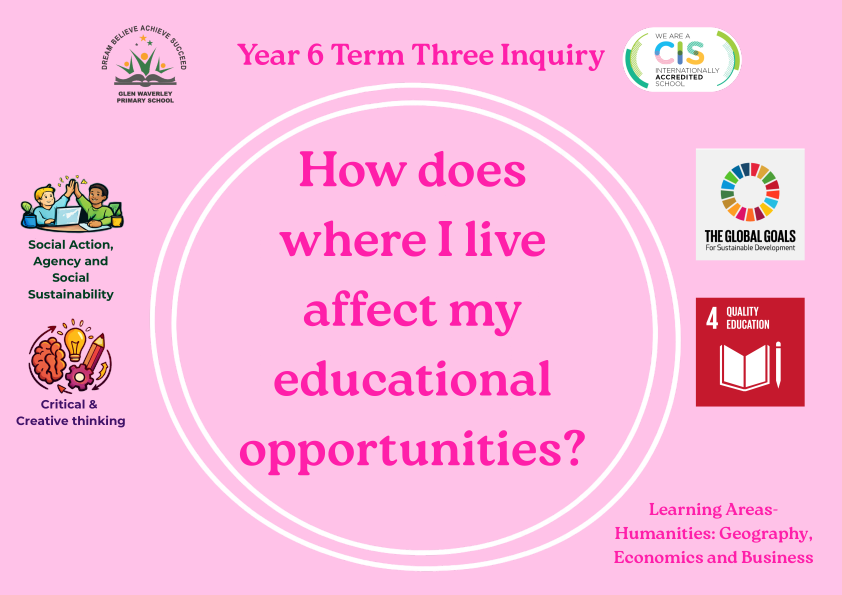
During Term Three, learners will explore the Inquiry question, 'How does where I live affect my educational opportunities?' They will investigate how factors such as geography, economy and social systems influence access to education in various communities across Australia and the world. Learners will compare educational settings to consider how physical location and economic resources impact educational opportunities among young people. Through this unit, learners will explore global and local inequalities in access to learning and critically reflect on ideas of fairness, privilege and equity. As their transfer of learning, they will take a broader perspective and explore choice and educational pathways for people with varying socioeconomic backgrounds.
Inquiry Key Vocabulary:
Equity, education, opportunity, access, resources, systems.
How can you support your child’s Inquiry learning at home?
- Talk about your own schooling and what shaped your educational experiences.
- Watch a video or documentary together about education in other parts of Australia or the world.
- Discuss examples of how location can create challenges or advantages for students.
- Encourage conversations about fairness and how people can improve access to education.
Wellbeing
The Resilience Project
During Term Three, students will continue to participate in The Resilience Project which focuses on building students’ emotional literacy and wellbeing through the key principles of Gratitude, Empathy and Mindfulness (GEM). Through engaging classroom discussions, reflective journaling, and activities that promote kindness and self-awareness, students are learning practical strategies to support their mental health and strengthen their resilience. We focus on key themes in our GEM chats, such as recognising positive moments in our day or showing empathy towards others. These link to real-life examples that students can apply at school and at home. We will also explore students' understanding of emotional literacy through learning about happy hormones, including dopamine, endorphins, oxytocin, and serotonin, as well as exploring the importance of sharing emotions. Students will develop their understanding of the chemical response triggered by different emotions and will describe how emotions influence behaviour.
Cyber Safety Project
During Term Three, students will refine their understanding of the critical values of responsibility, integrity, strength, and empathy, to foster positive online behaviours and interactions within students by nurturing responsible digital citizens. They will explore digital habits that may interfere with everyday life and build strength to make positive changes and overcome online challenges. Learners will engage with strategies to protect personal information, such as managing passwords and practicing safe online habits.
Stand Up Project
During Term Three, students will continue to enact The Stand Up Project, a powerful initiative focused on building a culture of respect, inclusion, and standing up against bullying. In the classroom, we’ve been unpacking what it means to be an upstander, learning how to recognise unfair or harmful behaviour, and practicing ways to respond safely and supportively. Through role-plays, group discussions, and personal reflection, students are developing the confidence to speak up, show leadership, and foster a more inclusive environment.
If you wish to support your child’s learning in Wellbeing this term, you can:
- Ensure that your child’s schedule outside of school has a healthy balance of academics, exercise and leisure.
- Conduct daily wellbeing check-ins with your child. Ask them what GEM chat prompts they used at school and see how your family would respond.
- As a family, practice some of the brain break and mindfulness activities that your child has learned at school, such as guided meditation, human knot game and so forth.
We encourage families to continue conversations at home around GEM principles and Cyber Safety at home. Our families have access to the Resilience Project Home - TRP@HOME portal along with the Cyber Safety Project home Resources - Cyber Safety Project. Working together supports learners in applying these strategies beyond the classroom and helps strengthen their wellbeing across all aspects of their lives.