Mathematics: Strengthening number sense at home

Everyday maths animations
These animations help you to engage your child in conversations about mathematics and numeracy in everyday activities.
- Watch animation: Around the House
- Watch animation: Outdoors
- Watch animation: At the supermarket
You can check out the below translated into a number of languages below:
One-to-one correspondence
The following tips and information will support you to practice the advice in the video to strengthen your child’s number sense at home.
What is one-to-one correspondence?
One-to-one correspondence is matching one number to one object when counting. For example, counting people in a picture by pointing at and counting each person one at a time; ‘1…2…3, there are 3 people’.
Practising this skill at home will help your child to understand that the last number spoken is the total number of objects in a group.
Tips
Here are some easy and fun ways to help your child develop their understanding of one-to-one correspondence.
At home
Dinner time
When setting the table for a meal, decide how many places need to be set. Touch and count each item together out as you are setting them out to make sure there are enough for everyone. Repeat the total.
Toys away
As you are tidying up toys, count each toy together as they are put away.
Counting from a page
Count objects on a page in a book, pointing to each object as your child counts.
At the supermarket
The big shop
Count like items one (for example, apples) at a time as they are put in the trolley. When you have finished counting ask, ‘how many do we have?’ If your child counts from the beginning again, let them finish and repeat the total; ‘that’s right, there are 5 apples’.
Checkout games
Ask your child to count the number of people in each checkout queue to decide which checkout has the smallest queue.
How many in the bag?
As you unpack a shopping bag, have your child count each item are they are taken out to be put away.
At the park
Nature numbers
When sitting under a tree at the park, ask your child to count the leaves you can see on the ground. Pick up each leaf one at a time, counting to 10, and then restarting. Once your child can do this without skipping any numbers, practice counting all the way up to 20.
The playground counts
Count similar parts of playground equipment. For example, the number of steps to the top of the slide, or the number of rungs on the monkey bars.
Watch and experiment
Watch Mathscots – Puppy jump photos to see the Mathscots use markers to measure how far they jump.
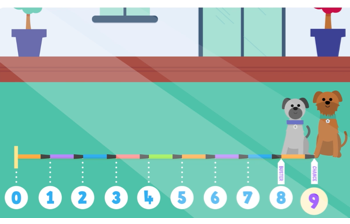
Mathscots – Puppy jump photos. CC BY: © State of Victoria (Department of Education).
You can then try marking out equal spaces using chalk on the pavement or even leaves at the park. Then count with your child how many spaces everyone in your family can jump.
Further information
To access other videos and tip sheets in this series as well as further tips, information and links for parents and carers, see: Mathematics and numeracy at home.
For further information about the Victorian Mathematics Ambassadors, see: Victorian Mathematics Ambassadors.
For further information on supporting your child’s education, see: Supporting your child's education | vic.gov.au.