Teaching & Learning Page:

Web Pages:
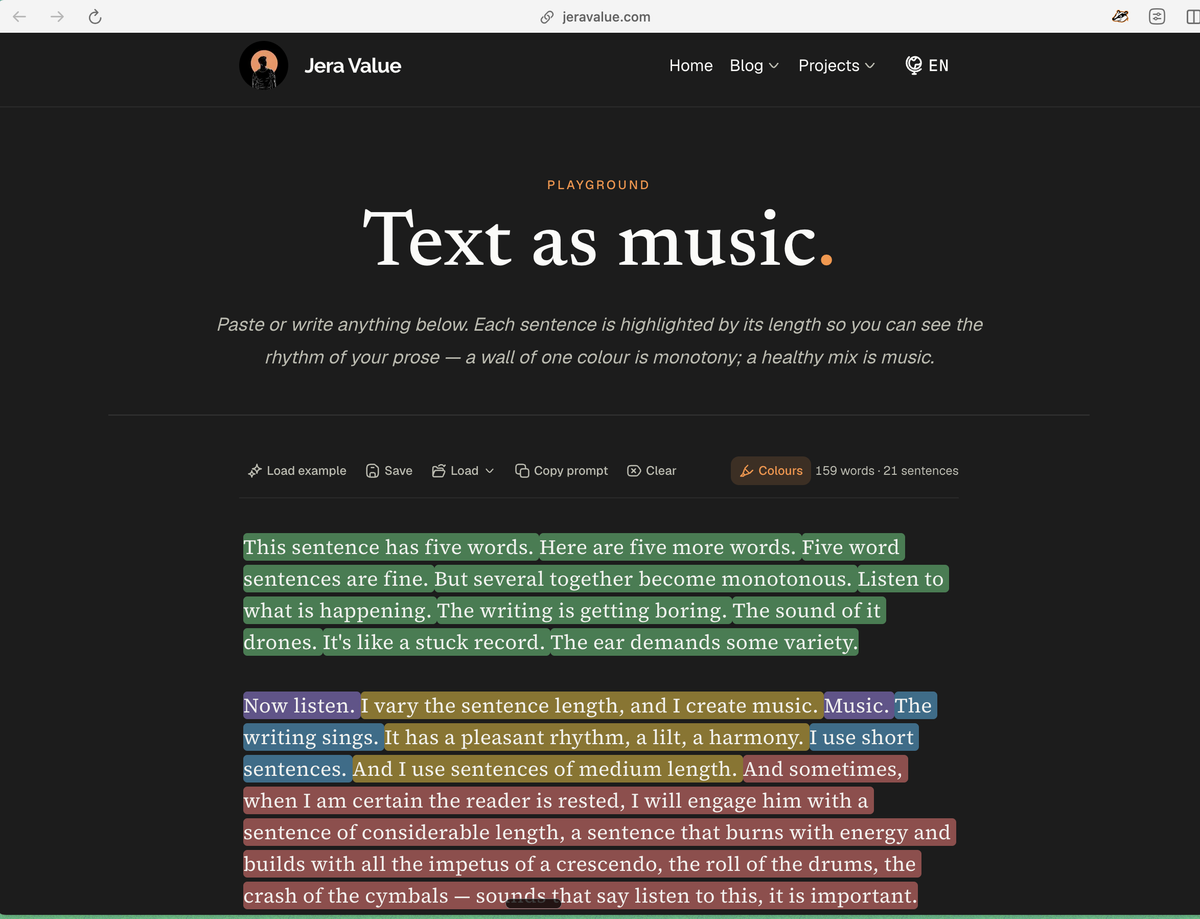
https://www.jeravalue.com/en/text-music
Paste or write something. Each sentence is coloured according to its word count. If it is all one colour, it sounds flat. If the colours mix, it sounds like music.

Techie Tips:

FaceTime Can Now Show Both Cameras at Once
If you have an iPhone 17, iPhone 17 Pro, iPhone 17 Pro Max, or iPhone Air, there’s a
feature called Dual Capture that lets you record yourself and whatever’s in front of you at
the same time using both cameras. It existed before but only for regular video recording.
iOS 27 brings this specifically to FaceTime. So now during a video call you can show
your face and what you’re looking at simultaneously to the other person.
This is genuinely useful for showing someone a view while still being visible yourself,
instead of having to choose one or the other.
If you’ve got an older iPhone though, this one’s not available to you.
Messages Finally Has Real Drawing Tools
iOS 27 fixes this properly. There’s now a dedicated “Drawing” option right in the app
drawer: tap the plus sign in the bottom left corner of Messages, and it’s right there.
And instead of that old basic tool, you get Apple’s complete Markup toolset. The same drawing tools you’d find in Photos or Notes, now built directly into your conversations.
It's a small thing, but it’s the kind of feature that’s genuinely fun to actually use once you know it exists.
Sketches:
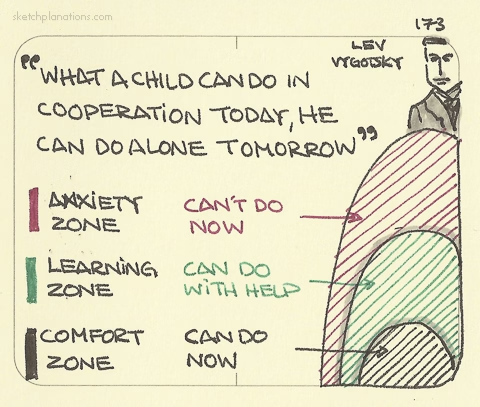
What a child can do in cooperation today, he can do alone tomorrow.— Lev Vygotsky
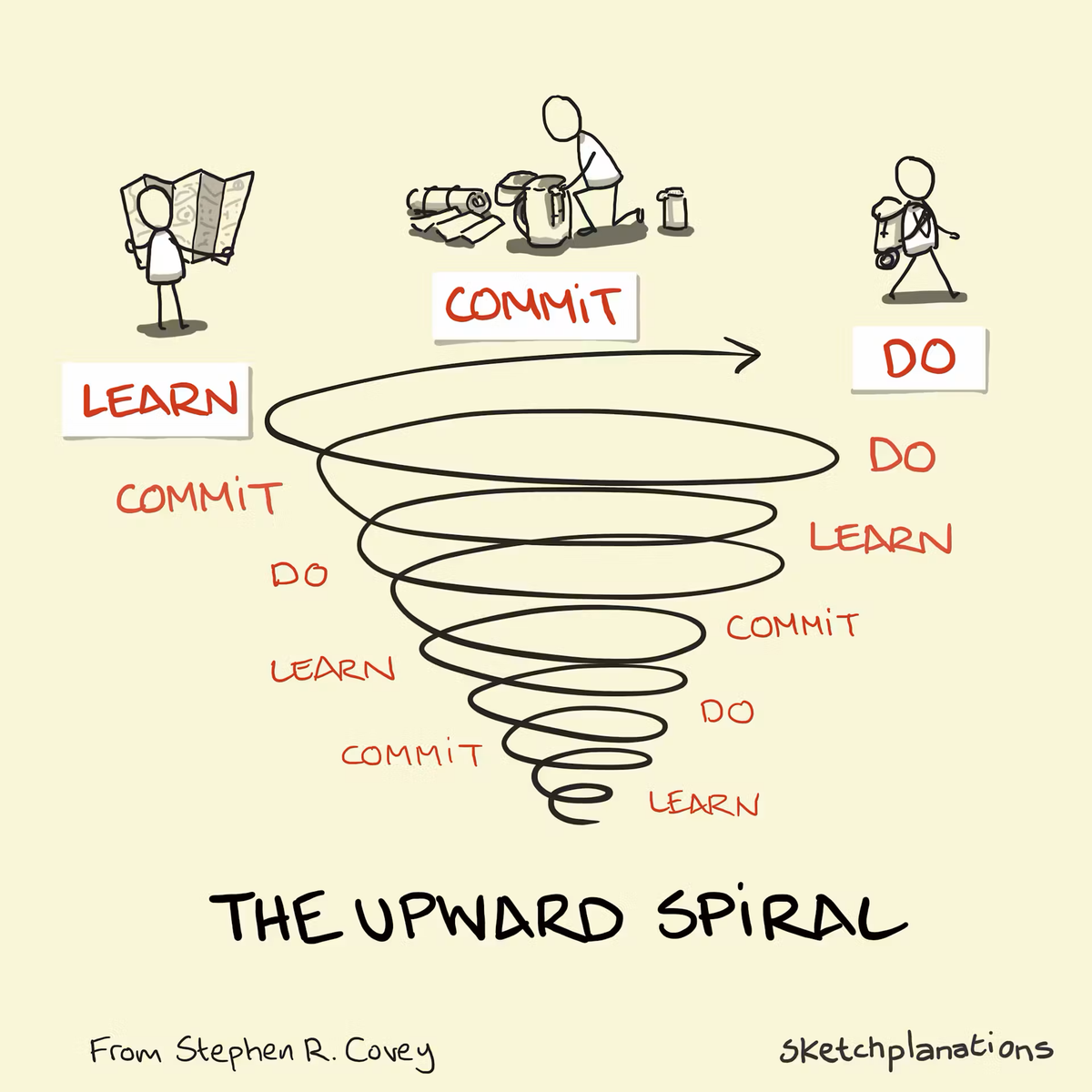
The upward spiral is Stephen R. Covey's simple model of personal growth and change, which repeats the three steps: Learn, Commit, and Do.
Of course, we are all doing it all the time. The difference is taking the time and effort to learn from our doing, committing to how we want to grow, and deliberately putting it into action. Getting better is in our control.
I've found the commit step to be surprisingly important. For me, "Commit" means actively deciding to make a change and following through with it. It's the difference between finding something intriguing and deciding to do something about it.
Coupling "Commit" with getting specific, for example, by using implementation intentions, can increase the chance of getting on that upward spiral. "Commit" is the mental shift of telling yourself you're going to make a change.
Repeating each of the three steps again and again is a simple and guaranteed path to improving at anything we try.
Stephen Covey discusses the upward spiral as part of sharpening the saw—renewing, refreshing, and recharging ourselves to be the best we can be:
"Renewal is the principle—and the process—that empowers us to move on an upward spiral of growth and change, of continuous improvement."
— Dr Stephen R. Covey
Article:
The 5 Traits That Predict Success Better Than Anything Else
Not hustle. Not luck. Researchers spent decades figuring this out… here’s what they found.
Open YouTube, Substack, or X right now, and you will be inundated with emergency sirens disguised as career advice.
- “You only have two years to escape the underclass!”
- “The next five years will define the rest of your life!”
- “AI is coming for your job!”
They put a timeline on your potential. To me, this is pure fear-mongering designed to spike engagement.
Any well-read person who knows a bit about history understands that humans are incredibly inventive.
Every generation faces “life-changing technologies” that terrify people, and every generation adapts. There is rarely a need for panic.
I’ve spent the last decade studying the actual mechanics of what makes people successful. When you strip away the hype, you are left with foundational principles backed by decades of research.
My guess is that you are already aware of these concepts. But they get snowed under by the current onslaught of fear-based content promising quick fixes or impending doom.
If you want to build a good life — sturdy, resilient, and compounded over time — forget the artificial timelines.
Focus on these five factors instead.
1. Learned Optimism
The Researcher: Martin Seligman
This concept is often misunderstood as blind positivity. Learned Optimism is not about ignoring reality, though.
Life is hard, and there’s no need to always be positive. However, you will benefit from having an overall optimistic perspective on life.
Seligman’s research found that how you explain setbacks to yourself dictates your resilience.
When bad things happen, do you view them as:
- Permanent? (“This will never get better.”)
- Pervasive? (“Because I failed at this, my whole life is a failure.”)
- Personal? (“It’s all my fault because I’m flawed.”)
Optimists view setbacks as temporary, specific, and often situational.
Because they believe the setback is fixable, they persist longer.
In domains where the game is long (like investing, writing, or building a business), the person who persists the longest usually wins.
Optimism is the fuel for persistence.
2. Growth Mindset
The Researcher: Carol Dweck
This concept has become a corporate buzzword, but let’s not dilute its power.
The takeaway from Dweck’s work is that a crucial mechanism is how you interpret failure.
Because let’s face it. We all fail.
People with a “fixed mindset” interpret failure as an indictment of their identity. I failed the test; therefore, I am stupid. This makes failure too painful to risk again.
People with a “growth mindset” interpret failure as raw feedback data. I failed the test; therefore, my strategy was wrong.
When failure is just information, you don’t take it personally.
You adjust your strategy faster.
Over time, the speed at which you integrate feedback and pivot is a massive predictor of future success.
3. Delayed Gratification
The Researcher: Walter Mischel
You know the famous study: put a marshmallow in front of a child and tell them that if they wait 15 minutes, they get two.
The kids who waited ended up more successful later in life.
For years, this was taught simply as “willpower.” But follow-up research added critical nuance: the effect shrinks when you control for socioeconomic background.
If a child grows up in an unstable environment where promises are rarely kept, eating the marshmallow immediately isn’t a lack of willpower — it’s the rational choice.
Why wait for a second marshmallow that probably won’t arrive?
The deeper predictor here isn’t just discipline. Delayed gratification is about having trust that the future will be better.
Success requires a fundamental belief that the environment is stable enough to reward future you for present sacrifices.
It’s the ability to prioritize a compounded reward over a short-term emotional impulse.
A big part of success is simply doing things that you don’t like today, so you have a life you do like in the future.
However, you must believe that the future will be better.
4. Deliberate Practice
The Researcher: Anders Ericsson
This is the antidote to the “life hack” culture. Ericsson’s research (which generated the often-misquoted “10,000-hour rule”) proved that expertise isn’t about talent or just about putting in time.
It’s about structured (and often painful) practice aimed at your weaknesses.
When it comes to research, deliberate practice works best in domains with clear rules and immediate feedback loops, like chess, music, or coding.
If you don’t know immediately whether what you just did was right or wrong, you aren’t practicing; you’re just doing.
If it feels easy, you aren’t growing. Skill grows where feedback is fast.
When it comes to other, more subjective, areas of life, you must find a way to generate a feedback loop.
This is why ambitious writers love writing online. They get instant feedback on whether something is good or not. Either the writing gets ignored or sparks a reaction.
The better your feedback, the more specifically you can train to become better.
5. Social Capital
The Researchers: Mark Granovetter, Robert Putnam
Self-help articles often ignore this because it’s the only predictor that isn’t purely individual.
Success isn’t just what you know or what habits you have; it’s a function of the information and opportunities flowing through your network.
Sociologist Mark Granovetter’s seminal research on “The Strength of Weak Ties” showed that your closest friends (strong ties) usually have the same information as you.
The biggest opportunities for new jobs, new ideas, and different perspectives come from your “weak ties” (acquaintances, friends of friends, and even strangers).
Your network is a big source of opportunities in your life.
So what does all this mean? Can you engineer success?
Yes… but it’s not an exact science.
Ultimately, the 5 predictors above are things that you can learn. You can look at them as personality traits or habits.
The thing is, you sometimes have to take action in life; otherwise, you just stay where you are.
Success is not math
So, will you become successful if you stick to the big 5 predictors?
I believe so.
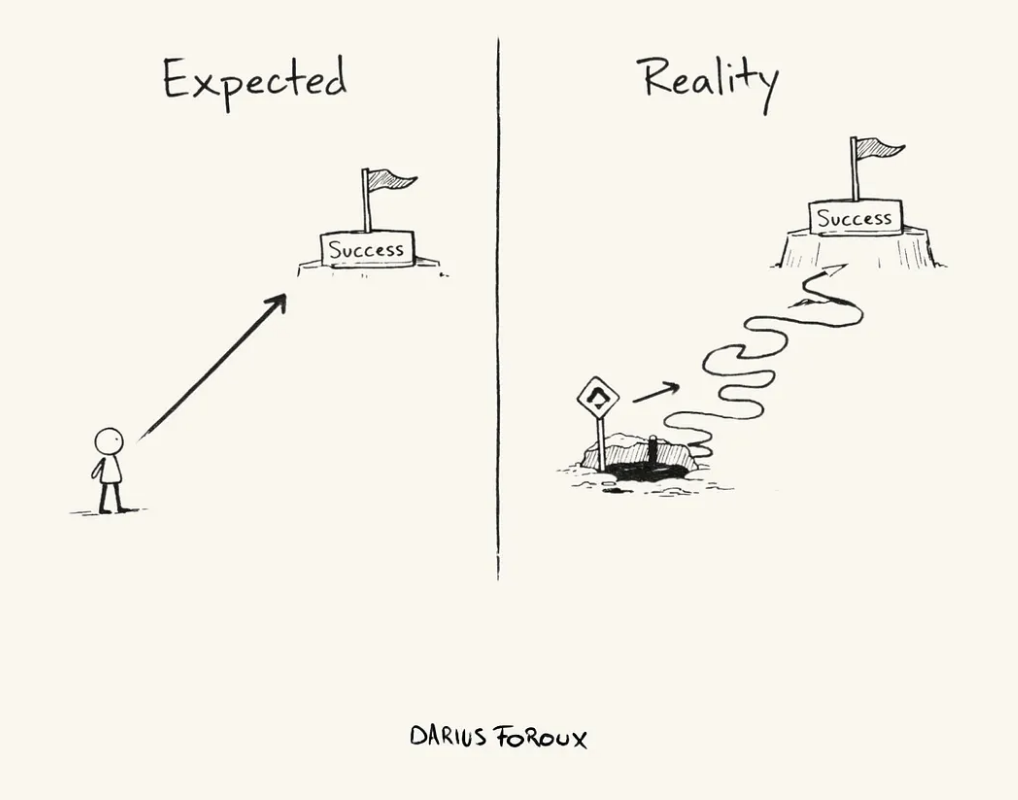
However, it’s not as easy as 1 + 1 = 2. To build the life that you want, you will probably take many detours. You will fail. You will get frustrated.
Sometimes you lose.
That’s all normal. Just keep believing in your ability to get to the next level.
If you look at the research, success isn’t about hitting an arbitrary two-year deadline set by the CEO of an AI company or someone with a big audience.
Success is about developing the traits that will make you a more rounded and valuable person.
And if you really think about it, the person who you become is the actual success.
Book Recommendation: