
Term 4 Learning Summary
English
Reading and Viewing
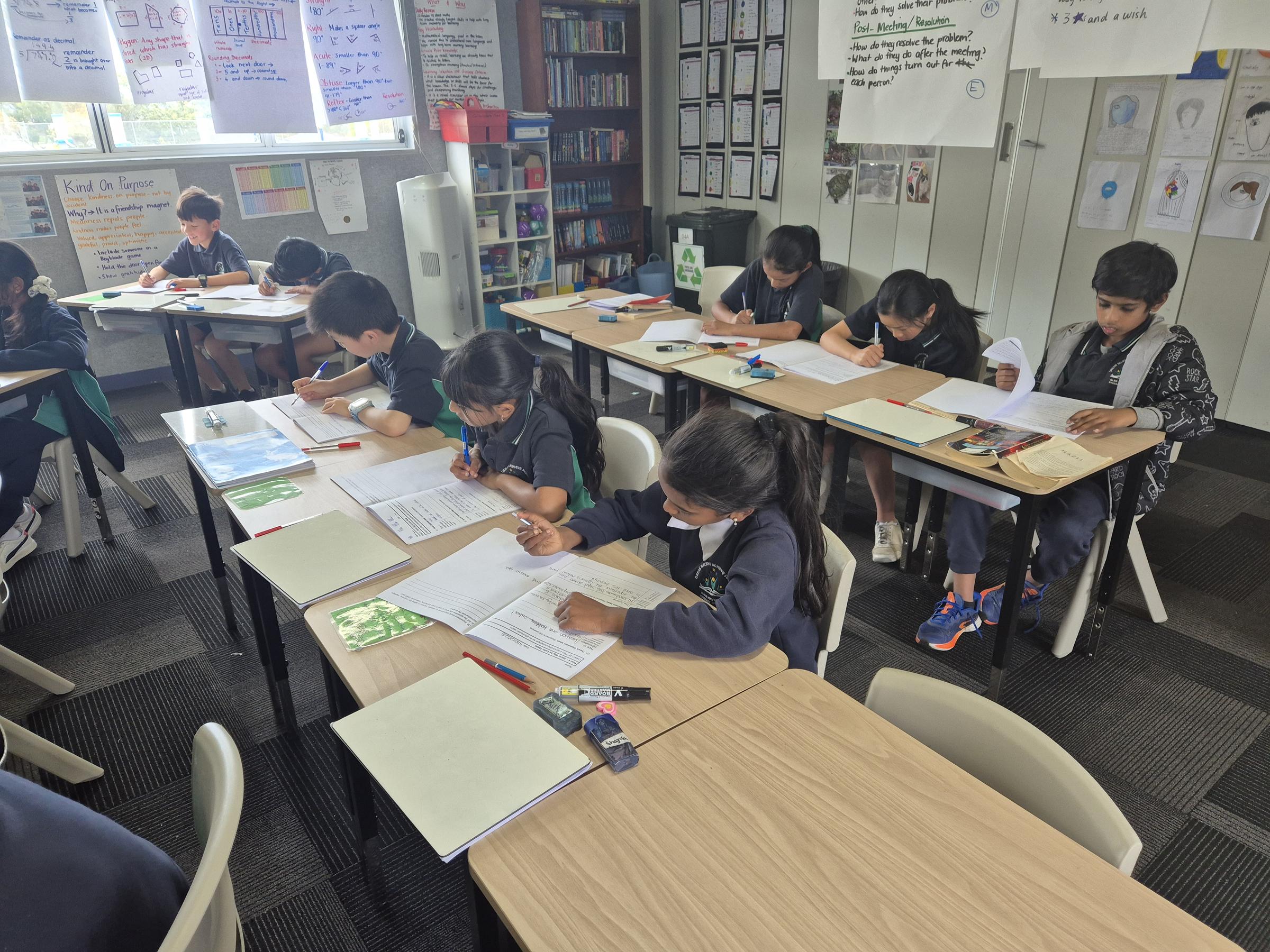
During Term Four, students will read the heartwarming and thought-provoking story, ‘The Wild Robot,’ authored by Peter Brown. They will build their fluency through partner and class read-alouds, while giving, receiving and recording feedback. In sentence-level writing, students will develop their understanding of connectives for addition, contrast and cause and effect. They will also explore affixes, compound and complex sentences, subordinating and coordinating conjunctions, clauses and new vocabulary, such as 'disbelief', 'rigorous', 'descended' and 'pamper.'
Writing
In Term Four Writing, students will plan, draft and edit a persuasive letter, arguing for a robot helper for home. They will investigate the structure of a persuasive letter, including an introduction, paragraphing, arguments, evidence and a conclusion, with a target audience in mind. Students will build their competency in using literary devices to create more persuasive arguments. They will utilise their understanding of the class text, using key details and main ideas, to write a summary paragraph.
Speaking and Listening
Students will have the opportunity to present their persuasive letters to their own and other classes, building their competency in the key components of public speaking, such as tone, volume, pace and clarity. They will continue to contribute to class discussions, verbalising thoughts and ideas, and using their newly learned vocabulary in sentences of different contexts. Students will build their fluency, focusing on reading with accuracy, an appropriate pace and using expression.
Key Vocabulary:
- Persuade
- Convince
- Argument
- Evidence
- Modality
- Emotive
- Fluency
- Accuracy
- Expression
- Grammar
- Phoneme
- Grapheme
- Morpheme
- Suffix
- Prefix
- Base
- Persuasive
- Analyse
- Infer
- Summarise
How can you support your child’s English learning at home?
Read with your child
Set aside time to listen to your child read at home and support them by analysing new or interesting vocabulary. Ask them questions about the text to assist them to understand on a deeper level.
- Talk about the words authors use When reading together, chat about how things are described in the book. Ask questions like, “What do you picture when you read that?” or “Why do you think the author used that word?”
- Practice using the five senses Help your child describe places or objects using their senses — what they see, hear, smell, feel, and taste. For example, describing a beach might include “the salty smell in the air” or “the warm sand underfoot.”
Make observations about advertising
When watching television or seeing advertising out and about, make it a talking point and ask your child what the advertisement is trying to persuade them to do, think or feel. Start a discussion about how the advertisement achieves this goal.
Mathematics
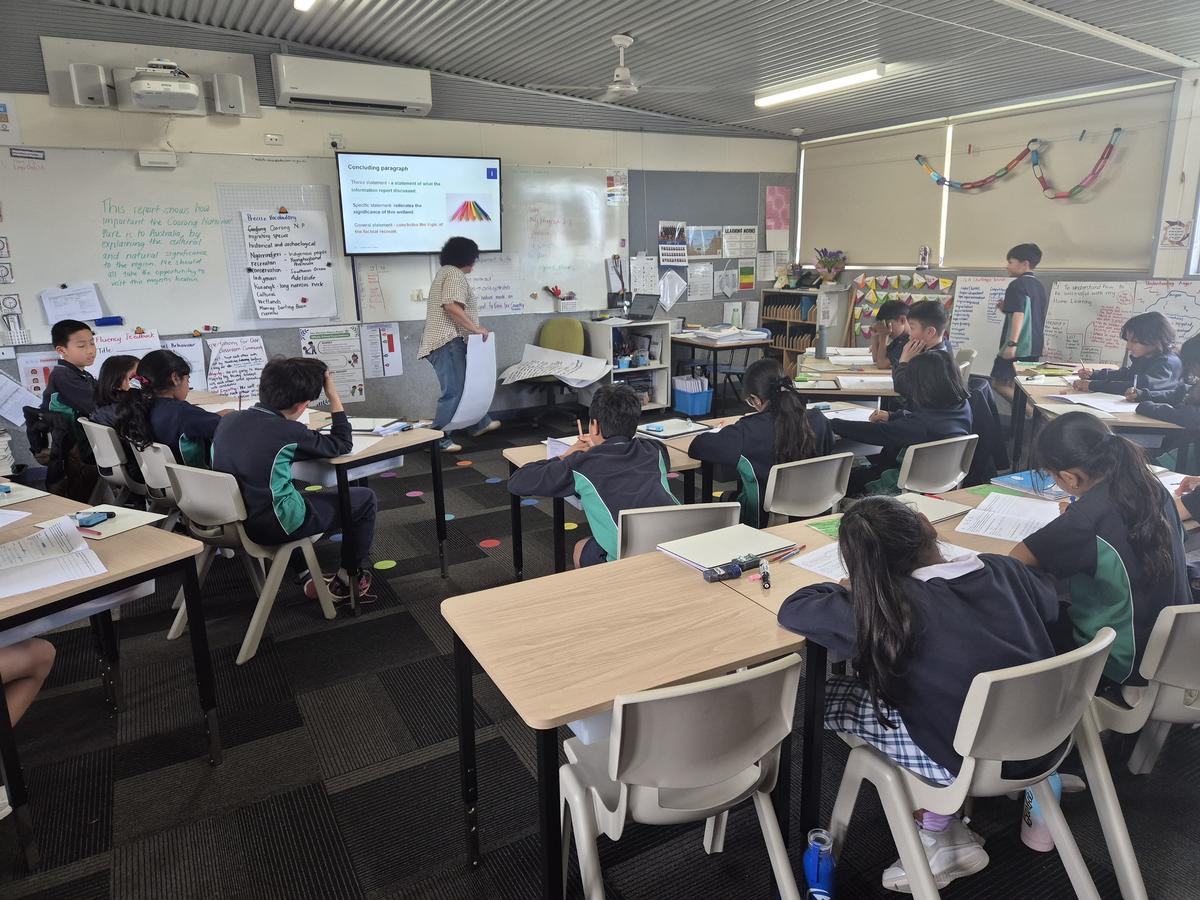
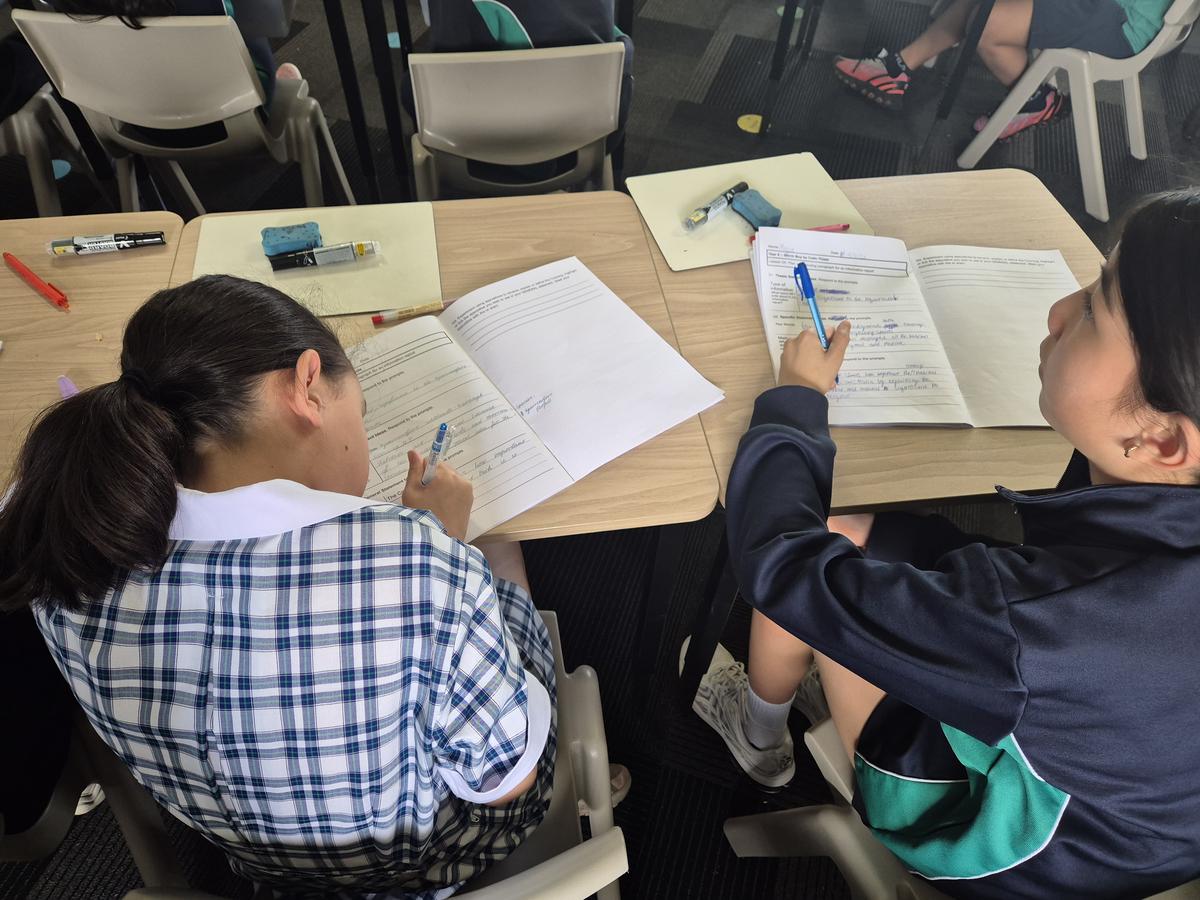
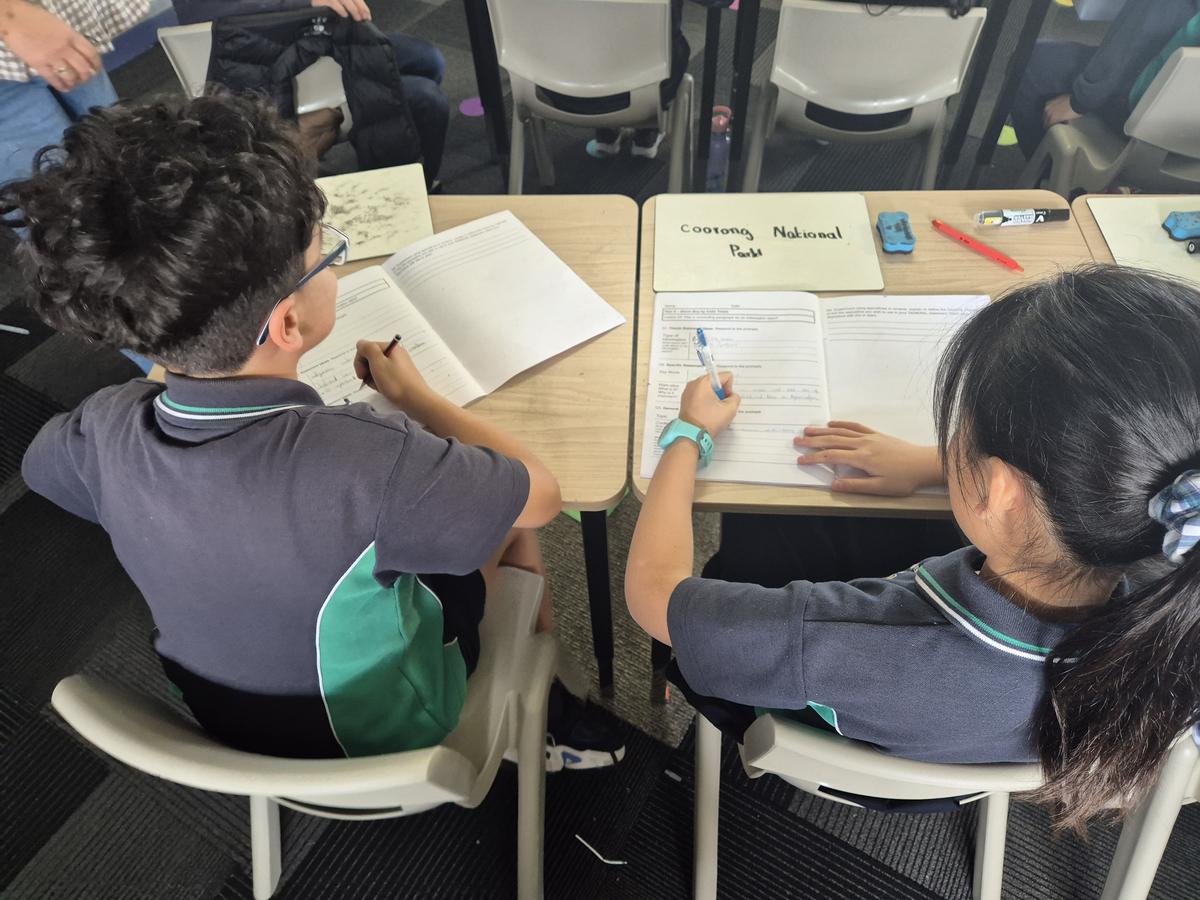
This term, students will continue to build their mathematical knowledge through engaging lessons and real-world applications. Our focus will be on three key areas: Data Investigation, Operations, and Fractions, Decimals and Percentages. Across these topics, students will be encouraged to explore, problem solve and explain their reasoning, helping them grow as confident and flexible mathematicians.
In Data Investigation, students will plan statistical investigations by creating clear, objective questions, collecting and recording data, and organising their results in frequency tables. They will learn how to read and explain what different graphs show, using the data to compare results and draw conclusions.
In Operations, students will use rounding to the nearest ten and hundred to estimate when solving multiplication and division problems, helping them check if answers are reasonable. They will also choose and explain appropriate strategies to solve worded problems, showing their working and reasoning.
In Fractions, Decimals and Percentages, students will recognise and represent percentages using hundred grids and bar models, including identifying complementary percentages (e.g., 30% and 70%). They will convert between fractions (halves, quarters, tenths and hundredths), decimals and percentages, calculate and order percentages, work out totals from a given percentage, and apply these skills in everyday contexts.
Key Vocabulary:
Data Investigation | Operations | Fractions, Decimals and Percentages |
Data: Information we collect (like numbers or answers to a question).
Frequency: How many times something happens or is recorded.
Table: A way to organise data into rows and columns.
Graph: A picture that shows data, such as a bar graph or column graph.
Interpret: To explain what the data or graph shows. | Round: To change a number to the nearest ten or hundred to make it easier to work with.
Estimate: To make a smart guess about the answer before solving exactly.
Multiply: To add equal groups together.
Divide: To share a number into equal parts.
Strategy: A plan or method used to solve a problem. | Fraction: A way of showing part of a whole, written with a numerator (top number) and denominator (bottom number).
Decimal: A number that uses a decimal point to show parts of a whole (e.g., 0.25).
Percentage (%): A way of showing “out of 100” (e.g., 25% means 25 out of 100).
Equivalent: Different numbers or forms that mean the same value (e.g., ½ = 0.5 = 50%).
Complementary percentages: Two percentages that add up to 100% (e.g., 30% and 70%). |
How can you support your child’s Mathematics learning at home?
- Data Investigation: Encourage your child to design a family survey, collect results, and represent them as a graph. Discuss what the data shows.
- Operations: Use shopping or cooking scenarios to practise rounding and estimating totals. Ask your child to explain their strategies.
- Fractions, Decimals and Percentages: Explore everyday percentages, such as discounts while shopping or statistics in sports. Use hundred grids or shaded diagrams to show how fractions, decimals, and percentages connect.
Inquiry
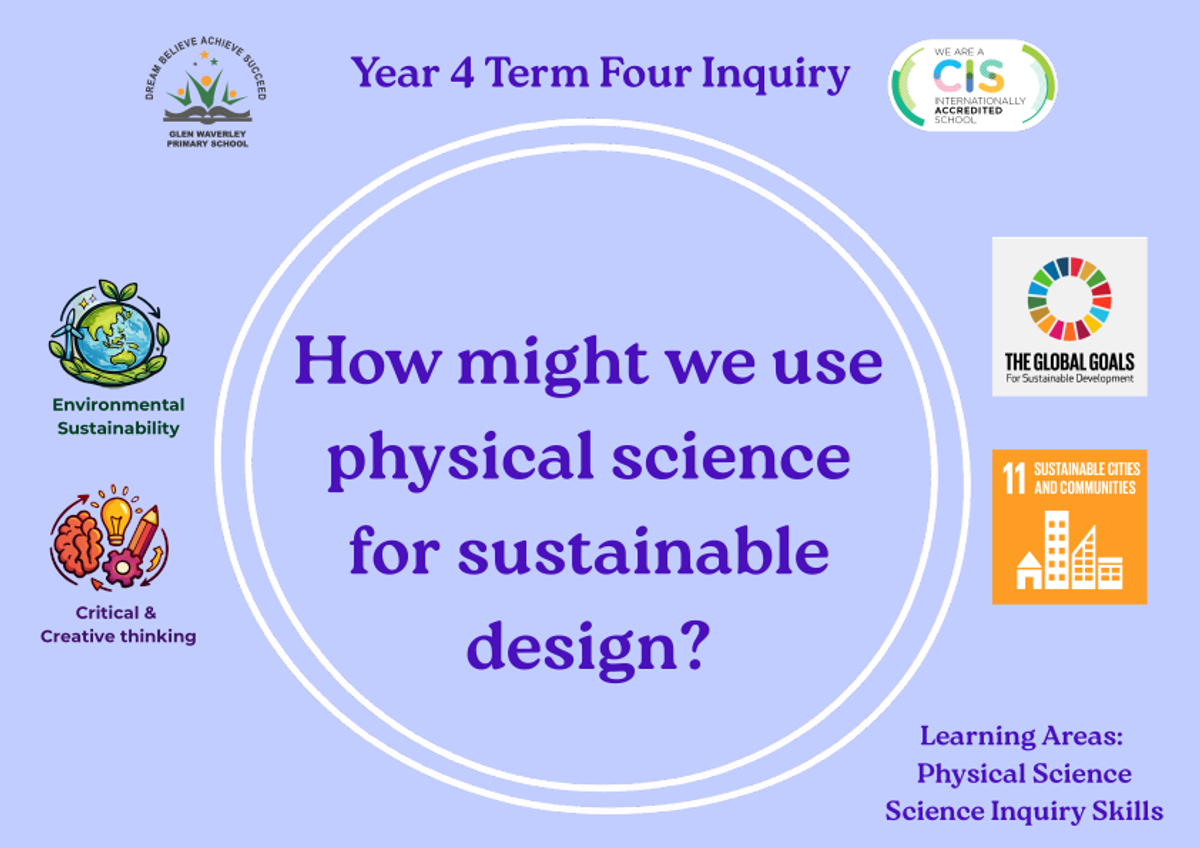
During Term Four, learners will explore how energy, motion, and forces will influence the design of everyday environments. Through scientific investigations and the STEAM design process, they will examine concepts such as push, pull, gravity, friction, and heat transfer, including conduction, convection, and radiation. Learners will investigate practical and sustainable ways to improve energy efficiency in homes and community spaces, comparing solutions such as insulation, weather stripping, and energy-efficient technologies. Their learning will culminate in the redesign of a space or house using TinkerCad, incorporating energy-efficient features and sustainable design principles.
Key Vocabulary:
- Force
- Energy
- Motion
- STEAM
- Insulation
How can you support your child’s Inquiry learning at home?
To support your child at home this term you could:
- Have open discussions with them about screen time
- Talk about what they are watching/playing
- Discuss what to do if they see something inappropriate
- Discuss different media types – perhaps what you used to use as a child (newspaper, magazine, watching the News on TV and listening to the radio)
Wellbeing
Throughout Term Four, Year Four students will build on their wellbeing and digital citizenship skills through The Resilience Project and the Cyber Safety Project. In The Resilience Project, students will explore the five pillars of wellbeing — Gratitude, Empathy, Mindfulness, Emotional Literacy, and Connection — with particular focus on Emotional Literacy and Empathy. They will expand their emotional vocabulary and engage in practices such as classroom routines, daily check-ins, and GEM Chats to support wellbeing and classroom connection.
Alongside this, the Cyber Safety Project will help students build confidence and responsibility in the digital world. Students will learn to recognise and manage emotional responses online, respond thoughtfully rather than react impulsively, and navigate peer pressure by making choices aligned with their values. Through role plays, students will explore the impact of online inclusion and exclusion on emotions, developing empathy and resilience in digital interactions. They will also reflect on their online habits by categorising activities as creation or consumption, helping them develop a balanced and purposeful approach to technology use.
Key Vocabulary:
The Resilience Project | Cybersafety |
Empathy Mindfulness Gratitude Resilience Positivity Reflection Emotional awareness Kindness Community Wellbeing Self-regulation Perspective Appreciation Connection | Digital citizen Online etiquette Empathy online Respect Responsibility Kindness online Privacy Consent Cyberbullying Communication Safety Digital footprint Positive choices Trustworthiness |
How can you support your child’s Wellbeing learning at home?
- Practise Gratitude: Encourage your child to reflect on things they are thankful for each day and share moments of gratitude together in conversation.
- Build Mindfulness: Support your child to take mindful breaks using breathing exercises, guided visualisations, or mindful walks to notice their thoughts and feelings.
- Develop Empathy: Talk about everyday situations at home, at school or in the community, and ask your child how others might feel and how they could respond kindly.
- Promote Safe and Respectful Online Behaviour: Discuss online safety rules, encourage thoughtful and respectful digital interactions, and check in regularly about your child’s online experiences.
We encourage families to continue conversations at home around GEM principles and Cyber Safety. Our families have access to the Resilience Project Home - TRP@HOME portal along with the Cyber Safety Project home Resources - Cyber Safety Project. Working together supports learners in applying these strategies beyond the classroom and helps strengthen their wellbeing across all aspects of their lives.