
Teaching and Learning

Assessment Rubrics Professional Learning
As is common at St Bede’s College, our staff continue to engage in Professional Learning that allows for continuous improvement. Recently, all teachers were involved in a number of sessions that will be built upon in order to update rubrics against which student assessments are made. The endeavour is to provide greater clarity regarding expected standards of skills and knowledge, a greater consistency across subject areas and year levels as well as a recalibration of marks that students receive upon completion of an assessment task.
In doing so, there were several elements that were deemed essential in developing the rubrics. This included incorporating standards and skills stated in the Victorian Curriculum 2.0, as well as developing skills necessary for success in VCE Subjects. This was coupled with a consistency in construction and language, and utilised the power of AI in order to overcome the complexity of incorporating all of the required elements.
One of the key components of these rubrics is the stating of ‘At Standard’ skills and knowledge in the ‘centre’ column of the rubric. For students, this clearly identifies what is expected of them in their current year level or class, what is considered ‘Below Standard’- which is what they should have been able to demonstrate in previous school years in the subject- and what might be expected if they are to be assessed as ‘Above Standard’. If a student is formatively assessed at any standard, the beauty of these rubrics is that it clearly states what a student should be able to do to improve. This is crucial in allowing students to take ownership of their own learning.
We are also aware of the impact that the new approach may have on achievement. Whereas we may have previously had skills and knowledge in the right hand column of a rubric - which may have resulted in higher marks -, by moving the relevant standard to the centre column will result in ‘At Standard’ assessments being in the 60 to low 70’s numerical range. This may present as a surprise to some students; nevertheless, this ‘recalibration’ over time will provide greater consistency across subjects and the College, providing a clearer picture of what is achieved against an externally determined standard.
Communication regarding the process of developing the rubrics as well as the impact on outcomes will continue to occur throughout the process. It is thought that the majority of the rubrics will be introduced across 2027 and, as is currently the case, these will be accessible to parents and carers via PAM.
Should you have any questions or require clarity, please be sure to reach out to the relevant subject teacher.
Parent-Teacher-Student Interviews
For the second time in 2026, we are currently engaged in Parent-Teacher-Student Interviews. These are a great opportunity for parents and carers to gain insight into student achievement as well as provide clear ways in which students can improve. As a College, we recognise the value in these conversations and the potential for a positive impact on student learning and outcomes. As such, we endeavour to do our best to provide ample opportunities for such conversations to take place.
Whilst we are aware that in some cases appointment times can be difficult to secure, our teachers value the impact a conversation with a parent or carer can have. Similarly, we are grateful for the support at home that is provided to students, ensuring their learning is prioritised and consolidated. If you have been unable to secure a time, you are encouraged to reach out to the individual teacher and they will provide information or feedback that you may require.
VCE Trial Exams
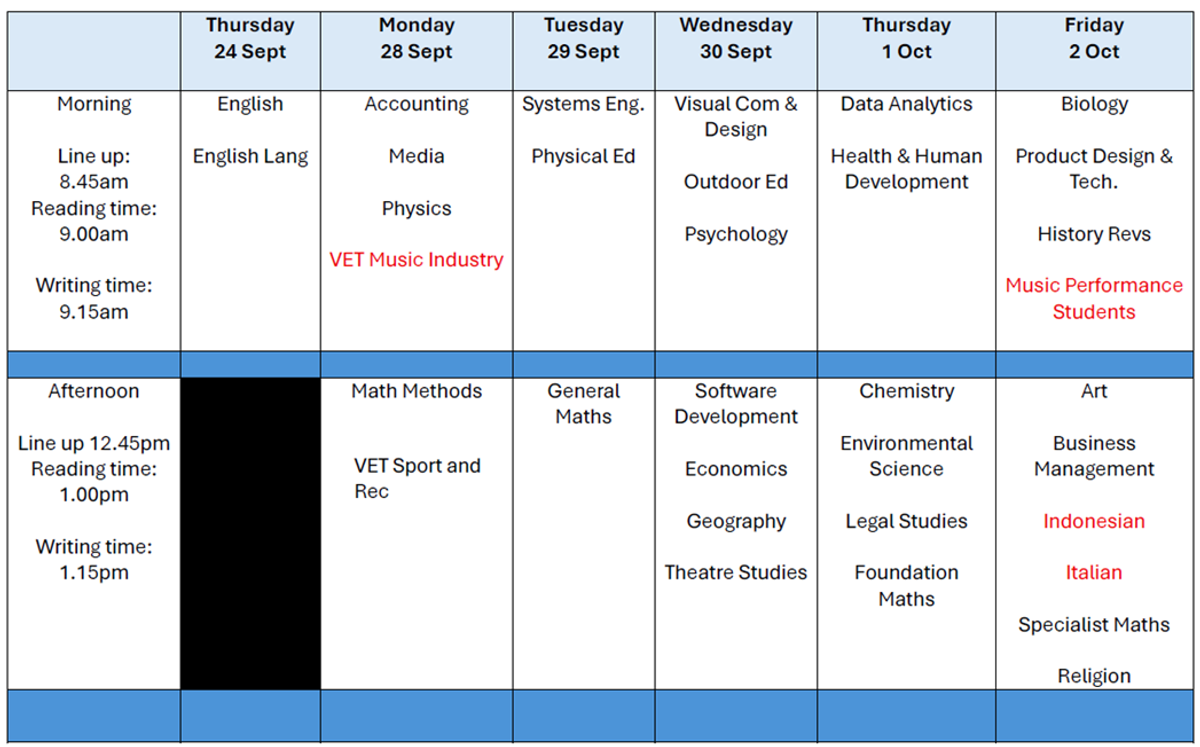
With only four or so weeks of classes remaining for Unit 3/4 students prior to Trial Exams, it is important that students begin to focus on the conclusion of their Year 12 subjects. Some students may have already commenced their preparation through organisation of notes, compilation of cue cards and study aides or by completing past exam papers. Importantly, effective study techniques and application to memorisation and exam preparation has a direct and legitimate impact on what a student will achieve if it translates into improved exam performance.
With the Trial Exams being a practice run for the exam period proper, taking the time and dedicating oneself to performing at the highest possible level at that time will yield real benefits if built upon. We remind our students of the Tutoring Program that continues in the Library each Thursday afternoon for a range of subjects, as well as the additional support offered by many of our teachers in preparation.
A reminder that Trial Exams are compulsory for all students studying a VCE Unit 3/4.
Unit 3/4 Trial Exam Timetable
Brenden Mair
Deputy Principal - Teaching and Learning