Welcome to Term Three
Welcome to Term 3!
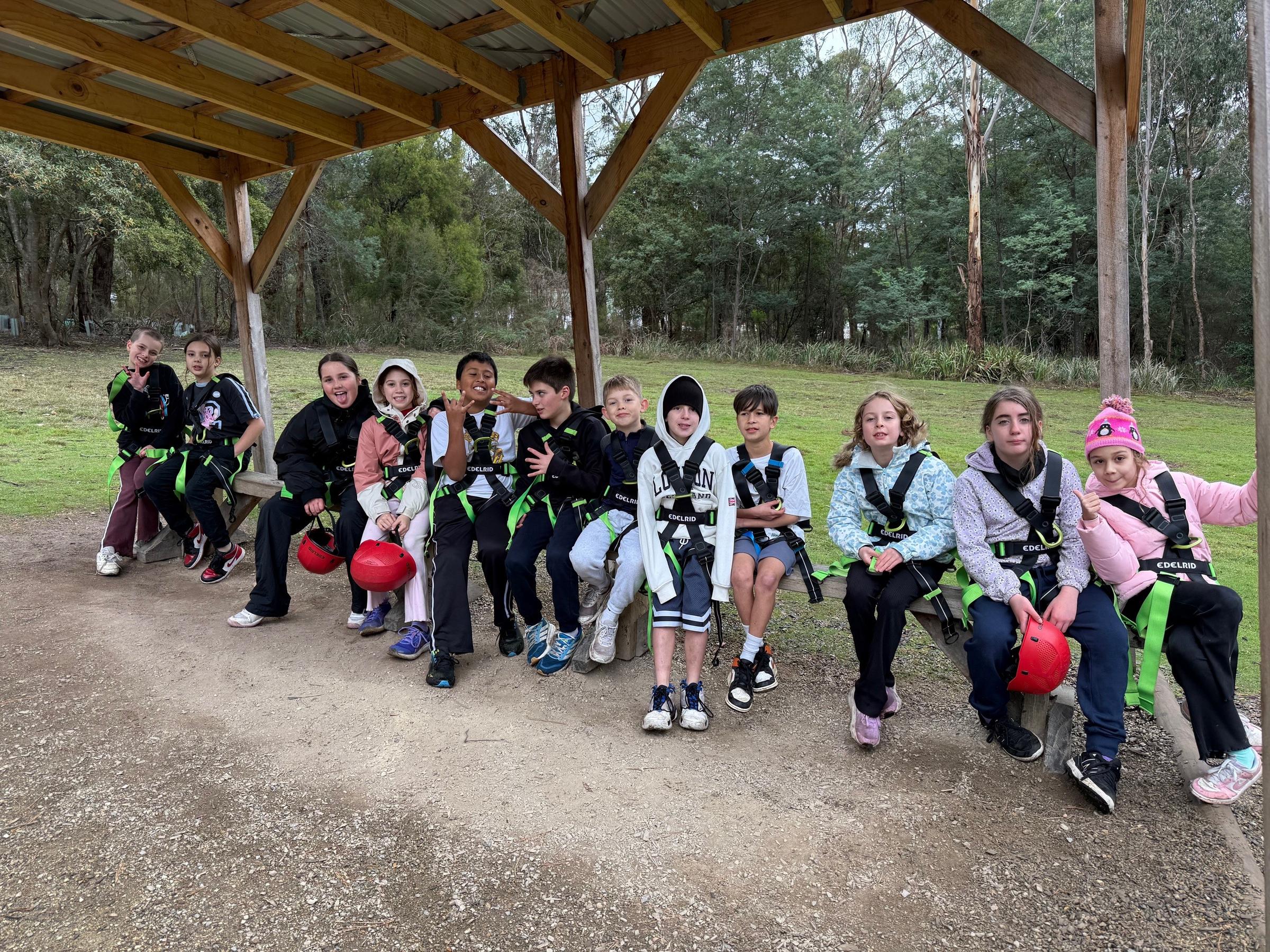
Term 2 has been filled with exciting learning opportunities, highlighted by our successful camp and wonderful school concert. We are incredibly proud of the students' achievements and look forward to an equally rewarding term three as we continue to build on their enthusiasm for learning.
Literacy
Our Literacy work this term will focus on:
- Realistic fiction writing.
- Expanding sentences and paragraphing.
- Identifying and writing dependent clauses of time, cause and condition.
- Identifying and using adverbs of manner.
- Using punctuation and conventions for direct and indirect speech.
- Adding suffixes and prefixes to words, homophones and spelling.
- Strengthening comprehension while reading our new class novel Strangers on Country.
Students will plan, draft, revise and edit a realistic fiction on a topic linked to our class novel as an expression of their learning from the term.
Core literacy skills will continue to be supported by weekly explicit phonics, vocabulary, handwriting, grammar and punctuation lessons. Our grammar, punctuation and spelling focus will be determined through assessment and analysis of student writing samples at the beginning of the term.
To support this learning at home you can continue to:
- Encourage your child to read outside of school times daily. If they are a reluctant reader, you could take it in turns to read a page each. Ask questions from time to time to monitor comprehension. Some examples are: Who are the characters? What is the plot? What do you think might happen next?
- Visit the local library to explore different genres.
- Encourage your child to write at home. E.g., keep a journal, write shopping lists or a convincing letter for that new game they’d like.
- Encourage them to use interesting adjectives and verbs (action) when writing.
- Encourage the correct use of full stops, commas and apostrophes.
- Encourage your child to edit their work for mistakes before they show you. They should also make sure the writing makes sense. Getting your child to read their writing aloud is a good technique to find mistakes in writing.
- Using a dictionary helps with spelling mistakes.
- Using a thesaurus helps to expand your child’s vocabulary.
- Encourage your child to practise handwriting at home, to improve neatness.
- Provide your child with pens, pencils, paper and a spot to write at home.
Mathematics
This term, students will focus on developing their understanding of multiplication, division, time, angles and probability through engaging, hands-on learning experiences.
Students will be learn how to:
- Strengthen multiplication skills using efficient mental and written strategies, including multiplication facts, algorithms and number patterns.
- Develop division strategies, including solving problems with remainders and applying division to real-life situations.
- Investigate number sequences and patterns involving multiples of 2, 3, 4, 6, 7, 8 and 9.
- Build understanding of time by reading analogue and digital clocks, calculating elapsed time, solving timetable problems and exploring 12- and 24-hour time systems.
- Explore angles by identifying, comparing and measuring acute, obtuse and right angles using appropriate mathematical tools.
- Learn about probability by conducting chance experiments, predicting outcomes, recording results and discussing the likelihood of events occurring.
- Apply mathematical thinking, reasoning and problem-solving skills through rich tasks, investigations and collaborative learning experiences.
Throughout the term, students will participate in pre- and post-assessments to monitor their growth and celebrate their progress in numeracy.
To support this area of learning at home you can:
- Support general maths fluency by practising skip counting or times tables together.
- Ask your child to teach you the place value games they have learnt at school including: Just Gridding, Mastermind, Four Move Wipe-Out.
- Ask your child to model some of the multiplication/division strategies they have learnt in the classroom (e.g., “Show me how you can use the bar model to show: 5x4”).
- Explore and conduct chance experiments, and predicting outcomes.
- Explore angles in everyday life.
Further ideas to support students at home can be found here: Literacy & Numeracy Tips to Help Your Child.
History – First Contacts
This term, students will explore how past events have shaped Australia through our History unit, First Contacts. They will learn about the rich history and culture of Aboriginal and Torres Strait Islander peoples, their deep connection to Country, and life in Australia before European settlement. Students will investigate significant explorers, the journey of the First Fleet, and the reasons Europeans came to Australia. They will also examine the impact of colonisation from a range of perspectives, considering how interactions between Aboriginal and Torres Strait Islander peoples and Europeans changed Australia.
Throughout the unit, students will develop their historical thinking by analysing sources, creating timelines and maps, exploring cause and effect, and reflecting on ethical questions about fairness, rights and the consequences of decisions. This learning will encourage students to think critically about different perspectives and gain a deeper understanding of Australia's shared history.
Respectful Relationships (RRRR)
RRRR learning supports social and emotional skill building. This term we will be focusing on positive coping and problem solving. Activities within this topic area will assist students to:
- Investigate how emotional responses vary in depth and strength.
- Identify and describe strategies to manage and moderate expression of emotions in a range of familiar and unfamiliar situations.
- Identify a range of productive coping strategies to use in different situations.
- Learn and practise self-calming techniques.
- Understand the value of a meaningful apology.
- Identify a range of conflict-resolution strategies to negotiate positive outcomes to problems.
- Discuss the concept of leadership and identify situations where it is appropriate to adopt this role.
- Describe and apply strategies that can be used in situations that make them feel uncomfortable or unsafe.
Information on this department mandated program can be found at the following link.
Specialist subjects
Performing Arts
Students will be reviewing their skills on the drum-kit, ukulele, guitar and keyboards. They will be reading from conventional notation and graphic scores and focusing on playing in time with other performers and using correct form when playing instruments.
Physical Education
Students will use elastics to further develop their balance and jumping skills. They will also focus on basic strategies used in games and sports, such as making space and positions.
Science
This term, students are beginning to look at physical science, exploring how heat energy can be generated from different sources.
Visual Arts
For the Hero’s Gallery at Art ForAll, inspired by Vincent Namatjira, students will create a “Hero” work using watercolour pencils. They will detail it with stitching.
Students will also creatively work with fabric and fibres, developing their sewing, knotting, weaving, and dyeing techniques.
French
Bonjour tout le monde! I'm Kristen, your new French specialist teacher from Canada and I’m so excited to get started with everyone this term! This term our Year 4 students are using French to initiate simple interactions and share information about themselves, building a personal project step by step each week.
Kind regards,
Prue, Binh, Emilia & the Specialist Teachers