Maths: Tips for Parents
Mrs Maria Wilson - Leader of Pedagogy







 St Joseph's Primary School Barraba

Maths: Tips for Parents
Mrs Maria Wilson - Leader of Pedagogy
Kindergarten - Topic: Volume - Week 4-5
Just by comparing items around the home, your child can begin to understand some basic principles of measurement:
• Sometimes, we can estimate an amount. We don’t always need an exact measure.
• The same object can be measured in different ways.
• A measuring tool needs to be used the same way each time.
Children need to play with a variety of materials and containers for filling, packing and pouring before they can move to using formal units such as kilograms and grams. They need to understand how things can be packed together to fill a container and which materials are better for packing.
Year 1 and 2 - Topic: Inverse Operations - Week 4-5
Fact Families and Addition & Subtraction Facts
Recently your child has been learning about Fact Families. What is a fact family? Fact families are usually represented in the form of a triangle, as shown in the below image. The three numbers forming the fact family are written in the three corners (near the vertices) of the triangle.
The operation’s sign connecting the three numbers is usually written in the middle. For the addition fact family, the sum of the numbers is usually written at the top vertex, and the numbers being added are written at the vertices at the bottom.
Take a look at the fact family triangle with fact family numbers 2, 5, 7.
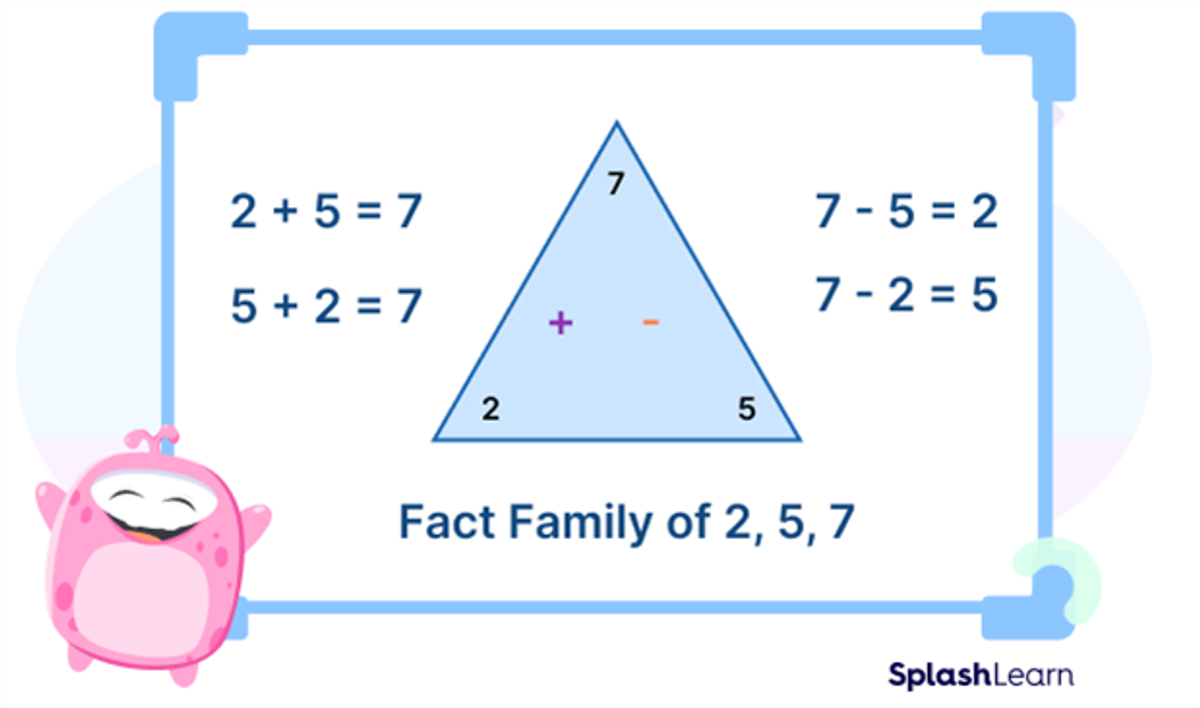
Fact families are vital to understanding complex math operations.
One of the reasons fact families are so important is because they help children learn their addition and subtraction facts. When children first learn these facts, it can be difficult to keep track of all the combinations. However, by grouping them into fact families, children can more easily see the relationships between the different facts.
A fact family is made up of three numbers and can be made up of at least four math facts. For example, if a child knows that 3 + 4 = 7 then they can also deduce that 4 + 3 = 7 and 7 – 4 = 3 and 7 – 3 = 4.
You can see that each number bond fact is related to two other facts in the family. In other words, they share two of the same numbers.
Subtraction can be especially difficult for some students than addition, but fact families can often help. Overall, fact families can be a helpful way for children to remember their facts, especially in the early stages of learning them.
Year 3 and 4 - Topic: Money - Week 5-6
Finding Maths at the Shops 1 page pdf (Australian Mathematical Sciences Institute)
Topics:
Page reading time:3 minutes (moneysmart.gov.au)
Year 5 and 6 - Topic: Multiplicative Relations - Week 5-6