
CHILD SAFE STANDARDS AT ST AGNES'

Child Safe Standards at St Agnes'
At St Agnes’, the safety, wellbeing and dignity of every child are central to all that we do. We are committed to creating a school environment where every student feels safe, valued, respected and empowered. As part of this ongoing commitment, each month we are highlighting one of the Victorian Child Safe Standards with our community.
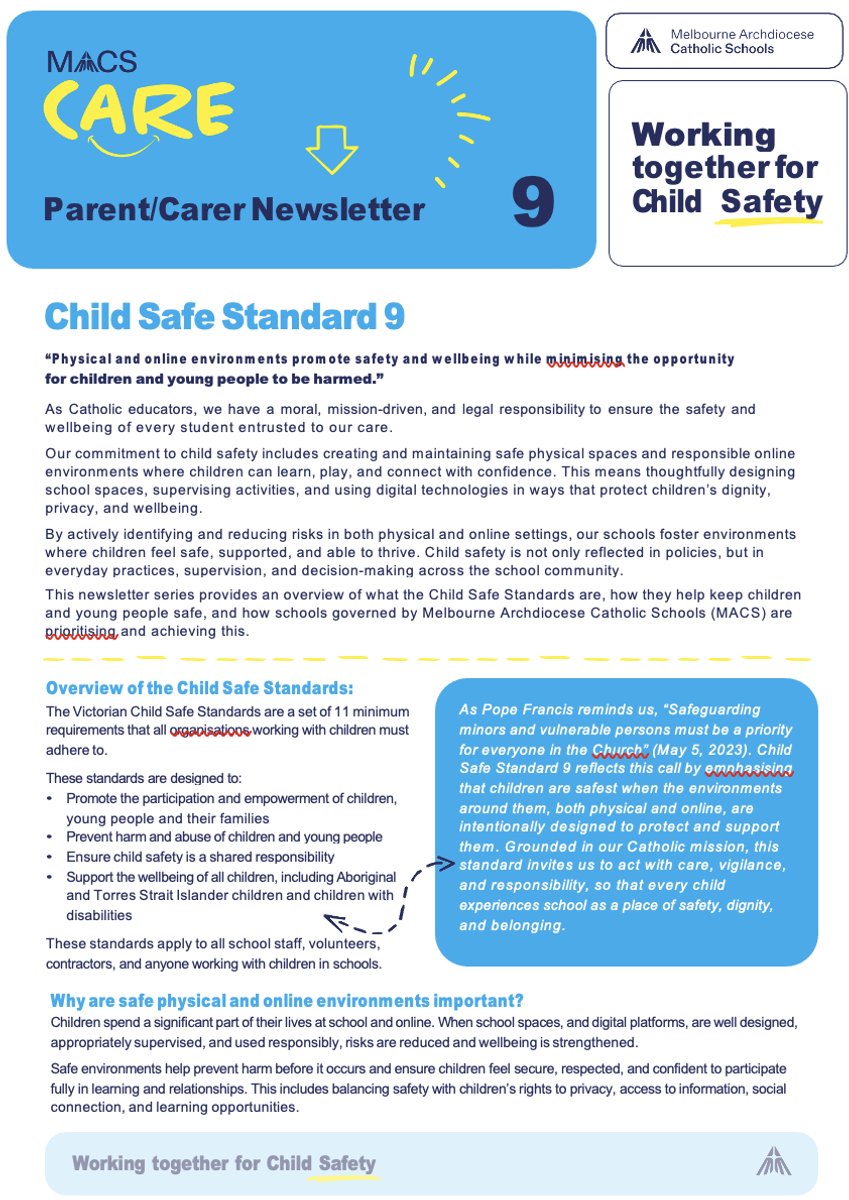
The Victorian Child Safe Standards are a set of eleven standards designed to help schools create and maintain child-safe environments through strong policies, practices and partnerships with families. They support schools in building cultures where children’s voices are heard, their wellbeing is prioritised, and safeguarding is embedded into everyday school life.
This month, we focus on Child Safe Standard Nine, which is about ensuring that the physical and online environments in which children learn, play and interact promote their safety and wellbeing while minimising opportunities for harm. Schools have a responsibility to regularly consider potential risks within these environments and put appropriate safeguards in place, while still ensuring students have opportunities to learn, explore and participate fully in school life.
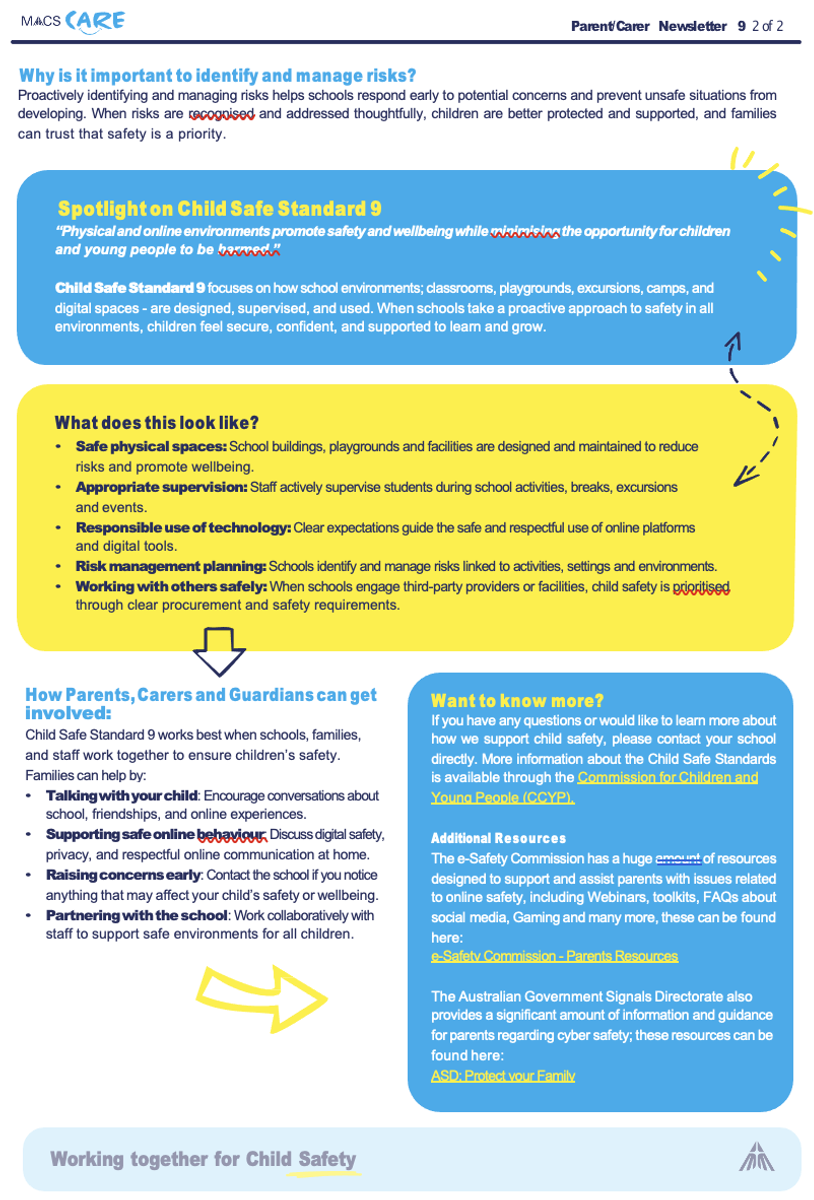
At St Agnes’, this is reflected in many of our everyday practices. Our staff actively supervise students before, during and after school, with designated duty areas and clear supervision expectations across our playgrounds, classrooms and shared spaces. We regularly review our school grounds and facilities to identify potential risks, and consider child safety when planning activities, excursions, camps, sporting events and other experiences beyond the school grounds. We also consider visibility when students are working with adults, ensuring learning spaces and practices support appropriate supervision and interactions.
Creating safe environments also extends to the online world. Technology provides wonderful opportunities for learning, but it also brings responsibilities and potential risks. At St Agnes’, students are explicitly taught about safe and responsible technology use, including protecting personal information, appropriate online communication and what to do if they encounter something online that makes them feel uncomfortable or unsafe. Access to digital platforms and online content is managed and monitored appropriately, with clear expectations for students and staff.
Importantly, managing risk does not mean removing every element of challenge from school life. Children need opportunities to explore, develop independence, take appropriate risks and build confidence. Our role is to carefully consider the environments and activities we provide and ensure appropriate safeguards are in place so students can participate safely and confidently.
Child Safe Standard Nine reminds us that creating a child-safe school extends well beyond our policies. It can be seen in the way we design and use our spaces, supervise our students, manage technology and continually assess potential risks. By remaining vigilant and proactive, we can continue to ensure St Agnes’ is a place where every child can learn, play and grow in an environment that prioritises their safety and wellbeing.
What this looks like at St Agnes'
At St Agnes’, we believe that keeping children safe requires us to carefully consider the environments in which our students learn, play, communicate and interact. Child safety is not only about how adults respond when concerns arise; it is also about proactively identifying potential risks and creating physical and online environments that promote the safety and wellbeing of every child.
Our physical environment is regularly considered through a child-safety lens. Across the school, we have clear expectations around student supervision, visibility and access to different areas of the school. Staff are allocated specific yard-duty areas, supervise students at arrival and dismissal times, and follow established procedures for students moving around the school. We also regularly review our grounds, classrooms and shared spaces to identify areas where additional supervision or changes to our practices may be required.
Visibility is particularly important when adults are working individually or in small groups with students. Staff consider where interactions take place and ensure spaces allow for appropriate visibility and supervision. The same principles apply when external providers, volunteers, contractors and other visitors are working within our school. Our aim is to create an environment where positive relationships can flourish while appropriate safeguards remain firmly in place.
These considerations extend beyond our school grounds. Excursions, camps, sporting events, swimming programs and other off-site activities involve careful planning and risk assessment. Staff consider supervision arrangements, student needs, transportation, facilities, external providers and the particular risks associated with each activity. Appropriate safeguards are then put in place so our students can participate fully and safely in these important learning experiences.
Child Safe Standard Nine also has an important focus on our online environments. Technology is an increasingly important part of learning and provides wonderful opportunities for our students, but we recognise that online environments can also present risks. At St Agnes’, access to digital platforms and content is carefully considered, with appropriate filtering, monitoring and expectations in place around how school technology is used.
Students are also explicitly taught how to navigate the online world safely and responsibly. Through classroom learning and our digital safety programs, students learn about protecting personal information, communicating appropriately online, recognising unsafe or inappropriate content and, importantly, seeking help from a trusted adult when something does not feel right. Our goal is not simply to restrict access, but to progressively build the knowledge and judgement students need to become safe and responsible digital citizens.
An important part of Standard Nine is recognising that managing risk does not mean removing every possible challenge from children’s experiences. Students need opportunities to explore, develop independence, solve problems and take appropriate risks. Our responsibility is to identify foreseeable risks and put sensible safeguards in place so these opportunities can occur in a safe and supportive environment.
Ultimately, Child Safe Standard Nine reminds us that child safety must be considered wherever our students are learning and interacting: whether that is in a classroom, on the playground, at camp, on an excursion or online. Through thoughtful planning, appropriate supervision, strong risk-management processes and ongoing education, we continue to ensure that St Agnes’ provides physical and online environments where every child can feel safe, supported and confident to learn.