Learning Area News











Foundation
Literacy
In Literacy, we have been learning to read and write four sound words such as ‘pond’ and ‘crash’. We have also been learning about plurals and using the letter ‘s’ to show a plural spelling. In Writing, we have been re-reading our work to engage in the editing process. Students have been using a check list to ensure their writing; makes sense, has a capital letter at the beginning, has a full stop at the end and has spaces between the words.
Numeracy
In Numeracy, we have been learning about location. Students have been learning vocabulary such as behind, in front of, next to, right and left to describe objects in our classroom. We have also been learning to move an object on a grid. The students enjoyed creating their own maps and giving directions to their peers to follow.
Religion
In Religion, we have been learning about the topic ‘We Are Special’. Students have explored the many gifts and talents that God has given each of us, helping us to recognise what makes us unique. They have enjoyed creating artworks that showcase the special qualities and talents.
Inquiry
In Inquiry, we have been learning about Physical Science. Students have explored the five senses and how these senses help us to understand and interact with the world around us. They have also investigated movement, exploring how people, animals, and objects move and how the materials they are made from can influence the way they move.
At home you could reinforce learning by:
- Read a story with someone at home. Talk about what happened at the beginning, in the middle and at the end of the story.
- Practise writing all your letters using lower case letter formation. Say the sounds as you write the letter.
- Create your own map at home and give directions for someone to follow.
- Practise spelling saying the sounds in the following words and have a go at spelling them.
Cost, soft, send, munch, crash.
- Look, say, cover, write and check the below words. You may like to put one of the below words into a sentence. Use your check list to ensure your sentence is correct. Or, for, where, what, want, was, there, they.
Year 1
Literacy
In Literacy, students have been reviewing tricky words and applying them in their reading and writing. They have also been practising their handwriting skills, focusing on correct letter formation, spacing and neat presentation. In writing they have been learning to identify and write the key parts of a story, including when, who and where. We have begun planning and writing the beginning of a story titled Blackout, focusing on introducing the characters, setting and time of the story.
Numeracy
In Numeracy, students have been learning about data collection and discussing which questions are useful for gathering information. They have been practising how to record data using tally marks and represent their findings by creating and interpreting picture graphs.
Religious Education
In Religious Education, students have been learning about the Good News that Jesus teaches through stories in the Bible. They have explored the four Gospels in the New Testament, listened to and read Gospel stories, and reflected on the messages and teachings found in scripture.
Push and Pull
In our Push and Pull unit, students have been learning to identify factors that influence the movement of objects. They have explored how the strength and direction of pushes and pulls can change an object's motion. Working in small groups, students designed and built ramps to investigate how the size and shape of different balls affect how far they roll. Through these hands-on experiments, students developed their observation, prediction and teamwork skills.
At home you could reinforce learning by:
Literacy
- Read the tricky words in your reader and booklet. Practise them every night.
- Listen to your child read their reader each night.
Numeracy
Data Collection
Ask 5 people in your family this question:
What is your favourite fruit?
Choices: Apple / Banana / Grapes / Orange
Step 1: Ask each person and make a tally.
Fruit | Tally | Total |
| Apple | ||
| Banana | ||
| Grapes | ||
| Orange |
Step 2: Draw a picture graph. Example: = 1 person
Step 3: Answer these questions:
- Which fruit was the most popular?
- Which fruit was the least popular?
- How many people chose apples?
- How many people did you ask altogether?
Year 2
Literacy
In Literacy, during spelling, students have been learning about words ending in -le, -ge and -dge, such as candle, little, table, cage, page, bridge and badge. Students focused on reading and spelling words that follow these spelling patterns and applying them in their writing. Tricky words for this fortnight have included should, shouldn't, favourite and interesting.
Grammar
During grammar lessons, students have been learning about adverbs and how they add more detail to sentences by describing how, when or where an action happens. They identified adverbs in a range of sentences and practised using them to enhance their own writing.
Mathematics
In Mathematics, students have been learning about fractions, with a focus on identifying and representing halves, quarters and eighths of shapes and collections. They have practised recognising equal parts and explaining how whole objects and groups can be divided fairly. Students have also explored arrays to help build their understanding of equal groups.
Religious Education
In Religious Education, students have been learning about the Parable of the Lost Sheep and the message of God's love and care for every person. They listened to the Godly Play presentation of The Lost Sheep, reflected on its meaning, and discussed how the story teaches us about compassion, forgiveness and belonging. Students shared their ideas and made connections between the parable and their own lives.
Science
In Science, students have been investigating how sound is made through vibrations. They conducted a range of hands-on experiments using balloons, wire coat hangers and string to observe how vibrations travel and create sound.
At home you could reinforce learning by:
Literacy
- Practise the tricky words: should, shouldn't, favourite and interesting.
- Listen to your child read their reader each night. When reading, students could practice using the ‘monitoring’ strategy to retell what the text is about.
Numeracy
- Find 3 objects or collections around your home. Draw them and show how you could divide each one into halves or quarters. Label each part and explain how you know the parts are equal.
- Draw an array and circle one-half or one-quarter of the array. How many objects are in each part?
Year 3
English
In English, we are continuing to enjoy our class novel, Charlotte's Web. Students have been exploring the characters, events and themes throughout the story. In writing, we have begun creating our own narratives, focusing on developing engaging introductions and exciting action paragraphs. Students are learning to introduce characters, establish settings and build suspense to capture the reader's attention.
SpellEx
During SpellEx, students have been exploring different spelling patterns, including the phonemes ire/ure and eer/air, along with consonant + 'le' word endings. We have also been practising the spelling of tricky and useful words to strengthen spelling accuracy and confidence in writing.
Mathematics
In Mathematics, we have completed our Multiplication and Division unit and have moved into our new topic of Time. Students have been developing their ability to read analogue clocks to the minute, interpret digital times and solve worded problems involving both analogue and digital time.
Science
In Science, we are continuing our exciting topic on Fossils. Students have been identifying different types of fossils and investigating how fossils are found within rock layers. We have also been exploring how fossils provide important information about plants, animals and environments from the past.
Humanities
In Humanities, we have been learning about Ancient Greece, focusing on the cities of Sparta and Athens. Students have been exploring the similarities and differences between these two cities and investigating the different forms of government used in Ancient Greek times.
Religion
In Religion, we are continuing our unit on Jesus Models Forgiveness. Students have been learning how Catholics celebrate God's forgiveness through the Sacrament of Penance. We have been discussing the importance of forgiveness, reconciliation and making positive choices in our everyday lives.
How Can You Reinforce Learning at Home?
The following activities are designed to take approximately 10–15 minutes each.
1. Narrative Writing Challenge
Create a short story introduction that includes a character, setting and an interesting opening. Then write an action paragraph describing something exciting that happens.
2. SpellEx Word Hunt
Find and write five words containing the spelling patterns ire, ure, eer or air. Practise spelling each word and use three of them in sentences.
3. Tricky Word Challenge
Choose 10 tricky words from your child's spelling list. Practise spelling them aloud, writing them from memory and checking for accuracy.
4. Time-Telling Challenge
Use an analogue clock at home to practise reading times to the nearest minute. Ask your child to write the matching digital time.
5. Daily Routine Timetable
Create a timetable of five daily activities, recording the starting time of each activity. Calculate how long each activity takes.
6. Time Word Problems
Solve these problems:
- A movie starts at 3:15 pm and finishes at 4:45 pm. How long does it last?
- School starts at 9:00 am. You arrive 25 minutes early. What time did you arrive?
- Dinner begins at 6:20 pm and takes 35 minutes. What time does it finish?
7. Fossil Research
Choose a type of fossil and investigate how it was formed. Draw a picture and write three interesting facts about it.
8. Ancient Greece Comparison
Research Sparta and Athens. Write two similarities and two differences between these Ancient Greek cities.
9. Forgiveness Challenge
Discuss a time when someone showed forgiveness or kindness. Explain why forgiveness is important and how it can help strengthen friendships.
10. Reading Fluency Practice
Read a familiar text three times:
- First read: Focus on reading words correctly.
- Second read: Focus on smooth and fluent reading.
Third read: Focus on expression and pausing at punctuation.
Thank you for your continued support at home. We look forward to another exciting fortnight of learning in Grade 3!
Year 4
Year 5
As a part of our Religious Education unit titled Discovering Our Christian Heritage, we continue to explore the world of scripture as we learn more about Abraham and the development of our Christian Faith. Christianity, along with Judaism and Islam are the only three monotheistic faiths, that is we believe in one God. We learn that Christianity has its roots in Judaism, as we know Jesus was Jewish, and we have common beliefs and rituals among the three religions. At home you may take some time to discuss what influences your faith choices.
We continue to explore the world Iceland through the novel The Last Bear. April, the main character befriends a polar bear that has been stranded on the island with no hope of returning to the mainland and connecting with the sleuth of polar bears. In a heart wrenching twist, all this changes as April takes thing in her own hands. We continue to explore writing persuasive letters in the hope of being advocates of change. Have a debate as a family the question Are we experiencing an Environmental Crisis?
Our Science and Humanities units have close links as we examine the impact and effects on the environment that the weather has along with the consequences of human use of the earth's resources. We learn that our First Nations people have an organic and systematic approach to take what is only needed from the earth and making sure that it is cared for and nurtured to help sustain life. What do you do as a family to help conserve the environment?
In Mathematics we are finishing our unit on statistics and data gathering. We have conducted surveys, used tables to collect the data, transformed the data in visual representations and made summary statements about our findings. How much waste does your household produce? Conduct a survey over a couple of weeks, collecting data of the total waste produced in the household. What conclusions can you make? Is there a need of improvement? Our next topic is Fractions, Decimals and Percentages.
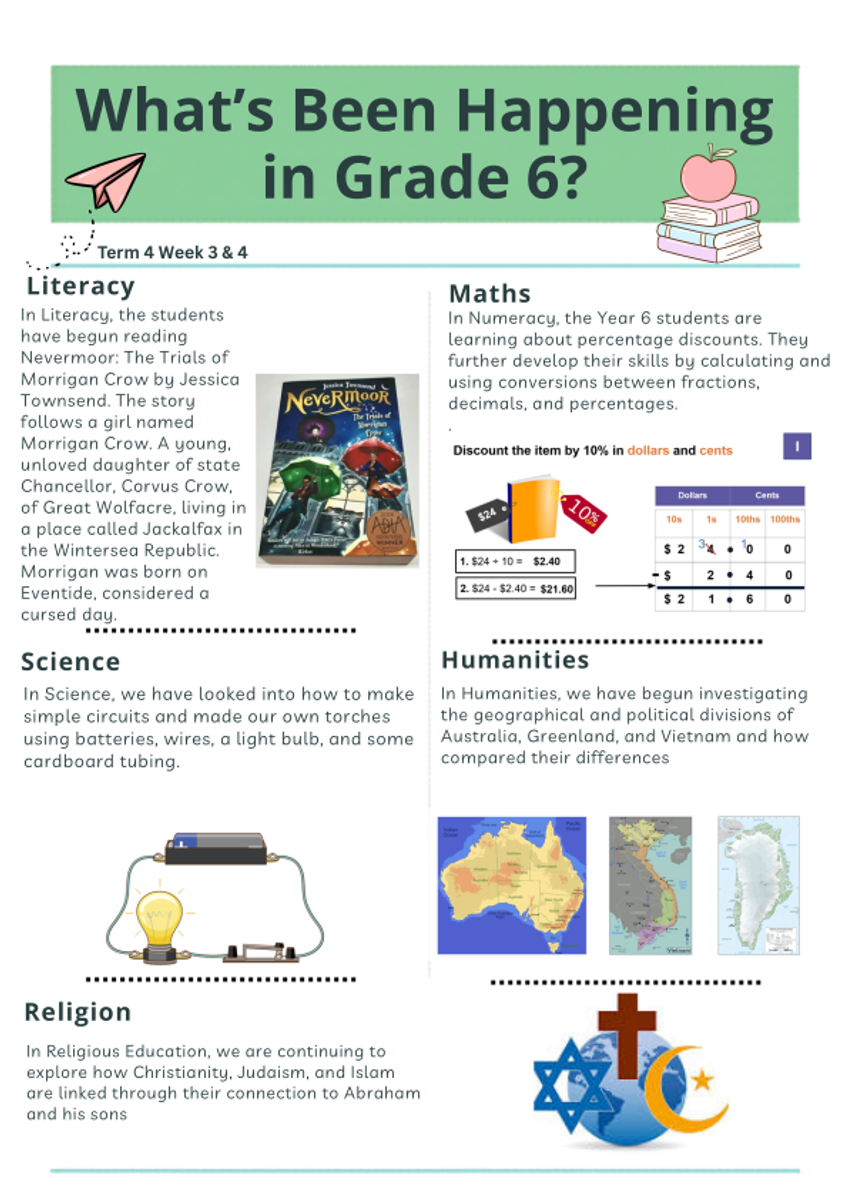
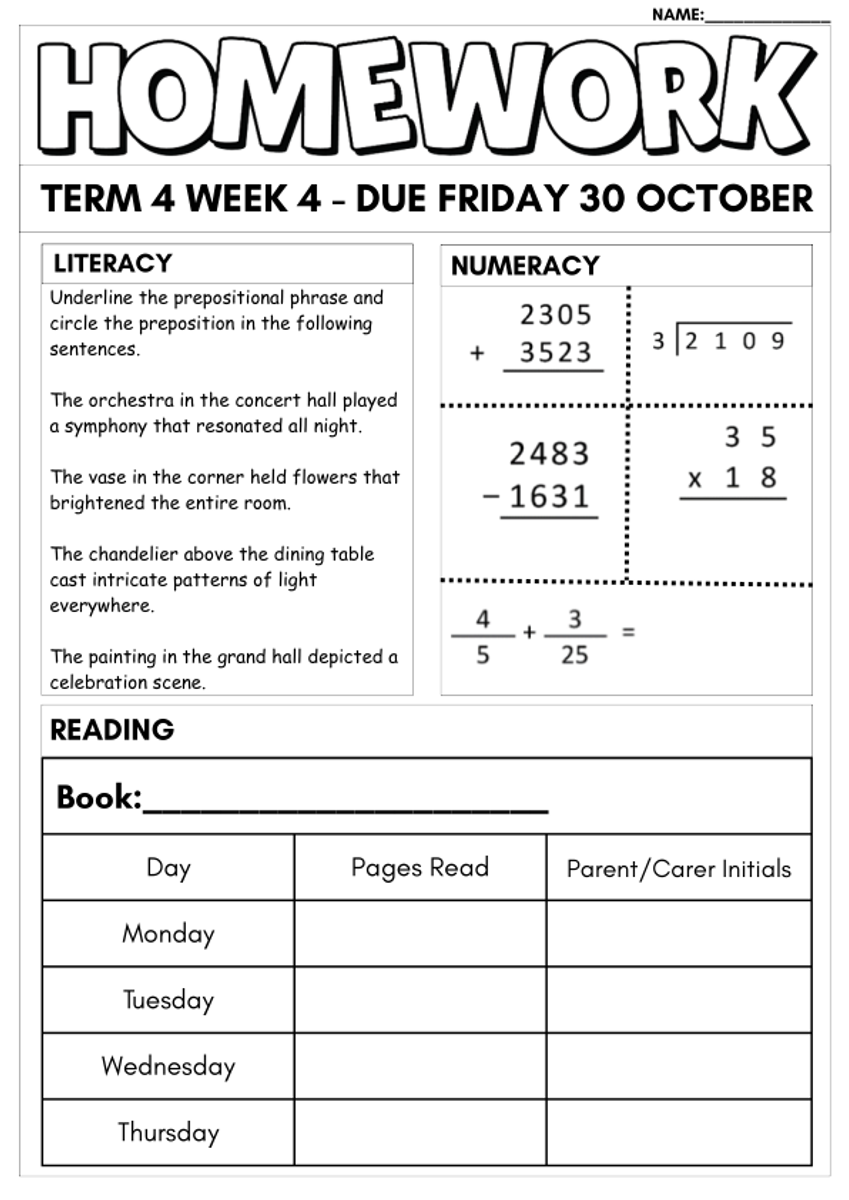
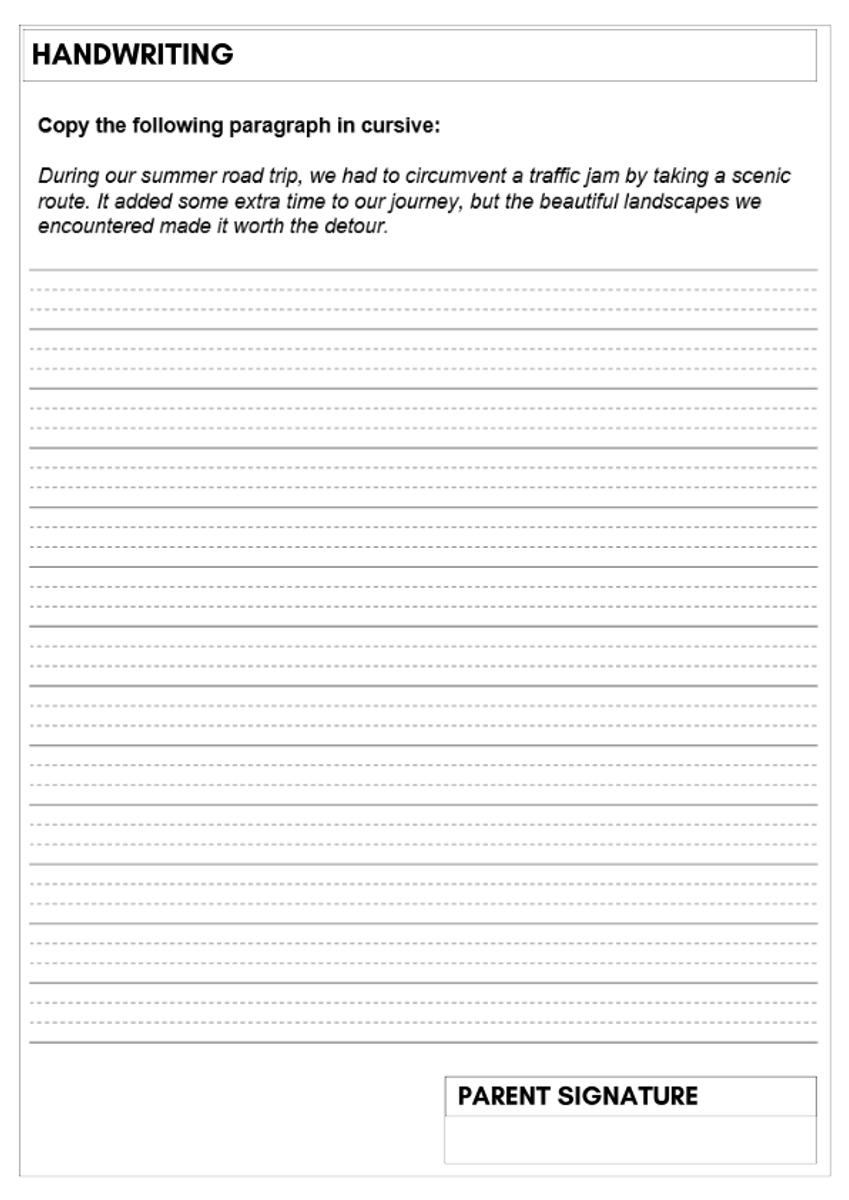
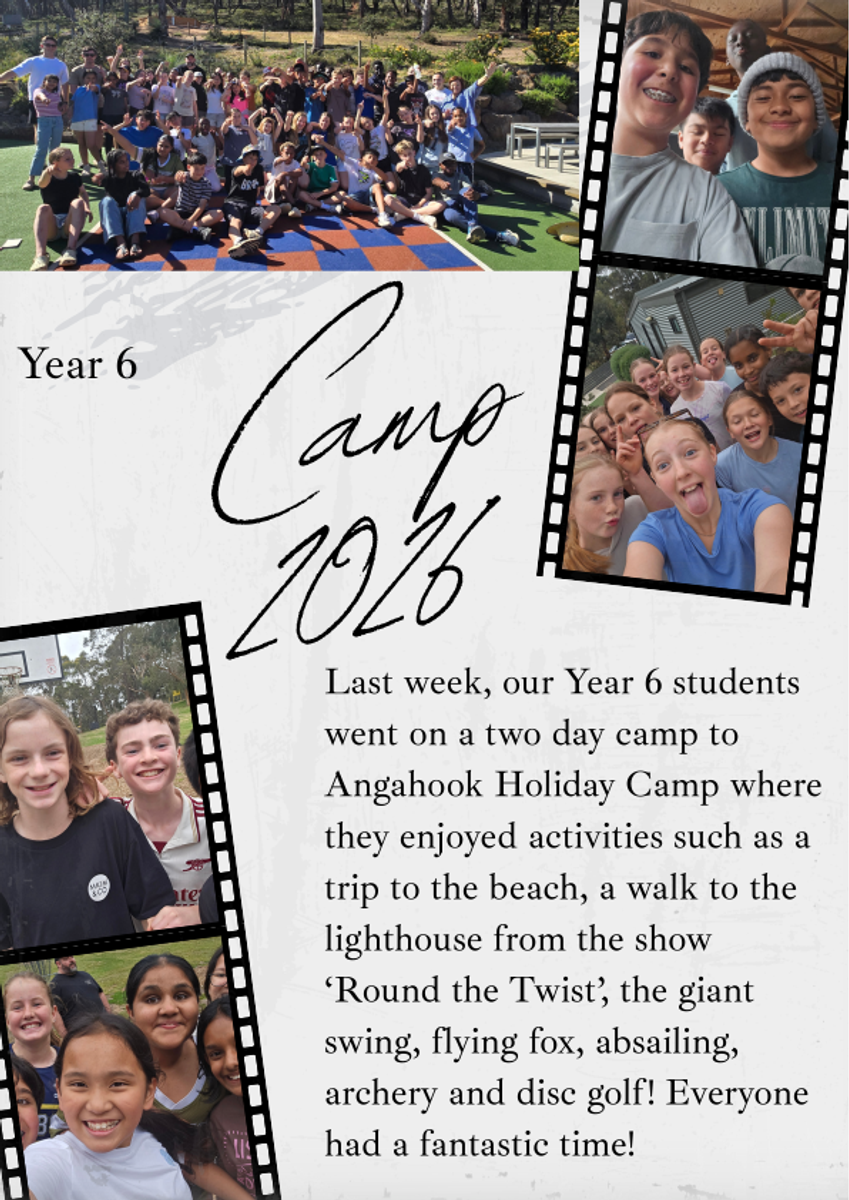
Year 6