Science News







 Glen Eira College
Science Talent Search 2026
Congratulations to our Glen Eira College students who participated in this year's Science Talent Search (STS), organised by the Science Teachers' Association of Victoria (STAV).
Celebrating its 75th year in 2026, the Science Talent Search encourages primary and secondary students to explore their scientific interests through independent investigations and creative projects. Students can submit work across a range of categories, including experimental research, science photography, video productions, games, inventions and working models.
We are pleased to recognise the following students for their achievements.
Certificates of Merit
- Avyaan Dhar and Max Gevaux – Dream State – Where the Mind Wanders (Video Productions)
- Isla Duffy – Photos of Nature (Science Photography)
- Mia Porteous – Spacetime Curvature (Experimental Research)
Certificates of Acknowledgment
- Tilak Barot and Vikhyath Reddy Polaka – Disaster Island (Games)
Congratulations to these students on their efforts and achievements. Developing an entry for the Science Talent Search requires initiative, creativity and a willingness to explore scientific ideas beyond the classroom. We also acknowledge all students who took on the challenge of preparing and submitting entries this year.
Acknowledging Our Year 12 Science Students and Teachers
As our Year 12 students approach the end of their secondary schooling, we would like to acknowledge the work and commitment they have shown throughout their VCE Science studies.
Biology, Chemistry, Physics and Psychology are demanding subjects, requiring students to develop a detailed understanding of scientific concepts while applying their knowledge to unfamiliar problems, practical investigations and written assessments. The final weeks have been particularly busy, with students completing practice examinations, reviewing feedback and preparing for their upcoming VCAA examinations.
Our thanks go to the VCE Science teaching team for their ongoing support of students throughout the year: Mr Marc Lewandowski and Ms Wendy Li (Chemistry), Dr Anand Datar (Physics), Ms Elizabeth Tasiopoulos and Mr David Ebert (Biology), and Ms Niketa Archer (Psychology).
As students prepare for their final examinations, teachers have continued to make themselves available beyond their regular teaching commitments, including using study periods to run additional revision classes, work through practice examinations and provide individual assistance. This has also included early morning Physics practice examination sessions supervised by Dr Datar over the past three school weeks. These additional opportunities have provided valuable support to students during an important stage of their VCE studies.
We also extend our thanks to Jess, our Science Laboratory Technician, for her considerable work behind the scenes preparing equipment and supporting practical activities and Extended Practical Investigations throughout the year. Her contribution plays an important role in providing students with meaningful hands-on learning experiences.
To our Year 12 Science students, congratulations on reaching this important milestone. We wish you every success in your upcoming examinations and in the pathways you choose beyond Glen Eira College.
7B students set the bar high with tectonic plates presentation
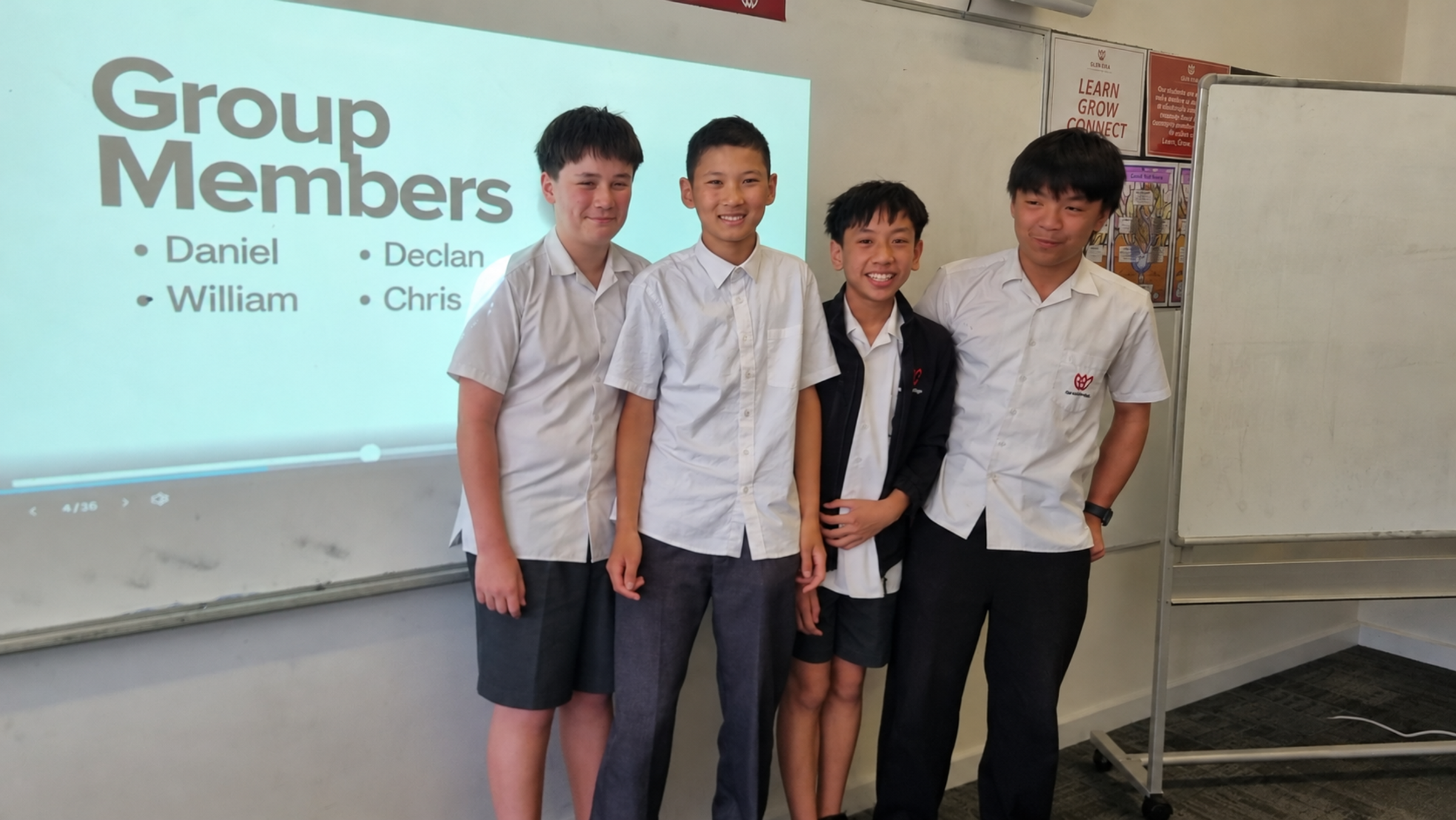
On 21 October, William, Declan, Daniel and Chris from 7B (SEAL) presented their research on tectonic plates to the class. Working as a team, they created a slideshow about convergent boundaries and explored the Himalayas as a case study.


Each student contributed to the presentation: William wrote the text, Declan added the photos, and Daniel and Chris worked on the animations. They were the first team to present to the class.
“We’ve set the bar really high,” the team said—and they certainly made a strong impression. Well done team.
Erik Van Weeghel
Science Learning Area Leader
Year 8D Science- Earthquake resistant building challenge
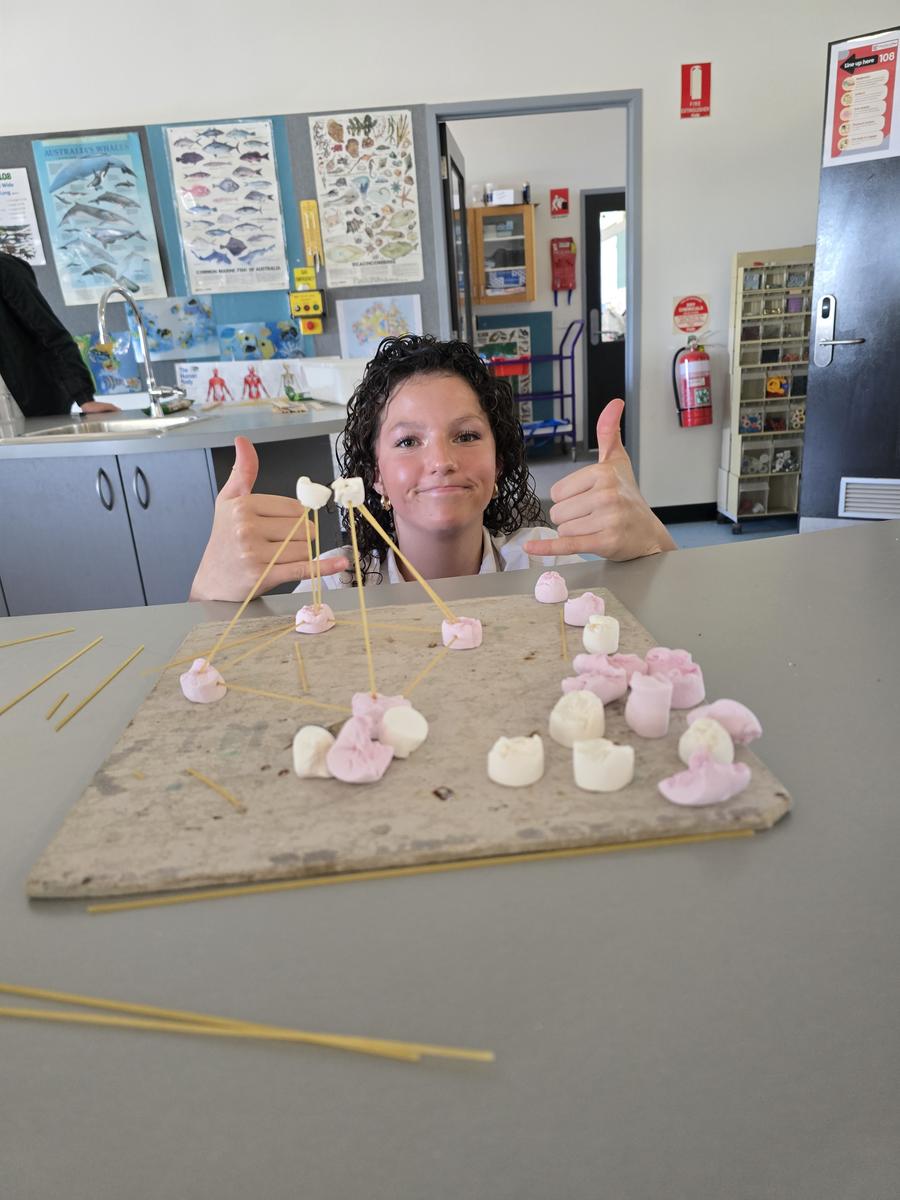
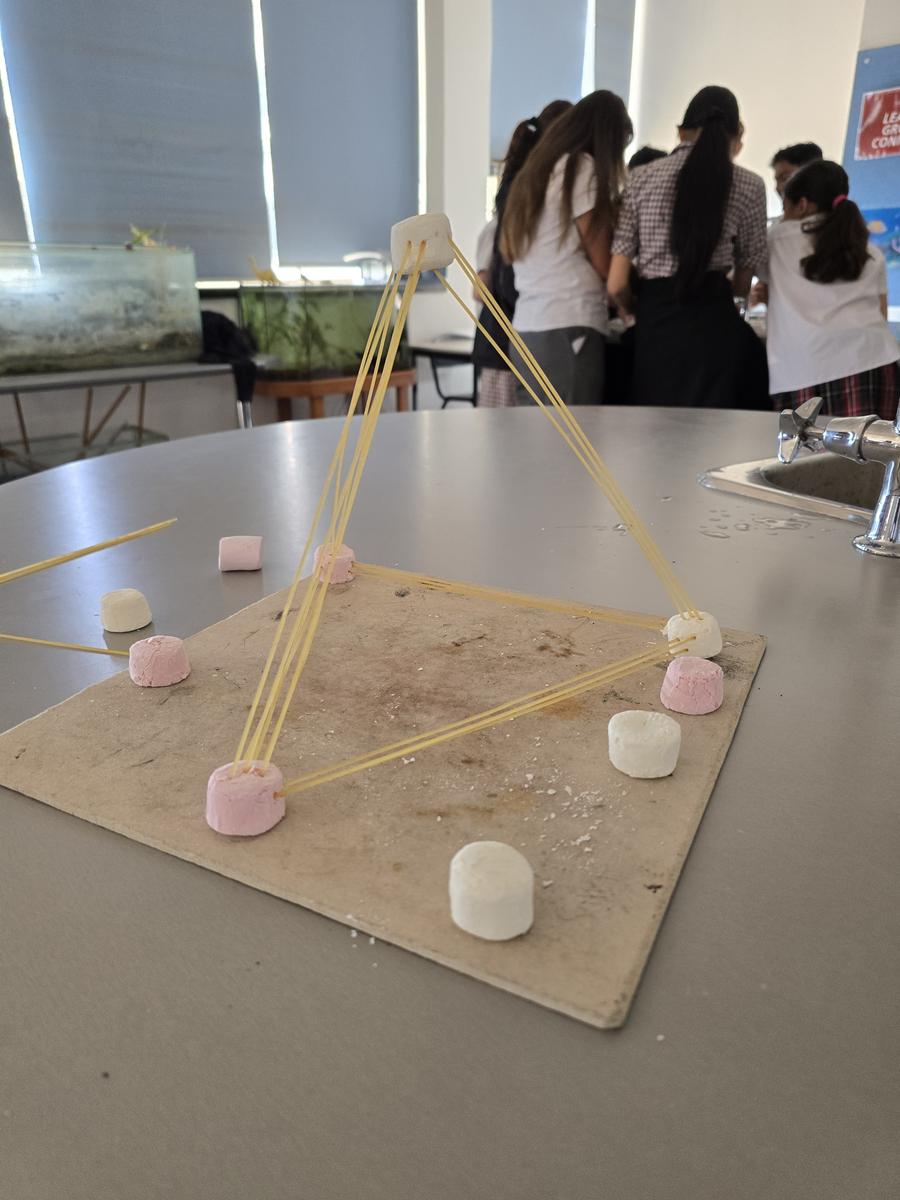
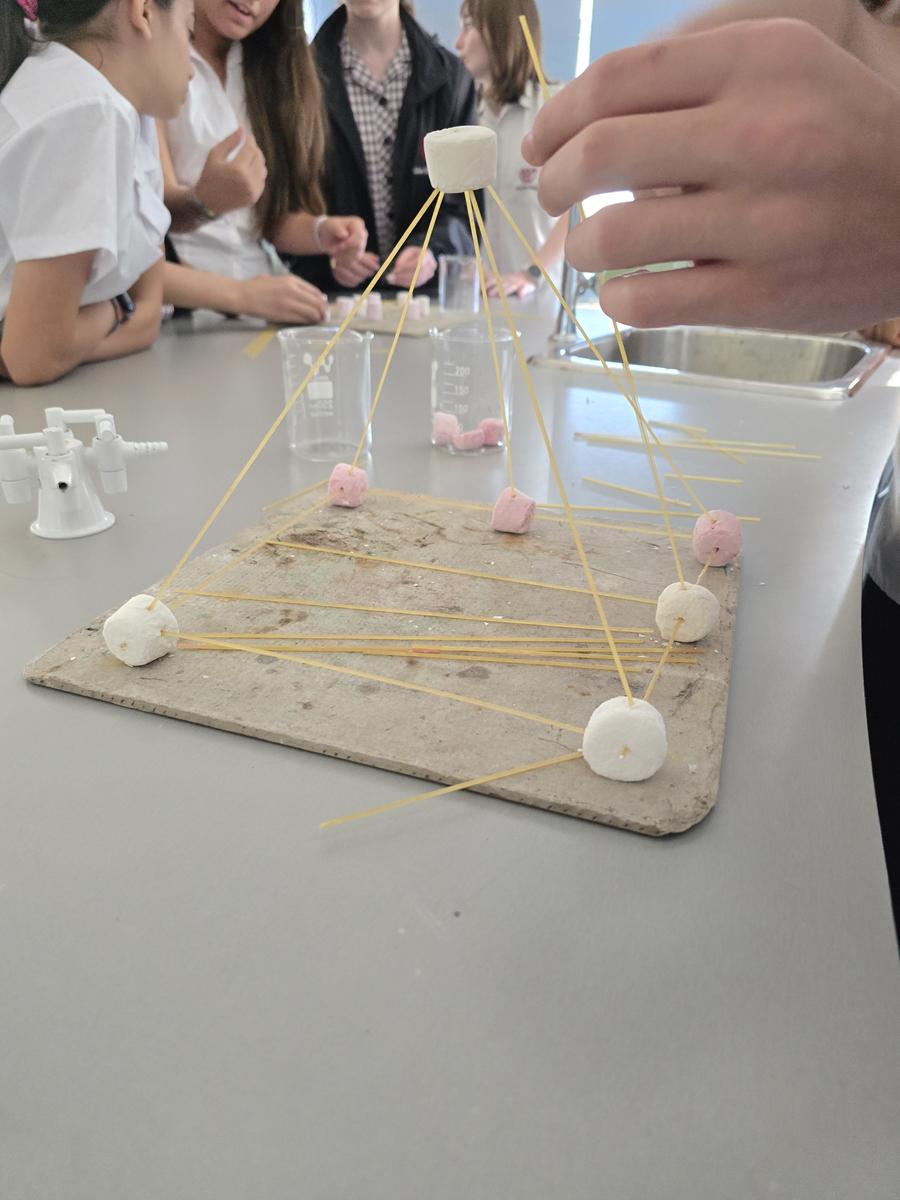
As part of the Year 8 Curriculum students have been studying plate tectonics and how they create volcanoes, earthquakes, and tsunamis. After learning about earthquakes and earthquake resistant buildings the students were given the challenge to build their own earthquake resistant structure using a set amount of marshmallows and spaghetti strands. They did a great job designing, building and testing their structures. Well done, 8D students!!
Elizabeth Allan
Science Teacher
The importance of Scientific literacy
What do we mean by Scientific literacy?
“The ability to use scientific knowledge, understanding, and inquiry skills to identify questions, acquire new knowledge, explain science phenomena, solve problems and draw evidence-based conclusions in making sense of the world.”Australian Curriculum, Assessment and Reporting Authority [ACARA] (2022). Science | v9 Australian curriculum. [online] Australiancurriculum.edu.au. Available at: https://www.australiancurriculum.edu.au/curriculum-information/understand-this-learning-area/science [Accessed 19 Oct. 2026].
What is the percentage of words known in a text to ensure reading comprehension? 95%! But ideally 98% for comfortable comprehension. SCHMITT, N., JIANG, X. and GRABE, W. (2011), The Percentage of Words Known in a Text and Reading Comprehension. The Modern Language Journal, 95: 26-43. https://doi.org/10.1111/j.1540-4781.2011.01146.x [Accessed 19 Oct. 2026].
Reading for understanding:
- In other words, the more words that you know or can determine the meaning of, the better your understanding of the piece of text will be.
- The better you understand your work, the more successful you will be when trying to learn it.
- Science is a language all in itself which encompasses highly specialised tier 3 vocabulary which requires explicit teaching, retrieval and practice.
Here is an example:
“Photoautotrophs are photosynthetic organisms that harness light energy to drive the synthesis of organic compounds from carbon dioxide. The specialised metabolic machinery of these organisms includes internal membranes with light-harvesting pigment systems. Examples include both photosynthetic prokaryotes, like the cyanobacteria, and photosynthetic eukaryotes. What type of organisms are they?”
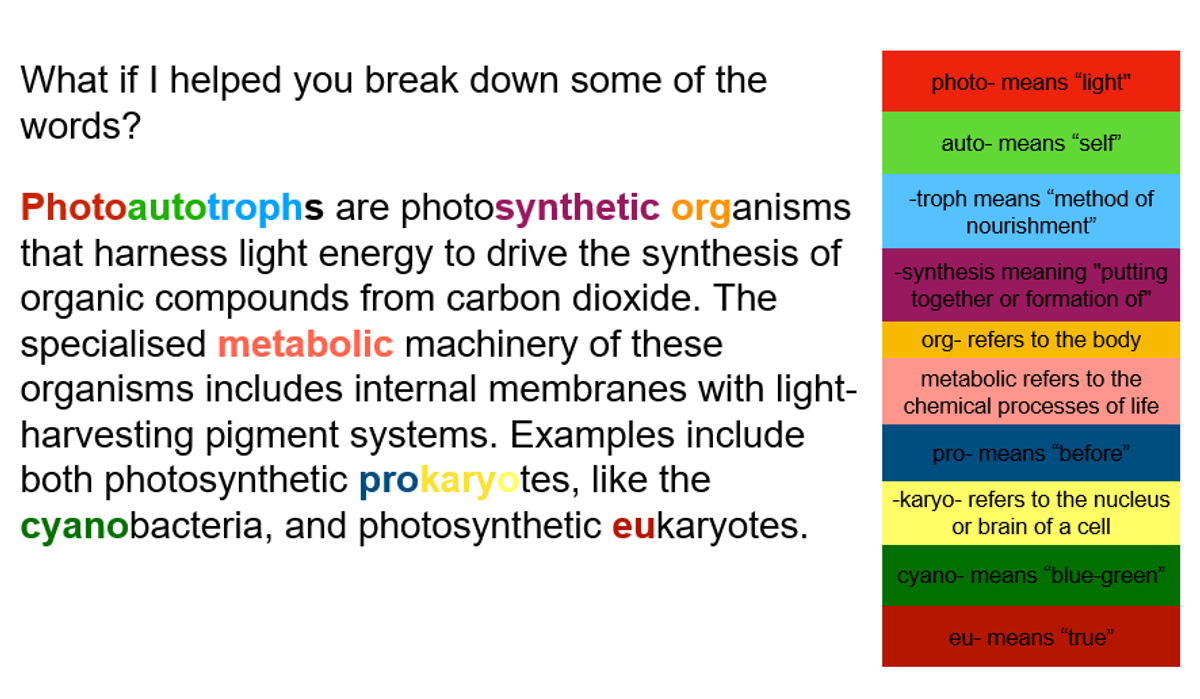
Answer – Plants.
Year 7 have started learning about Classification of organisms which has highly specialised vocabulary, with many terms derived from their Greek or Latin word roots. 7A took part in a word detective activity by researching common prefixes, word roots and suffixes used in Science. They researched the meaning and origin of the word using https://www.etymonline.com/ and then researched 10 words that share the respective prefix, word root or suffix. By the end of the activity, over 500 words had been generated.
Here is the result: https://docs.google.com/spreadsheets/d/1C87Snuvtj3L_Kdh_eEcC0T0xkOkAyd4CCA_np5W56oQ/edit?usp=sharing
What percentage of words have you heard of from the list?
Now you know the meaning of the prefixes, word roots and suffixes, would you feel more confident in comprehending a highly scientific piece of text?
We would hope so with practice.
Marc Lewandowski
Chemistry and Science Teacher