Learning About Learning:












 Western Heights School
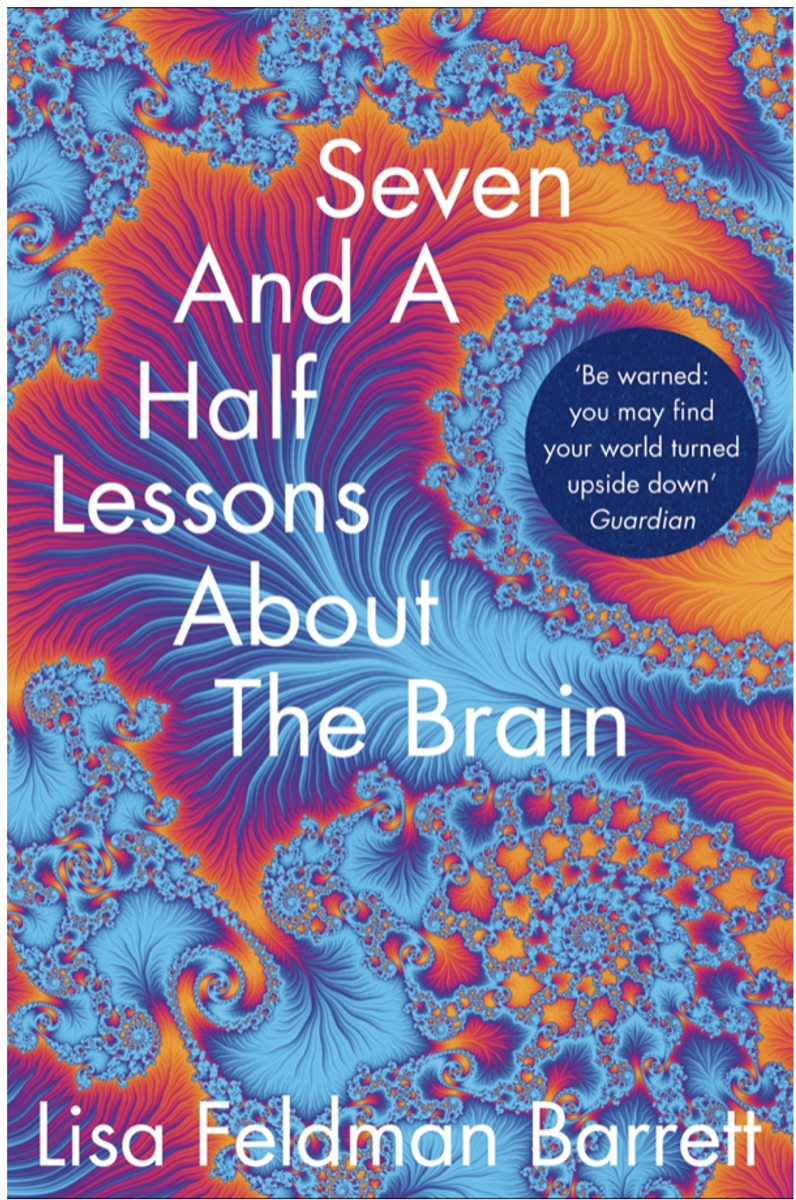
Lisa Feldman Barrett wrote this book of short, informal essays to intrigue and entertain you. It's not a full tutorial on brains. Each essay presents a few compelling scientific nuggets about your brain and considers what they might reveal about human nature.
Why are there seven and a half lessons rather than eight? The opening essay tells a story of how brains evolved, but it is just a brief peek into a vast evolutionary history - hence, half a lesson. The concepts that it introduces are critical to the rest of the book.
I am really enjoying learning what one neuroscientist thinks is fascinating about our brain and how that three-pound blob between our ears makes us human. The essays don't tell you what to think about human nature, but they do invite you to think about the kind of human you are or want to be.
Lesson Summaries:
You can think about energy efficiency like a budget. A financial budget tracks money as it's earned and spent. A budget for your body similarly tracks resources like water, salt, and glucose as you gain and lose them. Each action that spends resources, such as swimming or running, is like a withdrawal from your account. Actions that replenish your resources, such as eating and sleeping, are like deposits. This is a simplified explanation, but it captures the key idea that running a body requires biological resources. Every action you take (or don't take) is an economic choice - your brain is guessing when to spend resources and when to save them.
When it came to body budgeting, prediction beat reaction. A creature that prepared its movement before the predator struck was more likely to be around tomorrow than a creature that awaited a predator's pounce. Creatures that predicted most of the time correctly, or made nonfatal mistakes and learned from them, did well. Those who frequently predicted poorly, missed threats, or falsely alarmed about threats that never materialised didn't do so well. They explored their environment less, foraged less, and were less likely to reproduce.
The scientific name for body budgeting is allostasis. It means automatically predicting and preparing to meet the body's needs before they arise.
Your brain's most important job is to control your body - to manage allostasis - by predicting energy needs before they arise so you can efficiently make worthwhile movements and survive. Your brain continually invests your energy in the hopes of earning a good return, such as food, shelter, affection, or physical protection, so you can perform nature's most vital task: passing your genes to the next generation.
In short, your brain's most important job is not thinking. It's running what started as a little worm body that has become very, very complicated.
Of course, your brain does think, feel, imagine, and create hundreds of other experiences, such as helping you read and understand this book. But all of these mental capacities are consequences of a central mission: keeping you alive and well by managing your body budget. Everything your brain creates, from memories to hallucinations, from joy to shame, is part of this mission. Sometimes your brain budgets for the short term, as when you drink coffee to stay up late and finish a project, knowing that you are borrowing energy that you'll pay for tomorrow. Other times, your brain budgets for the long term, as when you spend years learning a difficult skill, such as math or carpentry, that requires a sustained investment but ultimately helps you survive and prosper.
You and I do not experience our every thought, every feeling of happiness or anger or awe, every hug we give or receive, every kindness we extend, and every insult we bear as a deposit or withdrawal in our metabolic budgets, but under the hood, that is what's happening. This idea is key to understanding how our brain works and, in turn, how to stay healthy and live a longer and more meaningful life.
What we call mental illnesses, then, may be rational body-budgeting for the short term that's out of sync with the immediate environment, the needs of other people, or our own best interests down the road.
Our brain network is not static - it changes continuously. Some changes are extremely fast. Our brain wiring is bathed in chemicals that complete the local connections between neurons.
These chemicals, such as glutamate, serotonin, and dopamine, are called neurotransmitters, and they make it easier or harder for signals to pass across synapses. They're like the airport staff - ticket agents, security screeners, ground crew - who can speed up or slow down the flow of passengers within an airport and without whom we can't travel at all. These network changes happen instantaneously and continually, even as our physical brain structure seems unchanged. In addition, some of these chemicals, such as serotonin and dopamine, can also act on other neurotransmitters to dial up or dial down their effects. When brain chemicals act in this way, we call them neuro-modulators. They are like the weather between airports. When it's clear, planes fly quickly. When it's stormy, flights are grounded or rerouted. Neuromodulators and neurotransmitters together allow our brain's single structure to take on trillions of different patterns of activity.
A brain doesn't store memories like files in a computer - it reconstructs them on demand with electricity and swirling chemicals. We call this process remembering, but it's really assembling.
And each time we have the same memory, our brain may have assembled it with a different collection of neurons. (That's degeneracy.)
A brain network is not a metaphor, as mentioned earlier; it's the best scientific description of a brain today. It allows us to consider how a physical structure can reconfigure in an instant to efficiently integrate vast amounts of information.
It reveals similarities and differences between various kinds of brains by quantifying their complexity. It even helps us understand how a brain might compensate when it's damaged.
Our brain network may even extend, surprisingly, into our gut and intestines, where scientists have found microbes that communicate with our brain via neurotransmitters.
We see similar consequences when little brains develop in poverty. Research shows that early and long exposure to poverty is bad for the developing brain.
Inadequate nutrition, interrupted sleep due to street noise, poor temperature regulation due to a lack of heat or ventilation, and other circumstances of poverty may affect the development of the frontal cortex, namely the prefrontal cortex. This brain area is involved in a range of critical functions, including attention, language, and body budgeting. Scientists are still studying how poverty affects brain development, but we do know that it's linked to poorer school performance and fewer years of education. These burdens ultimately increase a child's risk of living in poverty when he grows up and has children of his own.
On average, adversity and poverty are afflictions from which little brains struggle to recover. What's truly frustrating is that this tragedy is preventable. Politicians have dragged their feet for decades about lifting children out of poverty. So let's set the politics aside and frame the issue in simple financial terms: Childhood poverty is a colossal waste of human opportunity. Recent estimates suggest that it's far cheaper to eradicate poverty than to deal with its effects decades later. More school districts can offer free meal programs to students in need. Cities can enact noise ordinances in poor neighbourhoods. These sorts of steps are not merely about quality of life. They create the conditions for healthy brain development, so all children can become the workers, citizens, and innovators of the next generation.
Given the powerful impact of neglect and poverty on a little brain, it's tempting to ask how evolution got our species into this precarious situation in the first place. It's risky for a baby's brain wiring to depend so critically on social and physical input in order to develop typically. We, humans, must gain some advantage to offset the risks of developing this way. So what is it?
We can't know for sure, but a best guess based on evidence from evolutionary biology and anthropology is that this arrangement helps our cultural and social knowledge flow efficiently from generation to generation. Each little brain becomes optimised for its particular environment, the one it developed in. Caregivers curate a baby's physical and social niche, and the baby's brain learns that niche. When the baby grows up, he perpetuates that niche by passing his culture to the next generation through his words and actions, thereby wiring their brains. This process, called cultural inheritance, is efficient and frugal because evolution doesn't have to encode all our wiring instructions in genes. It offloads much of the work onto the world around us, including the other humans in that world. We unknowingly wire our cultural knowledge into our offspring after birth, for better or worse.
When it comes to the brain, simple distinctions like nature versus nurture are alluring but not realistic. We have a nature that requires nurture.
Our genes require a physical and social environment - a niche filled with other humans who shared our infant gaze, spoke to us with intent, set our sleep schedule, and controlled our body temperature - in order to produce a finished brain.
We all know that how we treat our children matters, but it matters more than it did even a few decades ago.
When you're awake at four a.m. trying to console your shrieking little angel, or when he calmly drops his Cheerios onto the floor for the ninety-third time, you are guiding his tuning and pruning whether you know it or not. Little brains wire themselves to their world. It's up to us to create that world - including a social world rich with wiring instructions - to grow those brains healthy and whole.