Learning Area News






Foundation
Literacy
In Literacy, we have been learning to read and write four sound words such as ‘pond’ and ‘crash’. We have also learnt the tricky words ‘down’, ‘come’ and ‘some’. In Writing, we have been re-reading our work to engage in the editing process. Students have been using a check list to ensure their writing; makes sense, has a capital letter at the beginning, has a full stop at the end and has spaces between the words.
Numeracy
In Numeracy, we have been learning about data. Students have been learning to compare data collections by stating which has more and which has less. The students have also been collecting their own data to find out information.
Religion
In Religion, we have been learning about the topic ‘We Are Special’. Students have explored the many gifts and talents that God has given each of us, helping us to recognise what makes us unique. They have enjoyed creating artworks that showcase the special qualities and talents.
Inquiry
In Inquiry, we have been learning about Physical Science. Students have explored the five senses and how these senses help us to understand and interact with the world around us. They have also investigated movement, exploring how people, animals, and objects move and how the materials they are made from can influence the way they move.
At home you could reinforce learning by:
- Read a story with someone at home. Talk about what happened at the beginning, in the middle and at the end of the story.
- Practise writing all your letters using lower case letter formation. Say the sounds as you write the letter.
- Collect some data at home by asking a yes/no question. For example, ‘Do you like popcorn?’. Look at the data you collected and identify which answer has more and which has less.
- Look, say, cover, write and check the below words. You may like to put one of the below words into a sentence. Use your check list to ensure your sentence is correct. Said, where, what, want, was, little.
Year 1
Literacy
In Literacy, students have been learning to spell words with the prefix 'un'. They have been practising the tricky words know, walk and talk using them in their reading and writing activities.
Writing
In Writing, students have been learning to identify and use adverbs to add detail to their sentences. They have practised saying sentences with adverbs and writing their own sentences that include adverbs to describe how, when or where actions happen.
Numeracy
In Numeracy, students have been learning about sharing and grouping numbers. They have explored ways to split whole numbers into smaller groups and have developed their understanding of equal sharing. Students have also been using arrays to count rows and columns, helping them build confidence in recognising number patterns and developing early multiplication skills.
Religious Education
In Religious Education, students have been learning about the Good News that Jesus teaches through stories in the Bible. They have explored the four Gospels in the New Testament, listened to and read Gospel stories, and reflected on the messages and teachings found in scripture.
In our Push and Pull unit, students have been learning to identify factors that influence the movement of objects. They have explored how the strength and direction of pushes and pulls can change an object's motion.
At home you could reinforce learning by:
Literacy
- Find words in your take home reader with the prefix 'un’.
- Write a report using the structure of headings subheadings and diagram.
- Practice putting the tricky words, know, talk and walk into sentences.
- Listen to your child read their reader each night.
Numeracy
🐻 Draw 20 bears.
Can you share the 20 bears equally into 5 groups?
How many bears are in each group? ______
Challenge: Share 18 apples equally into 3 groups.
How many apples are in each group? ______ 🍎
Extra Challenge: Can you draw the groups to show your thinking? 🎨
Super Challenge: If 20 bears are shared into 5 groups and 1 more bear joins each group, how many bears will there be altogether? ______ 🐻🐻🐻
Year Two
Literacy
In Literacy, during spelling, students have been learning about contractions and words ending in -le, such as candle, little and table. They explored how contractions are formed by combining two words (e.g. can't, didn't, we're) and practised using them correctly in their writing. Students also focused on reading and spelling words with the -le ending pattern. Tricky words we have been focusing on are 'around', 'though', 'can't' and 'don't'.
Grammar
During grammar lessons, students have been learning about adverbs and how they add more detail to sentences by describing how, when or where an action happens. They identified adverbs in a range of sentences and practised using them to enhance their own writing.
Comprehension
During comprehension, students have been applying a range of reading strategies to read and understand persuasive texts. They have practised making predictions, monitoring their understanding, asking questions, making connections, and identifying persuasive language and text features to support comprehension.
Mathematics
In Mathematics, students have been exploring the features of 2D shapes, with a focus on identifying and describing polygons, including their sides and vertices (corners). They have also been learning to distinguish between regular and irregular polygons, identify pairs of parallel lines, and recognise parallel lines in a variety of shapes
Religious Education
In Religious Education, students have been learning about the Good News shared by Jesus through stories in the Bible. They have explored the four Gospels of the New Testament, listened to and discussed Gospel stories, and reflected on the important messages and teachings that Jesus shares through scripture.
Inquiry
In Inquiry, our topic is Science. Students were introduced to the concepts of sound and light, exploring how sounds are made and how light helps us see the world around us.
At home you could reinforce learning by:
Literacy
- Practise the tricky words: around, though, can't, don't.
- Listen to your child read their reader each night. When reading, students could practice using the ‘monitoring’ strategy to retell what the text is about.
Numeracy
- Go on a shape hunt around your home and find 5 polygons (e.g. triangle, rectangle, pentagon, hexagon).
- For each shape, record: the number of sides, the number of vertices (corners), whether it is regular or irregular, any pairs of parallel lines it has.
Year 3
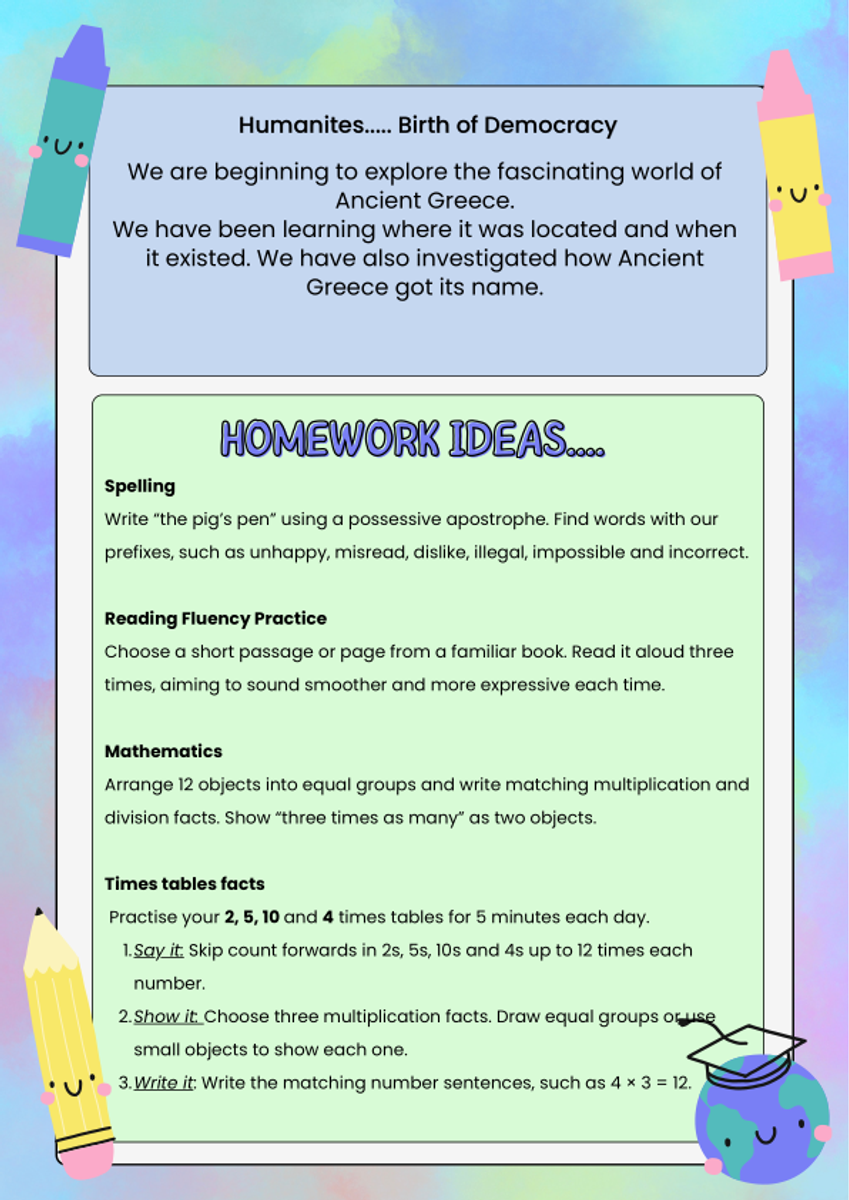
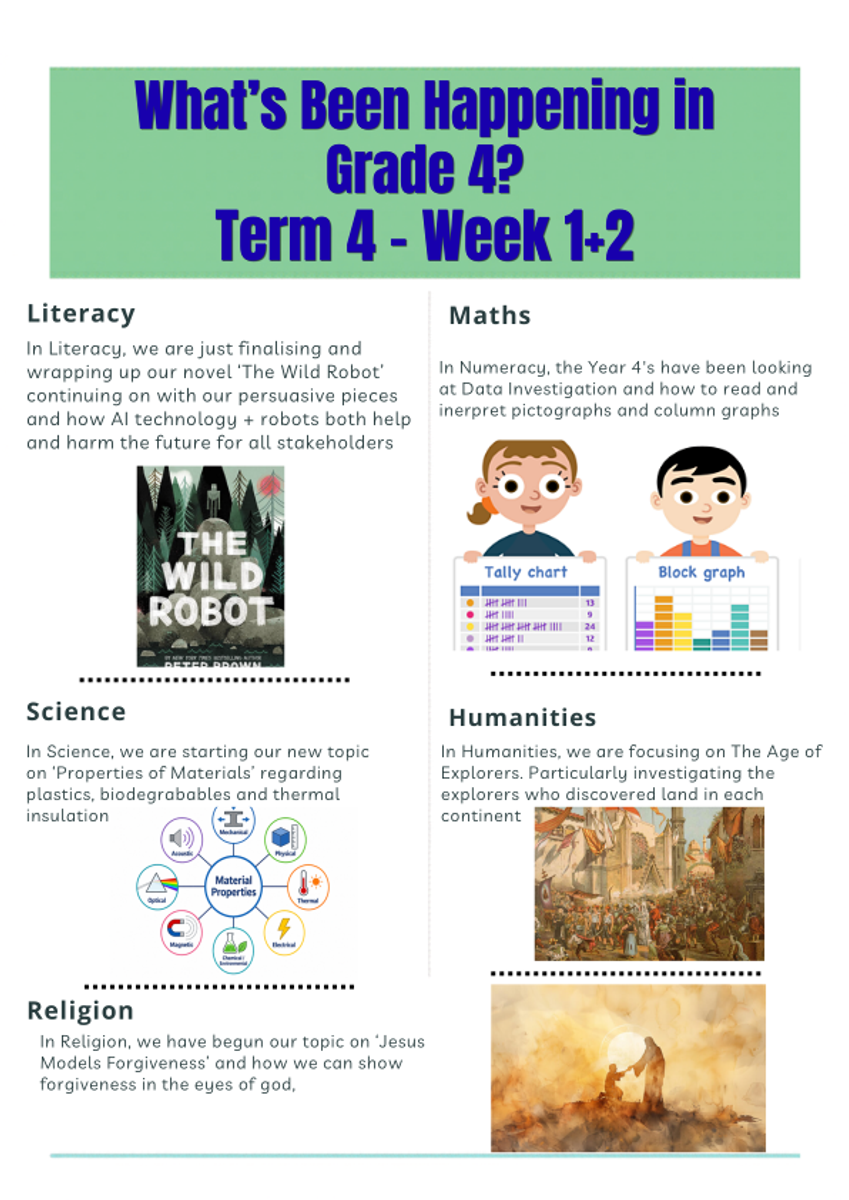
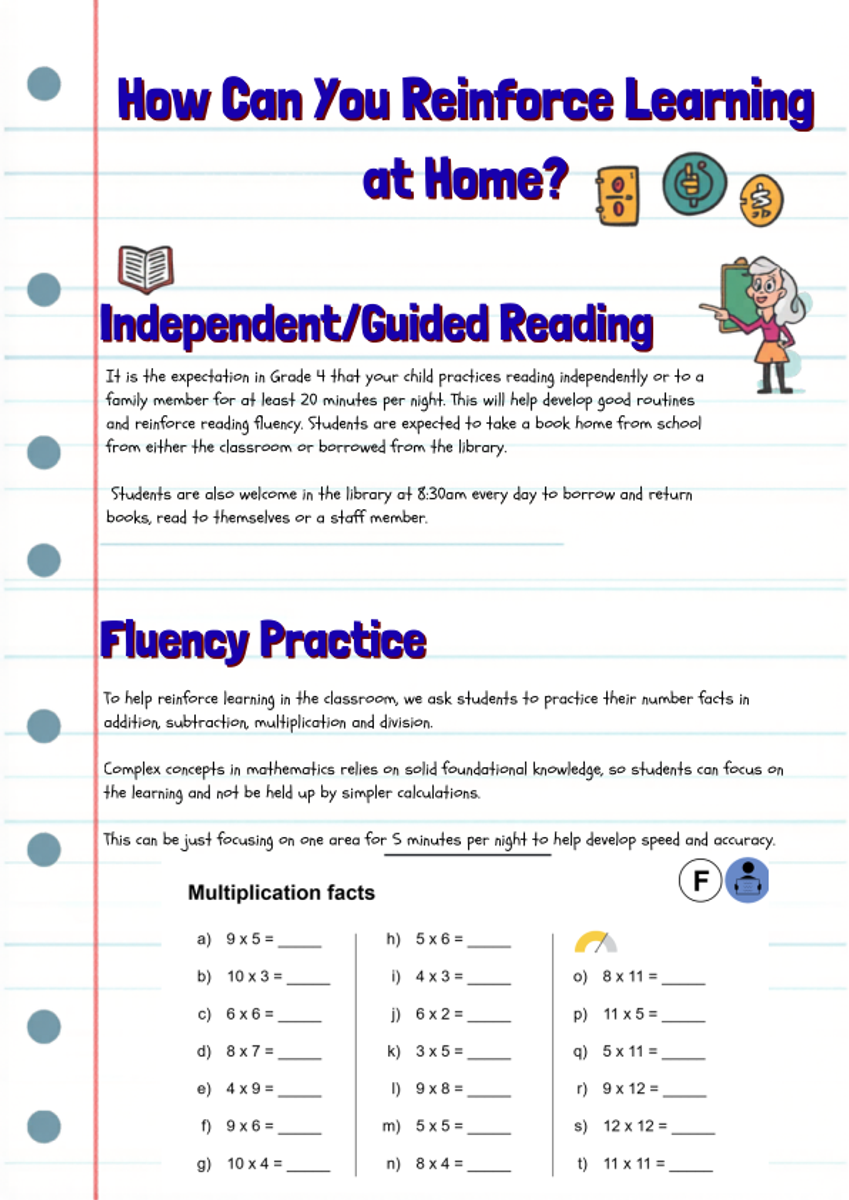
Year 4
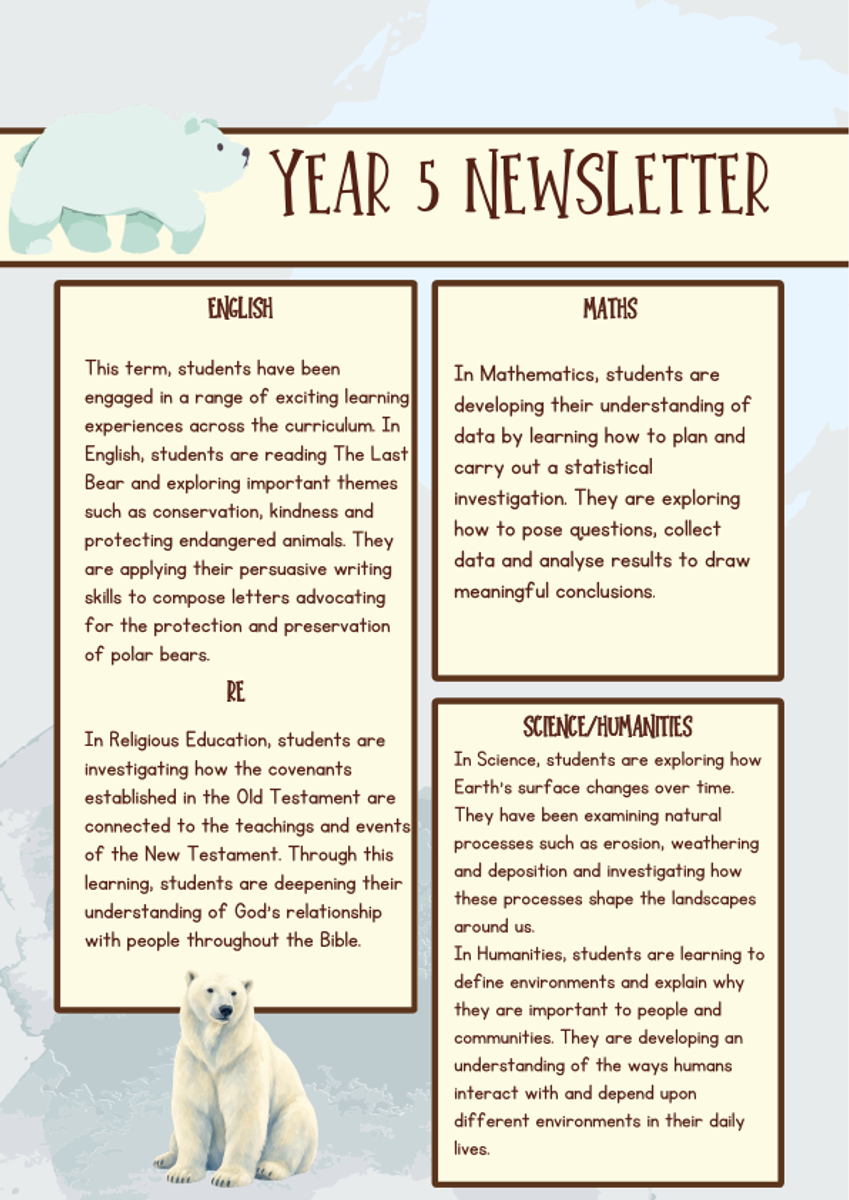
Year 5
Year 6