Teaching & Learning Page:












 Western Heights School

Web Pages:

https://artsandculture.google.com/experiment/blob-opera/AAHWrq360NcGbw?hl=en
Blob Opera
Every now and then, Google reminds us that not everything has to be useful. Sometimes it’s allowed to be wonderfully ridiculous. Blob Opera is proof.
Instead of giving you another productivity tool or AI assistant, Google created four adorable blobs that sing opera. That’s the entire idea.
You drag them around the screen, and they somehow harmonize beautifully. I have absolutely no musical talent. The blobs were kind enough not to judge me.
Five minutes later I was conducting my own tiny opera performance with the confidence of someone who had definitely never won a Grammy. It’s delightfully silly, surprisingly clever, and exactly the sort of website that makes you smile for no reason at all.
Honestly…the internet needs more blobs.

Cloudhiker
After my last article, someone also recommended Cloudhiker. Their description was innocent enough. The website itself was not.
Imagine someone wandered around the internet collecting thousands of genuinely fascinating websites, quietly ignored all the clickbait, and put the best discoveries in one place. That’s Cloudhiker. You don’t really visit Cloudhiker. You disappear into it.

Drive & Listen
I have a terrible habit. Whenever someone says, “You have to see this website,” I immediately tell myself I’ll only spend five minutes there. That has literally never happened.
Drive & Listen was one of those recommendations that sounded almost too simple to be interesting.
You pick a city, sit in the passenger seat, and watch someone drive while local radio plays in the background. That’s it.

https://explorer.audubon.org/home
Techie Tips:
Safari Can Watch a Webpage and Alert You When the Price Drops

We all have a product page we keep reopening every few days to see whether the price has moved. Safari can now do that checking for you with a new feature called Notify Me.
Open the page you care about and click the More Options menu on the right side of the active tab. Choose Notify Me and type what Safari should look for in plain words, like “price drops,” “back in stock,” or “new post.” Safari takes a moment to confirm it understands the request, then asks how often to check.
You can pick hourly, daily, weekly, or monthly checks, and you can choose the exact days
of the week and the time of day. Once it’s set, Safari checks the page on that schedule in the background and sends you a notification when the thing you asked about actually changes.
Besides getting the alerts on your Mac, you will also get them on your iPad and iPhone as
long as they are all signed into the same iCloud account.
Price drops are the obvious use, but the feature works on anything that updates. You can
watch for event registrations opening, a sold-out item returning, or a new post on a site youcare about (you know, like The Useful Tech). As a side benefit, you also stop handing your email address to every store that offers to “let you know” when something comes back.
Photos Can Change the Camera Angle of a Photo You Already Took
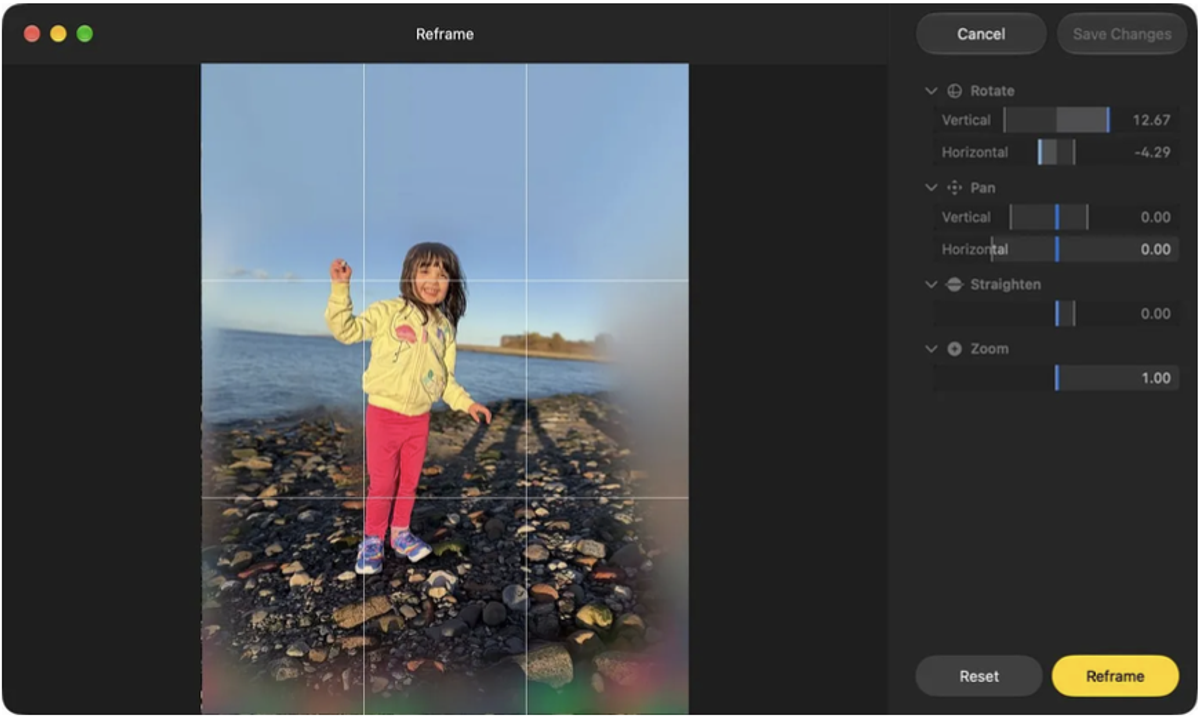
Open any photo, click Edit, then click Tools at the top. You’ll find three AI tools: Clean Up,
Extend, and Reframe.
Reframe is the headline. You drag across the image, and Photos shifts the viewpoint up,
down, left, or right, as if the camera had been standing slightly elsewhere. The Mac version also gives you sliders for vertical and horizontal movement, straightening, and zoom, which the iPhone doesn’t have. I tried with a few photos I took, and while small adjustments look convincing, when you push too far, faces and other objects start to look off.
The Extend feature adds new space around a photo. You drag the edges or pick an aspect
ratio, and Photos fills the blurred area with matching content. This is how you turn a
landscape shot into a portrait version without cropping away the sides.
The Clean Up feature, which is not particularly new, now has three quality settings: Auto,
Fast, and High Quality. It also fills the removed area with generated content instead of
smudging it.
Reframe and Extend run on Apple’s Private Cloud Compute servers, so you need an
internet connection. Keep in mind that these tools invent details your camera never
captured, so compare each result with the original before you save. Expanding an image
used to mean paying for Photoshop’s generative fill. Now it’s built into the Photos app
every Mac already has.
Finder Suggests a File Name Based on What’s Inside the File
Everyone’s Downloads folder has files called “IMG_4471,” “document (3).pdf,” and
“file_example.webp,” and figuring out what they are means opening each one.
In macOS 27, Finder reads the file and suggests a name. Go to Finder, open Settings, and
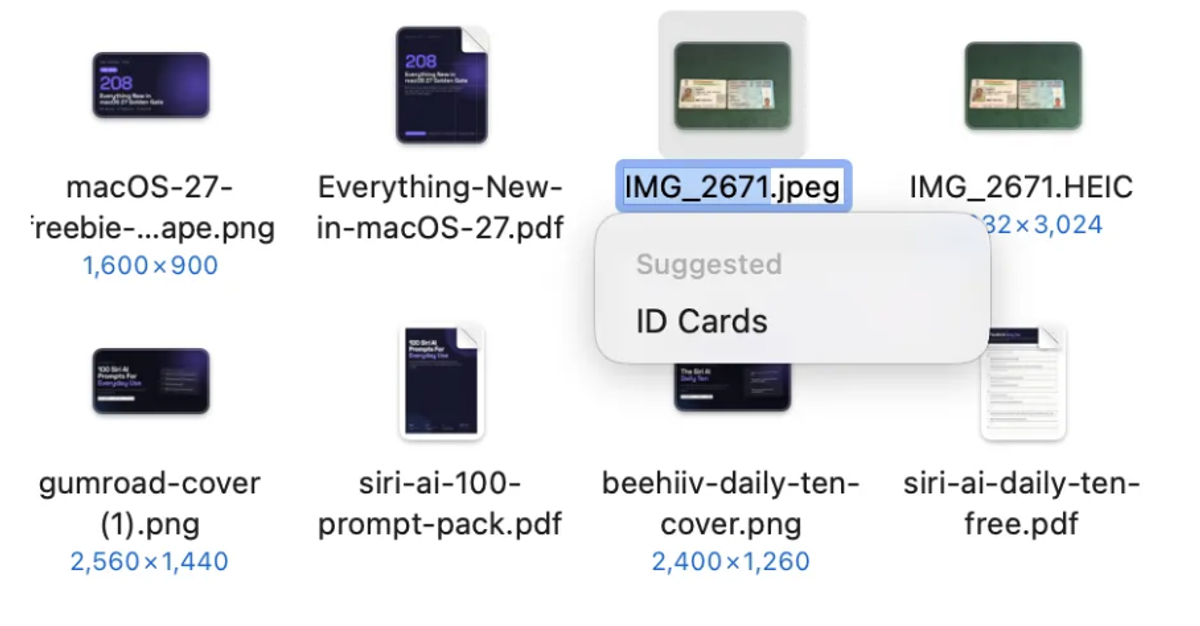
make sure Suggest file names is turned on in the General tab. Then click a file, click its
name to edit it, and pause for a second. A small Suggested box appears with one or more names based on the contents.
It works on documents, PDFs, screenshots, and images, and it also suggests names for
folders based on what they hold. Apple says suggestions appear when saving files, too. It
doesn’t handle videos yet.
This is the feature you’ll use most often without thinking about it. Screenshots and scanned PDFs are the best place to start, since their default names tell you nothing.
Sketches:
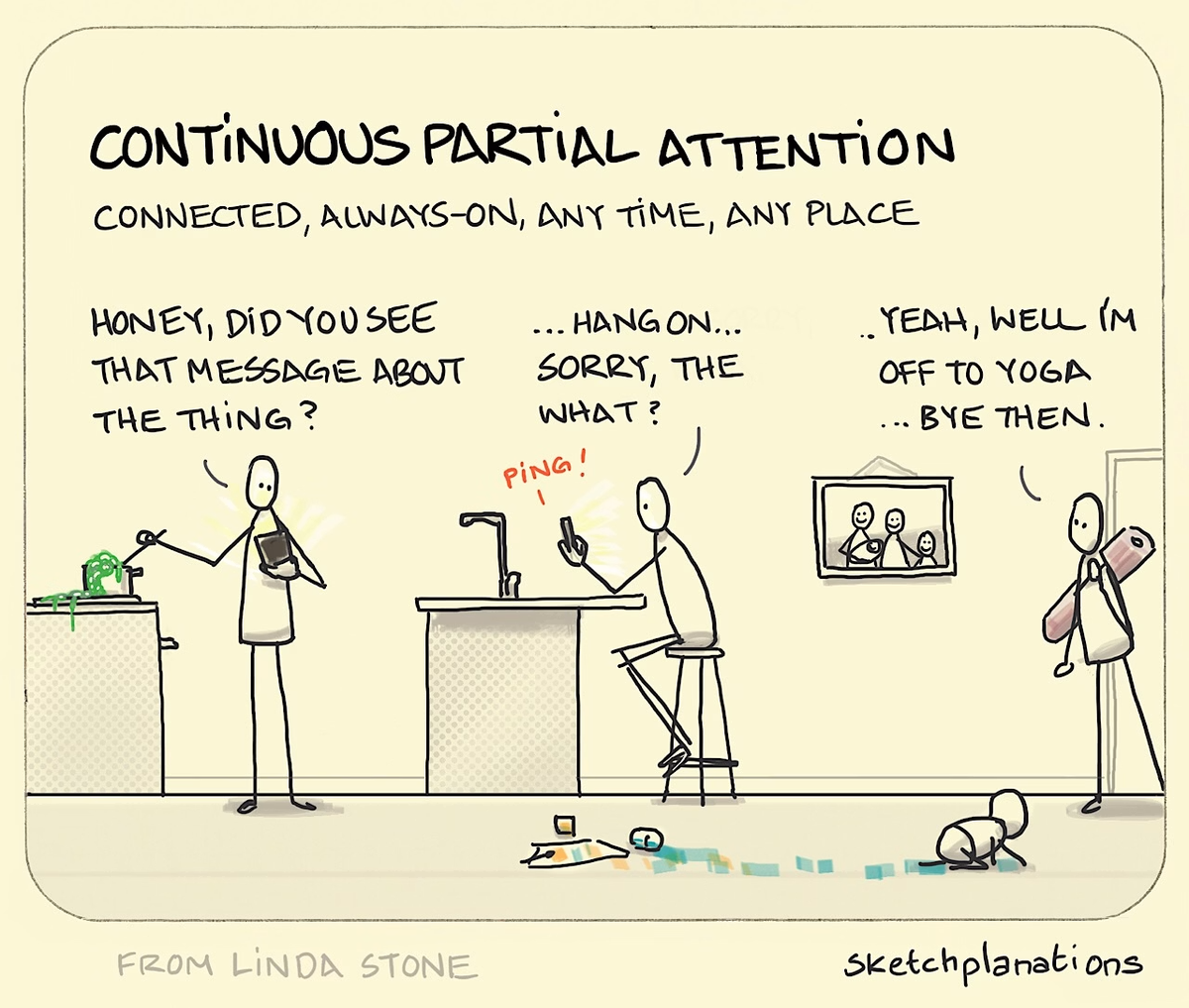
Continuous partial attention describes the state many of us find ourselves in as we try to stay connected to all the different areas of life that are now possible — as a result, we pay only partial attention to anything.
The accompanying stress or tension and, sometimes, decrease in relationship quality may contribute towards our increasing desire and awareness for the opposite: the wholly disconnected times of meditation, yoga, forest bathing, time in the outdoors (the 3-day effect), and other activities that allow us to give our full engaged attention for our wellbeing once more.
Continuous partial attention was coined by Linda Stone .
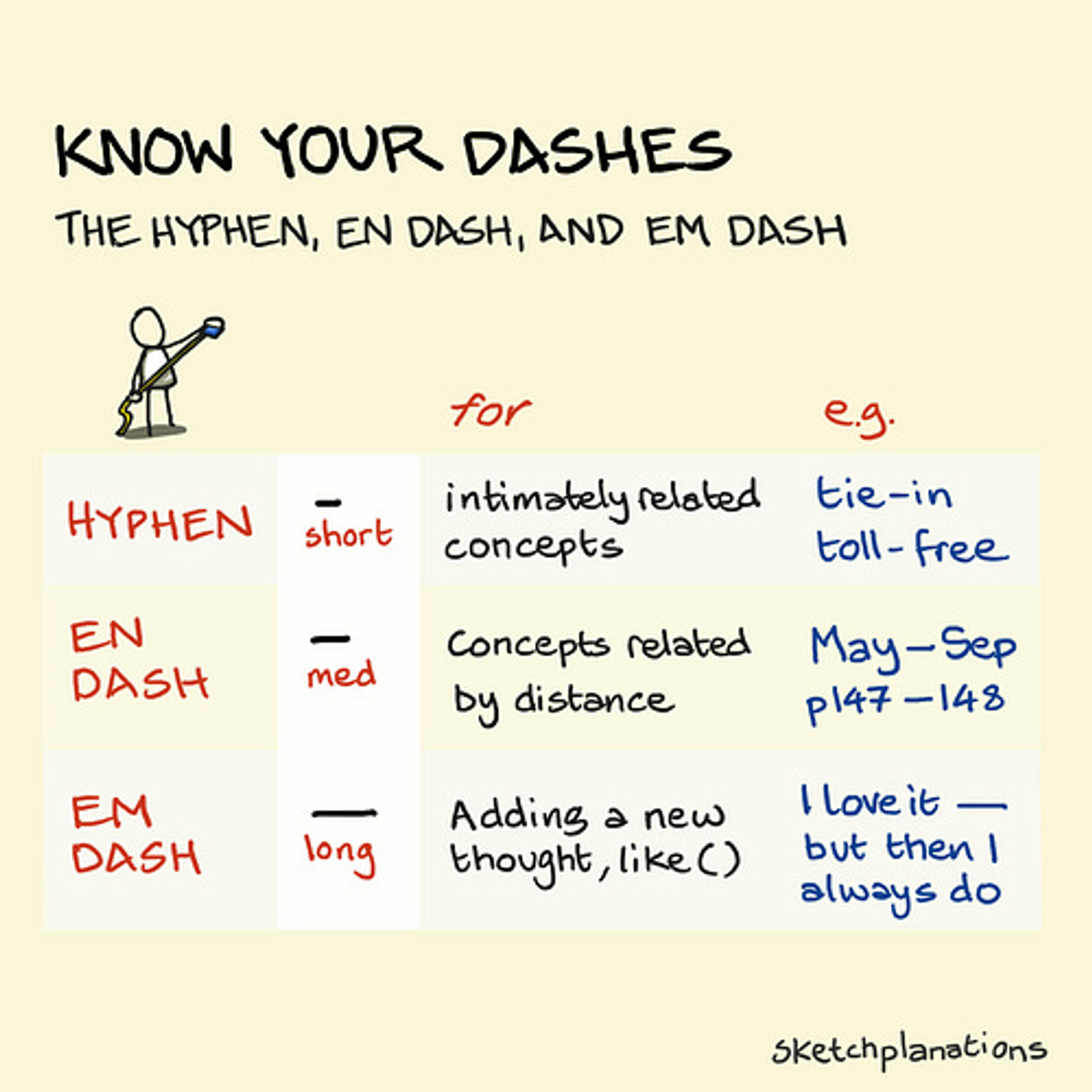
What is an em dash? And when should you use one? And how is that different from a hyphen? And what's an en dash? It's all here for you to know your dashes.
OK, so you can get a little over the top about these, but I do notice when a hyphen is used to add a thought in text rather than the em dash, which is better made for it—and it's much nicer than using brackets or parentheses ().
And—to go the full mile—why not use an en dash when you’re separating your page numbers 1–5, or months May–Sep, next time?
Didn’t spot the difference?
- hyphen · short
– en dash · medium
— em dash · long
I had a lot of fun talking about this in the podcast episode on Know Your Dashes: hyphen, en dash, em dash
How to Type En Dash and Em Dash on both Mac and Windows
Typing them on a Mac
En dash: Option + -
Em dash: Shift + Option + -
Typing them on a Windows PC
En dash: Alt + type 0150 on the number pad
Em dash: Alt + type 0151 on the number pad
Many writing programs will also turn two hyphens followed by a space into an em dash for you.
All sorts of grammar and writing advice in the excellent The Elements of Style by Strunk and White .
Article:
Scientists were unsure of how microplastics harmed the
body – until now
Scientists worry that microplastics may build up in the body, creating more reactive
chemicals than the immune system is prepared to handle.
For decades, scientists believed that plastics were some of the safest materials
around. Now it’s clear how flawed that view was.
Their long chemical chains, companies and researchers believed, wouldn’t react with food, water or – perhaps most importantly – the human body.
Now, a new study in the journal Nature shows just how flawed that assumption was.
The research from scientists at Columbia University shows that when water is exposed to
tiny microplastics, it releases highly reactive chemicals. These chemicals, known as
reactive oxygen species (ROS), are known to contribute to heart disease, cancer and
neurological diseases like Alzheimer’s.
“They can essentially react with nearby biological molecules such as proteins, DNA, lipids,
RNA – you name it – and damage them,” said Wei Min, professor of chemistry at Columbia
University and one of the authors of the study, which was published earlier this month.
“Because they’re high energy, they can, for example, bump into DNA and cause
mutations.”
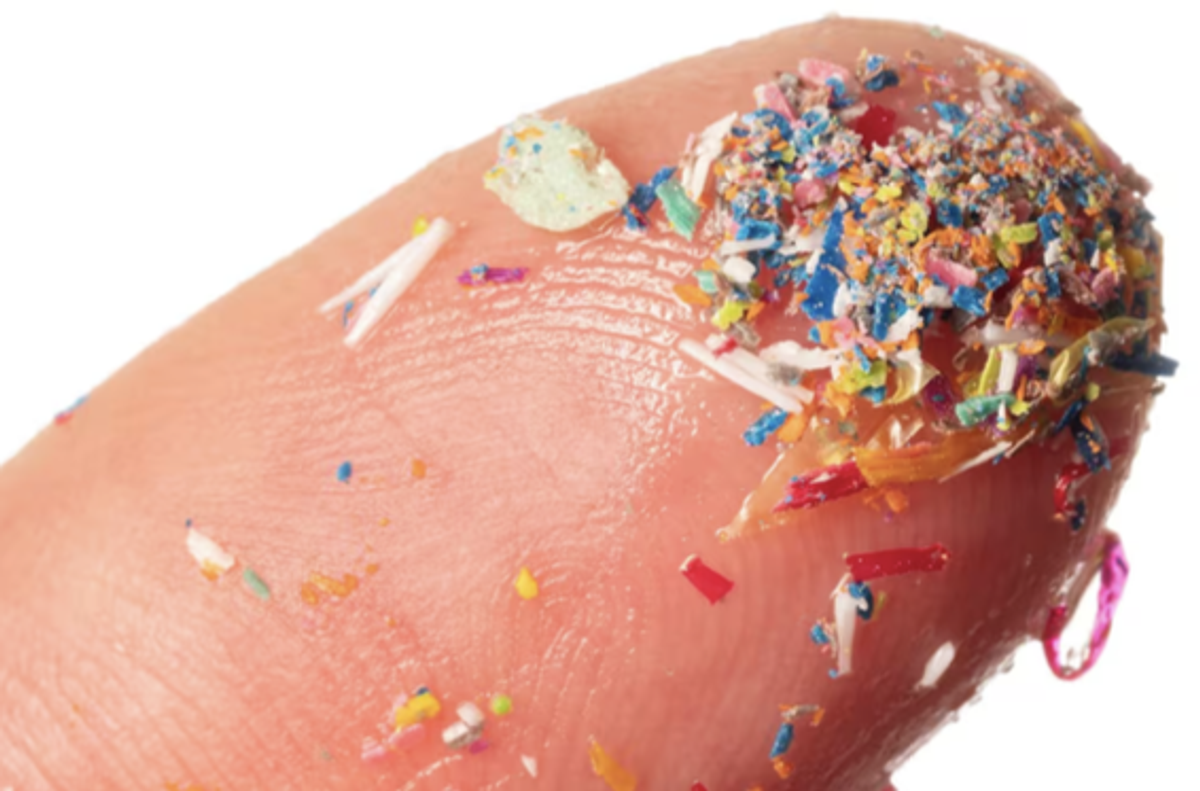
A range of studies over the past few years have found links between microplastic exposure and various health problems. In humans, research has shown that higher microplastic concentrations in a key artery are linked to heart disease. In experiments with mice, scientists have found that exposure to microplastics can lead to Alzheimer’s-like symptoms and atherosclerosis.
But what these experiments haven’t found is a clear mechanism of action, an explanation
for why microplastics could cause these harms. The new paper suggests that the
chemicals they release could be causing oxidative stress, where the production of
dangerous free radicals in the body overpowers natural defences. That, in turn, can
contribute to inflammation and other health problems.
In one experiment, the researchers took tiny particles of polystyrene – the plastic used in
Styrofoam cups and other take-out containers – and combined them with water and methyl orange, a type of dye that degrades when exposed to reactive oxygen species.
Over the course of 10 days, the methyl orange degraded to leave the water nearly clear –
eaten away by the high-energy chemicals. The scientists also examined other common
plastics, like polyethylene, used in cups and as a lining in take-out containers, and PET,
used for water bottles.
The human body, of course, is mostly water. Researchers also tested the effect of plastic
particles in blood serum and cell cultures, and found that the reactive oxygen species were still present.
Astrid Delorme, a lecturer at the University of Hawaii at Manoa and a scientist studying
plastics degradation, said that researchers have long thought that only older plastics,
weathered by the wind and sun, had chemical effects.
“Here, they’re showing that even pristine plastics, just in the context of water, are
chemically reactive,” said Delorme, who was not involved in the study. “It’s a huge finding.”
It’s all about the size of the tiny plastics, according to researchers. While large pieces of
plastic are unlikely to react with water, tiny microplastics have a larger surface area, which
provides more opportunity for them to form dangerous molecules. When a plastic credit
card breaks into microplastics, for example, its surface area increases by a thousand-fold,
Min said. That surface area is part of what allows water to split into reactive chemicals.
The human body does have some defence mechanisms to root out reactive oxygen
species. But scientists worry that microplastics may build up in the body, creating more
reactive chemicals than the immune system is prepared to handle.
“Plastics last for a long time,” Min said. “I think everybody will start to worry because this
will likely trigger chronic inflammation.”
Book Recommendation: