Year 3 Term 4 Newsletter







 Cheltenham East Primary School
Meet the teaching team
3A - Kate Burman (PLC Leader)
3B - Emma Cecil (alternate Mondays, Tuesday, Wednesday)
- Lauren Harris (alternate Mondays, Thursday, Friday)
3C - Bec Taylor
Welcome to Term 4
Welcome to Term 4! The students arrived back at school re-energised and ready to learn. We are looking forward to an exciting and productive last term. The highlight of this term is our Year 3 camp at Golden Valleys Adventure Camp. Students will be away from the classroom and will engage in hands-on learning adventures. There are so many benefits of going on camp, including developing skills such as teamwork, resilience and communication and providing the opportunities for the students to make positive connections with their peers and also the school.
Specialist Timetable
Specialists | 3A | 3B | 3C |
Music (Sue Digby) | Tues | Mon | Tues |
Art (Suzanne Reid) | Wed | Thurs | Wed |
Italian (Stella Mondy) | Wed | Thurs | Mon |
Science (Louise Slann) | Mon | Wed | Wed |
PE (Bec Robinson) | Fri | Wed | Fri |
Library | Tues | Tues | Tues |
Important Dates
28/10-29/10: Golden Valleys Adventure Camp
02/11: Curriculum Day (Student free day)
03/11: Melbourne Cup Public Holiday.
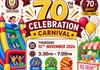
12/11: CEPS 70th Year Celebrations
16/11 - 20/11: Swimming Lessons, Mentone Grammar.
19/11: Special Food Day
3/12: Health Education
10/12: Health Education
14/12: Curriculum Day (Student free day)
17/12: Health Education
18/12: End of Term– 1.30 pm dismissal
Electronic Rolls
Our electronic rolls are legal documents therefore, we must be accountable for any absences. Please assist with this by informing the school by replying to the text message sent by Compass in the event of your child being away.
Teaching and Learning
English
Reading
Students use their growing knowledge of phonics (sound: letter relationships), morphology (how words are structured from meaningful elements), vocabulary (the meaning of words and the relationship with other words, e.g. synonyms and antonyms, word types (e.g. nouns, pronouns)) and grammar to read accurately and for meaning.
In our literacy sessions, students continue to revise phoneme (sound): grapheme(s) (letter(s)) correspondence to develop automaticity. In addition, they investigate how time is represented through tenses of verbs by adding a suffix to the base word, e.g. -ed. -ing, and using auxiliary verbs, e.g. I was hoping. When reading, students will become more proficient at recognising when changes have been made to the base word, e.g. identifying the base word in “hoping” as “hope” not “hop”. Students practise applying the above knowledge to segment and blend unfamiliar multi-syllabic words and will become more disciplined at reading all the morphemes/ syllables/ phonemes in a word to improve their reading accuracy.
In our reading comprehension sessions, students continue to read the class, The One and Only Ivan. At the start of each session, students participate in paired reading of the novel, practising reading aloud to develop phrasing and expression, and to improve their fluency. Students read for meaning by applying taught comprehension skills. Students work independently, provide a written response to a specific question, and work in small groups or as a whole class to discuss their understanding of the text, using evidence to support their answers.
Writing
At the start of this term, students completed their persuasive letter putting forward the case to end deforestation of Australian old-growth native forests. Then students apply the knowledge and skills they have developed in writing this persuasive text to write a series of short texts on specific topics, e.g. Everyone should learn to swim, with increasing independence. Next students will write a series of short stories (narratives) in response to picture prompts. Students will revise the text structure of a narrative and how to use “show don’t tell” to add detail and description to their writing. They will also explore how verbs can be used to tell the reader not only what the character is doing but also what they are thinking, feeling and saying, using vocabulary that provides a more precise description of these processes, e.g. using “whispered”, “yelled” or “mumbled” in place of “said”. At the end of the term, students will return to information reports and will plan, research, draft and publish a report on a celebration of their choice as part of our Humanities Unit.
As part of language conventions lessons, students will be supported in taking on more responsibility for rereading their own texts and revising and editing their work for meaning, grammar, spelling and punctuation. They will become more aware that their first draft is one step in the process of creating a final published text.
Speaking & Listening
Whole class, small group and paired discussions with their peers continue to be important for everyone’s learning and are used across the whole curriculum. In our reading comprehension sessions, students are placed into groups and are explicitly taught the expected behaviours of group work and the skills required to work collaboratively and productively with each other to achieve a shared goal. Throughout the term, students will have regular opportunities to present their work to the class, e.g. reading their short story to the class, and all students will present their presentation on a celebration of their choice to the class, as part of the final project for our Humanities Unit.
Mathematics
In the final term of Year 3, students will build on their knowledge and skills of the four operations: addition, subtraction, multiplication and division. They will solve practical problems involving financial contexts and develop their understanding of money. Students will also learn to read the time to the nearest minute on both analogue and digital clocks, and will benefit from plenty of opportunities to practise this skill at home. In our data representation unit, students will collect, organise and represent data using tables, lists and graphs. They will interpret data displays, identify patterns and use the information to answer questions and draw conclusions. Students will also investigate 2D shapes and 3D objects by identifying, classifying and comparing their key features, and explaining how these features relate to their uses.
Humanities
Our big question is: “What is the significance of celebrations and commemorations in Australia and around the world?” Students will explore the meaning and significance of celebrations and commemorations, identifying events that are recognised within families (e.g. birthdays and funerals), communities (e.g. end-of-Year 3 celebrations) and across Australia (e.g. ANZAC Day). Students will select a celebration or commemoration of personal interest and investigate its purpose and history, how it is celebrated or commemorated and the associated traditions and features, including clothing, food and other significant items (e.g. giving presents at Christmas). They will share their findings by presenting their project to the class. Throughout the semester, students will develop their inquiry, research and communication skills while making meaningful connections to people, places and cultures.
Wellbeing
CEPS VALUES
COURTESY RESPECT CO-OPERATION RESPONSIBILITY
This term, our CEPS value focus is Responsibility. Students will participate in Wellbeing sessions where they will explore and discuss ways to be responsible learners and develop greater independence. They will have opportunities to practise managing their time wisely, helping others, moving around the classroom and school sensibly, and taking care of their belongings.
Through our Respectful Relationships program, students will focus on positive coping strategies. They will explore and practise a range of strategies to help them manage their emotions, navigate challenges and respond positively to change. Students will develop an understanding of how positive coping strategies can support their wellbeing, build resilience and help them manage everyday situations with confidence.
We will continue to celebrate students who demonstrate our school values through weekly awards, presented at our fortnightly Friday afternoon assemblies. Students may also receive CEPS raffle tickets for demonstrating our school values, with winners drawn and announced at assembly.
Supporting learning from home
Reading
By now, students should have developed a habit of reading for ideally 15 minutes each day. This should be a time where there are no screens so both parents/ carers and children can focus fully on this activity. Your child should read both fiction and non-fiction books that are of interest to them, and as they become competent and confident readers, they should graduate to reading books with an increasing amount of text. To encourage reading, your child may also enjoy reading together with you so it is a shared experience; for example, you could read Charlie and the Chocolate Factory or Harry Potter as part of your nightly routine. This also provides an opportunity to support your child’s comprehension by discussing what you are reading to ensure they are reading for meaning and to clarify any unfamiliar vocabulary and concepts in the text. These reading sessions should be enjoyable, so aim to be enthusiastic, encouraging and patient.
Maths
At home, students should continue to practice recalling single-digit addition and subtraction facts to 20 until fluent and extend this knowledge to larger numbers, e.g. 8 + 4 = 12, 28 + 4 =32, 80 + 40 = 120. Similarly, students should practise recalling multiplication and division facts for 2’s, 3’s, 5’s and 10’s. It is expected that they have mastered these facts by the end of Year 3 so that they are able to dedicate greater mental effort to problem-solving. To achieve this, play the card and dice games on Google Classroom, as well as online games, such as those found on www.mathplaygound.com and www.coolmathgames.com. In addition, we are focusing on reading the time to the minute on digital and analogue clocks. Wherever possible, ask your child to tell the time using the correct language, e.g. if the time is 3:15, they could say three fifteen, quarter past three or fifteen minutes past three.
Activities continue to be assigned on Mathletics that complement the topics studied in class and can be completed as part of their homework.
Writing
Reading provides a foundation for good writing. Students who read regularly become familiar with how texts and sentences are structured and how language is used to engage the reader. In turn, students use this knowledge to improve their own writing. This includes using ideas and details from previously encountered texts, particularly from their favourite authors, in their own work. Reading is also strongly linked to vocabulary development, and it is always a delight to see students using new words they have discovered from the books they read in their own texts. New experiences for students also provide opportunities to build new vocabulary and can enrich students’ writing, e.g. going to a night walk or on a camping trip.
Homework
In Year 3, Homework is expected to be daily reading routines and completion of assigned Mathletics tasks.
Term 4 Additional Information
Communication
If you have any queries along the way, please feel free to contact us using our emails listed below, or you can send a Class Dojo. If any more urgent concerns arise, please organise a time to meet with your child’s teacher.
Kate Burman (catherine.burman@education.vic.gov.au)
Bec Taylor (rebecca.crawford2@education.vic.gov.au)
Emma Cecil (Emma.Cecil@education.vic.gov.au)
Lauren Harris (Lauren.Harris2@education.vic.gov.au)
If you need an important message to be passed on to your child, we ask that you communicate this via the office.
We use Compass to communicate School and Year 3 Information and Class Dojo to communicate the following: 1:1 communication between teachers and families.
On occasion, we will post photos to celebrate classroom learning.