Maths: Tips for Parents
Mrs Maria Wilson - Leader of Pedagogy




 St Joseph's Primary School Barraba
Maths: Tips for Parents
Mrs Maria Wilson - Leader of Pedagogy
Kindergarten - Multiplication: Weeks 1-3
Putting objects together in equal groups helps children to understand early multiplication. Encourage your child to move objects to create equal groups. There are lots of opportunities to make and show equal groups in everyday life. Think about events when sharing is needed and ask your child to help you create equal groups.
• Sharing equal amounts of food
• Baking biscuits or cupcakes where the mixture is shared equally
• Building 2 Lego towers the same height
• Giving equal amounts of time to play with a toy
• Organising your toys into equal groups.
• Sharing out cards for a card game
One of the best ways to explore equal groups is to make unequal groups and problem solve together how to make them equal.
Year 1/2 - Fractions: Weeks 1-2
Involve your child in sharing with another ensuring that each person has a fair share. Both halves need to be equal.
- Chance: Week 3
Talk about chance when playing games (e.g. It’s possible that I will roll a six but not certain).
Suggested by NESA:
using the language of chance such as certain, impossible, more likely, equally likely and less likely when describing everyday events. For example, I have an equally likely chance of tossing heads or tails on a coin flip or We are in the Summer season, so it is certain to be hot again tomorrow.
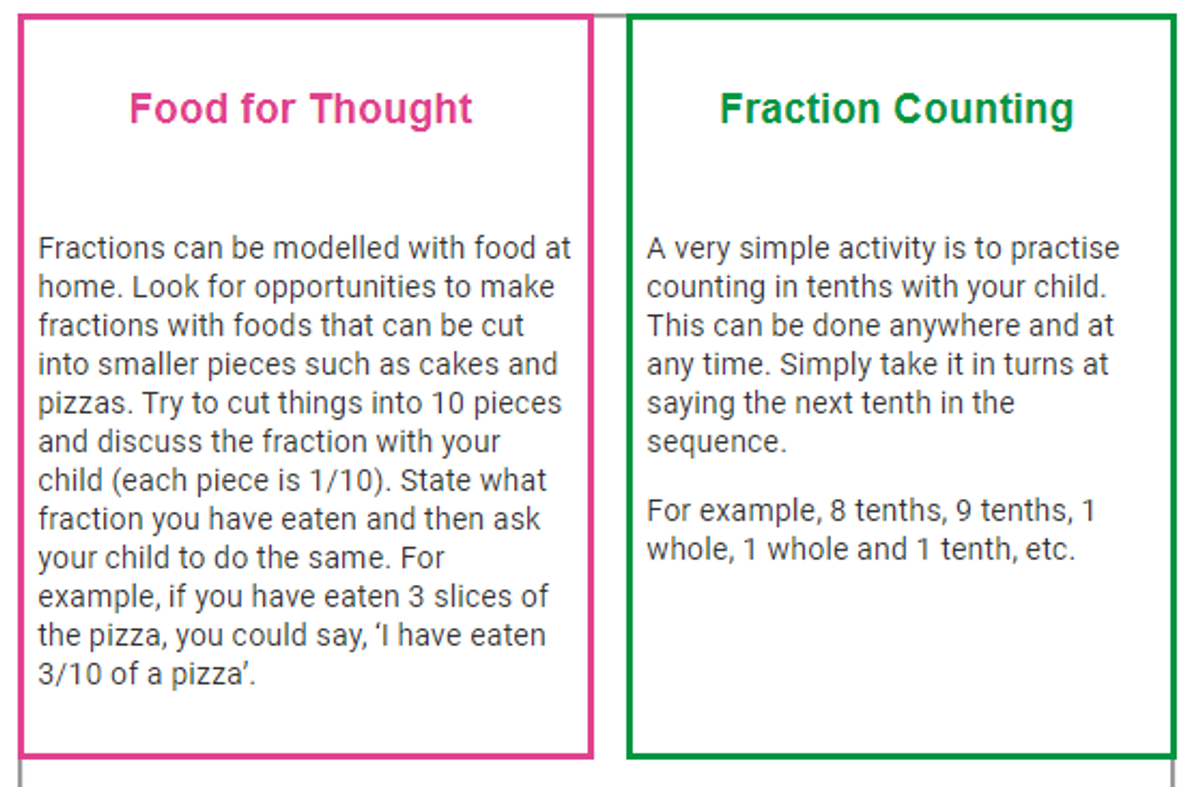
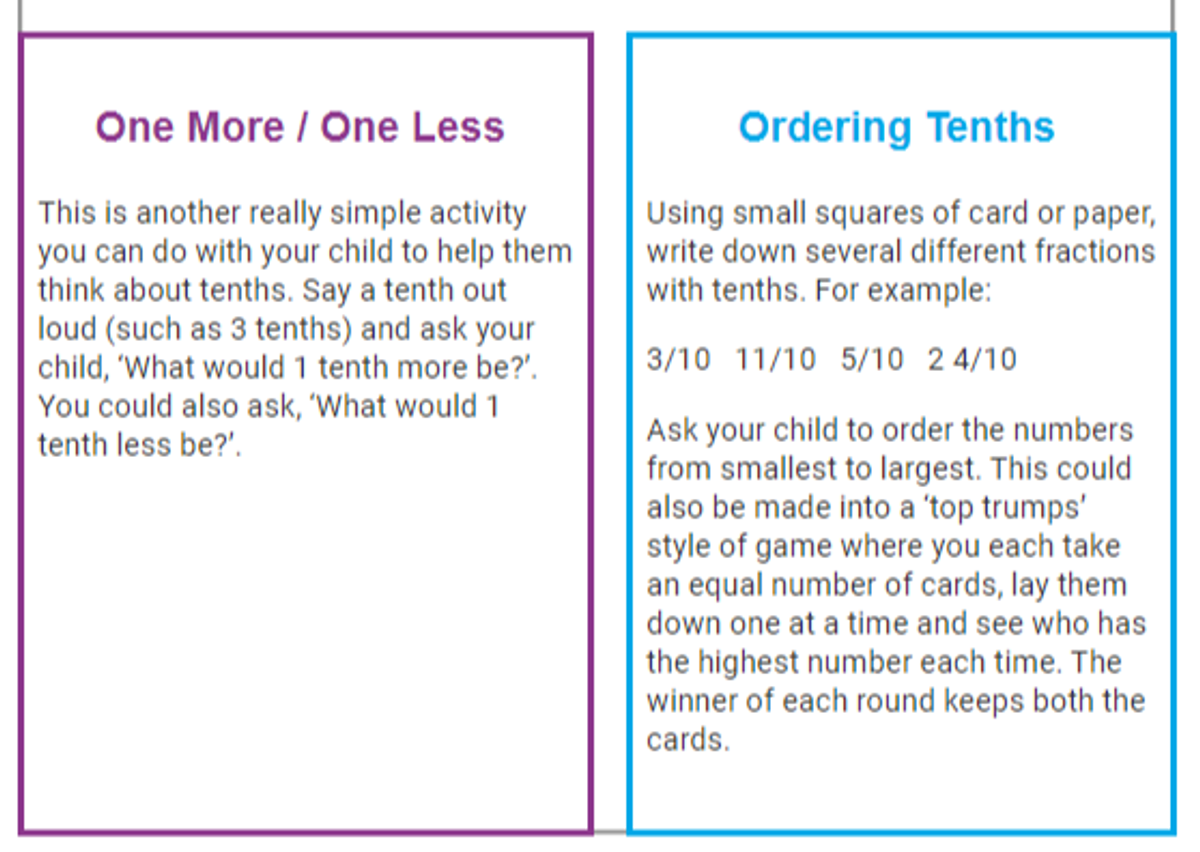
Year 3/4 - Decimals: Weeks 1-2
- Length: Weeks 3-4
Measure Objects Together: Encourage your child to measure objects at home, starting with larger items in metres and centimetres, then moving to smaller ones in millimetres. This helps them practice using different units.
Estimate and Check: Ask your child to estimate the length of objects before measuring them. This builds their estimation skills and reinforces the use of benchmarks.
Emphasise Precision: Discuss why precise measurements matter, especially for small objects. Practice measuring small items in millimetres and recording them accurately using the correct abbreviations.
Measure Everyday Objects: Involve your child in measuring tasks at home, like checking the length of a table or a room. Encourage them to choose the right tool (ruler, tape measure) and unit (metres, centimetres) and record the measurements.
Estimate Before Measuring: Before measuring, ask your child to estimate the length or perimeter of an object. Then, measure together and compare the estimate with the actual measurement. Convert units (e.g., cm to mm) and use decimal notation.
Explore Perimeter: Measure the perimeter of objects like a garden bed or a piece of furniture. Discuss how to add up the sides and ensure they use the correct units and decimal places when recording.
Year 5/6 - 2D Shapes: Weeks 1-2
Point to various objects in and around the home and ask your child to tell you what shapes make up that object and, more importantly, how they know that it is that shape.
For example, if you have stairs in your house, you can ask your child, "what shapes make up the stairs?" Hopefully they will be able to identify rectangles. Ask them how they know that the shape is a rectangle and support them to identify that it has four sides with two sets of equal length. If you want to extend their understanding at this point, you can ask them what other shapes have four sides and then get them to recognise what makes these shapes different to a rectangle. For example, they may recognise that a square also has four sides or a parallelogram.
Picture books are another great source of shapes for children to identify. During your regular reading sessions, build in conversation around the shapes used in the pictures encouraging the use of the more technical language of sides and angles and number.
Hands-On Exploration: Provide materials for your child to physically manipulate shapes, encouraging them to cut, translate, reflect, and rotate to create new configurations.
Real-Life Examples: Relate transformations to daily life, like moving objects on a table (translation), seeing reflections in a mirror (reflection), or observing clock hands (rotation).
- Area: Weeks 3-4
Real-World Examples: Point out large areas like parks or farms to your child, explaining that these are measured in hectares or square kilometres because they are much larger than a house or room.
Visualise a Hectare: Help your child visualise a hectare by explaining that it's the size of a square with 100-meter sides, equating to 10 000 square metres. Compare this to familiar spaces like sports fields.
Practice with Rectangles: Have your child measure and calculate the area of rectangles at home, using different units (cm², m²). Discuss how rectangles with the same area can have different dimensions and compare rectangles with the same perimeter to see how their areas differ.
Visualise with Paper Cutouts: Encourage your child to cut out triangles and duplicate them. Have them rotate the duplicates to form parallelograms. This hands-on activity helps them see how two triangles with the same base and height form a parallelogram.
Discuss Observations: Ask your child to describe what they notice about the relationship between the triangles and parallelograms. Discuss how the area of one triangle is half of the parallelogram's area, reinforcing the concept without focusing on calculations.
Use Everyday Examples: Relate the shapes to everyday objects, like cutting a sandwich (triangle) and arranging pieces to form different shapes. This makes the learning process relatable and easier to understand.