Learning Specialist
Be Kind
Be Responsible
Be an Active Learner






 South Melbourne Park Primary School
Learning Specialist
Be Kind
Be Responsible
Be an Active Learner
Throughout 2026, South Melbourne Park Primary School has been exploring how we can use the Instructional Hierarchy to structure our planning and teaching of Mathematics.
The Instructional Hierarchy provides a framework to understand how learners go from the Acquisition stage, where they are building their accuracy and ability to perform a new skill, to Fluency, where they are becoming automatic. Once learners are fluent, we move them to the Generalisation stage, where they can build flexibility in new settings, and then to the Adaptation stage where they are able to problem solve and demonstrate mastery of their skill across a range of areas.
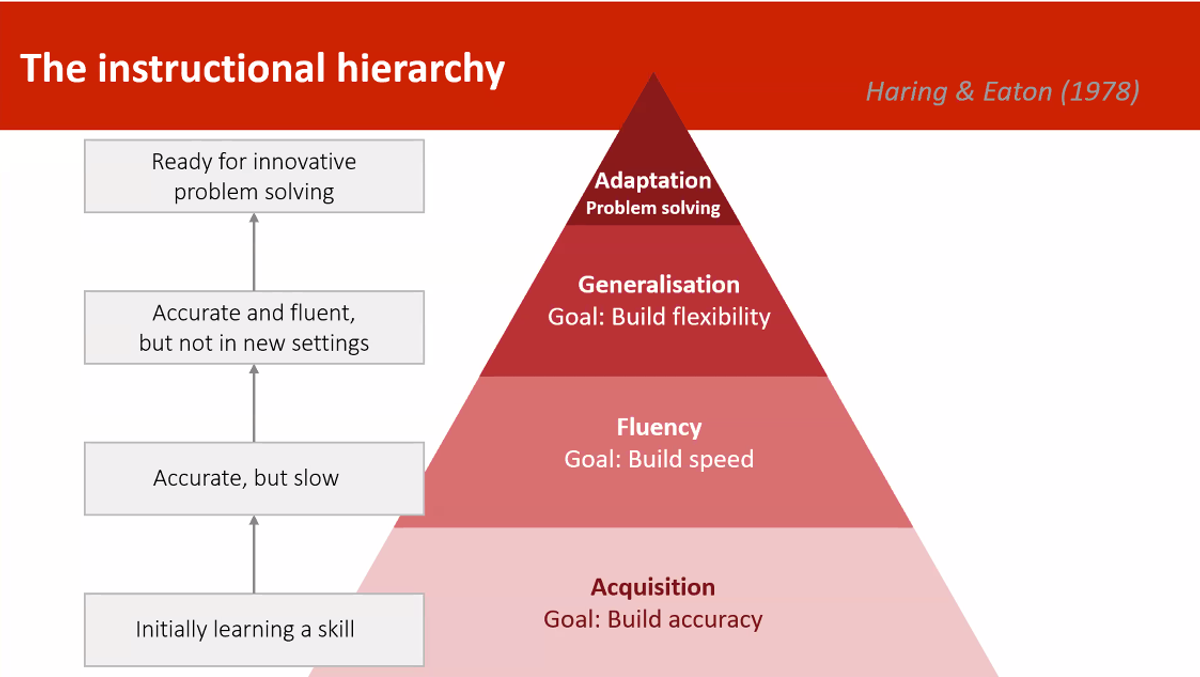
At SMPPS, we want to ensure all students are challenged and have the opportunity to demonstrate mastery. By explicitly teaching new content, knowledge and skills, developing fluency and extending students further through generalisation and adaptation, we can provide deep cognitive engagement and opportunities for problem-solving.
This term, we explored what the Instructional Hierarchy would look like beyond Mathematics, including in the Specialist domains. For example, in an Art unit on perspective, teachers would begin instruction on how to draw using 2 point perspective. Starting simple to build accuracy and fluency with quick drawings, students would practice creating buildings that follow the rule. When ready, students would be tasked to incorporate new elements and create more complex drawings, involving windows, doors and multiple buildings. Finally as they move to the adaptation stage, students combine 2 point perspectives, with other art elements such as contrasting colours and drawing people to create a final piece of art. Students would continue to demonstrate mastery, by using the skills and knowledge they built from 2 point perspective in other areas of art.
Another example of challenging students would be in Spanish, as students learn location and direction preposition vocabulary. Students build their knowledge and fluency in stand alone activities, before practicing this vocabulary with previous learnt vocabulary, and then applying it when directing students around the classroom. In PE, students learn the skills of a sport in stand alone drills. Once fluent, they reach the Generalisation stage, where they might play simplified or modified games, before progressing to the Adaptation Stage, where they are able to apply their skills in a real game, and then use their knowledge to assist them in similar games.
Across SMPPS, there are strong examples of teachers thinking carefully about the Instructional Hierarchy as they plan challenging and engaging units of work. Teachers set themselves a Term 4 goal, identifying their next step in using the framework and will continue to deepen their own learning, as they develop, plan and teach units of work with the aim of creating a strong foundation of knowledge and skills that challenge students and provide opportunities to demonstrate mastery.
Melanie Davis