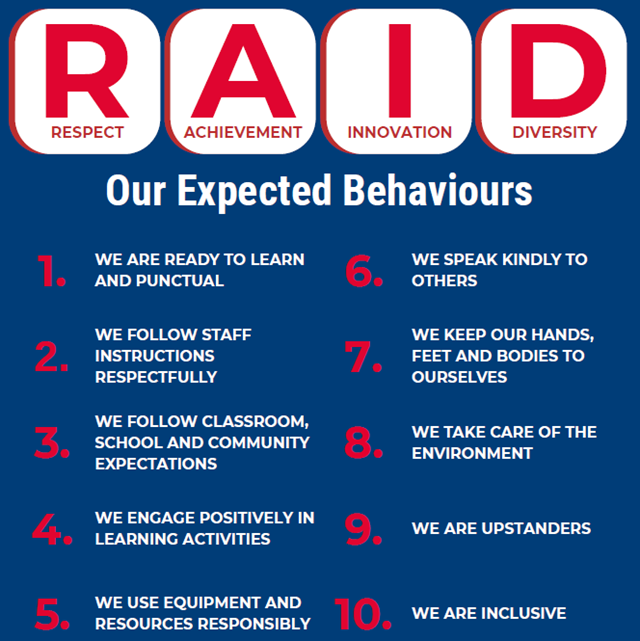
School Wide Positive Behaviour System




















We have recently completed our Annual SWPBS Evaluation Report and wanted to share with our school community our Executive Summary.
“The implementation of School-Wide Positive Behaviour Support (SWPBS) at the College reflects a sustained commitment to establishing a proactive, consistent and evidence-informed approach to student wellbeing, social-emotional learning and behaviour. The framework has supported a shift towards explicitly teaching behavioural expectations, reinforcing positive choices and creating learning environments in which all students can engage successfully. This work has been underpinned by staff professional learning, collaborative planning and the integration of SWPBS principles into everyday College practices. Staff training has included the introduction and embedding of SWPBS alongside the Enabling Learning framework, as well as whole-staff professional learning in Positive Classroom Management Strategies (PCMS). This has strengthened staff understanding of proactive classroom management, consistent behavioural expectations and the importance of establishing orderly, predictable learning environments.
To support consistent implementation, the College has reviewed and clarified expected behaviours across the school and established consistent classroom entry routines. A student-informed Merit and Rewards system was introduced to recognise and reinforce positive behaviour, with student voice contributing to the development of approaches that are meaningful and relevant to the College community. The establishment of regular SWPBS team meetings, supported by standing agenda items and systematic analysis of behavioural data, has strengthened the College's capacity to monitor implementation, identify emerging trends and determine priorities for improvement. Communication has also been strengthened through the introduction of a dedicated SWPBS section in the College newsletter, providing regular updates to parents and the broader community about initiatives, progress and improvements. In addition, Compass Chronicle and Pulse have been realigned to better support staff in recording, monitoring and responding to student behaviour in accordance with the SWPBS framework.
The effectiveness of implementation is monitored through established fidelity measures, including the Tiered Fidelity Inventory (TFI) and the School-Wide Evaluation Tool (SET). These measures provide evidence of the extent to which the College is implementing the core features of SWPBS consistently and as intended, with a fidelity threshold of 70% or higher providing an important benchmark. The College has achieved a 13 percentage-point increase in its Tier 1 TFI score, rising from 80% in 2024 to 93% in 2026. This result demonstrates substantial progress in embedding universal SWPBS practices and strengthening the consistency of implementation across the College. The improvement also provides an evidence base for continued refinement of practice, ensuring that decisions regarding student behaviour and wellbeing are informed by both implementation data and observed outcomes.
Behavioural data indicates encouraging improvements in student behaviour and the effectiveness of the College's proactive approach. Year to date, the number of students receiving six or more MAJOR behaviour referrals has a 26% reduction. This trend suggests that the consistent reinforcement of behavioural expectations, recognition of positive choices and explicit teaching of expected behaviours are contributing to improved student behaviour. While continued monitoring is necessary to establish the sustainability of these improvements, the data provides a valuable measure of progress and reinforces the importance of maintaining consistent, school-wide practices.
Student voice and perceptions of school climate also provide important evidence of progress. Attitudes to School Survey (AToSS) results show a 1.8 percentage-point improvement in positive endorsement of Managing Bullying across Years 7–12, alongside a 1.9 percentage-point improvement in School Connectedness over the same period. These improvements are encouraging indicators of progress towards creating a safer, more inclusive and connected school environment. Consideration of these results alongside Compass Pulse checks, student feedback and parent and community perspectives enables the College to evaluate the impact of its practices from multiple viewpoints. This triangulation of evidence supports a continuous improvement approach in which student experiences, staff observations and behavioural data inform the refinement of strategies and the identification of emerging needs.
Looking ahead, the College's strategic priority is to consolidate the progress achieved and continue developing the capacity of SWPBS to support students with increasingly complex behavioural and wellbeing needs. The College is working towards achieving the SWPBS Silver Award in 2026, with the longer-term goal of achieving Gold Award recognition in 2027. To support this progression, the College has established dedicated Tier 2 and Tier 3 SWPBS teams alongside its Universal SWPBS Team. This tiered structure strengthens the capacity to provide targeted and individualised interventions for students requiring additional support, while maintaining consistent universal practices for the whole school. The next phase of implementation will focus on strengthening intervention planning, monitoring student outcomes, building staff capability and maintaining fidelity to the framework. Through this ongoing commitment, the College aims to embed SWPBS as a sustainable, whole-school approach that promotes positive behaviour, strengthens relationships and maximises opportunities for every student to achieve success.”
We also look forward to our whole school SWPBS Assembly on Friday 20th November, where we will come together to celebrate and recognise the achievements of our students and acknowledge those who demonstrate our RAID values.