Parent Corner













 Boroondara Park Primary School

Parent Corner: How Do We Assess Mathematics?
Understanding your child's progress in Mathematics
At Boroondara Park Primary School, we know that learning Mathematics is about more than finding the correct answer. It involves understanding numbers, recognising patterns, solving problems, explaining thinking and applying skills to everyday situations.
Three Ways We Check Mathematics Progress
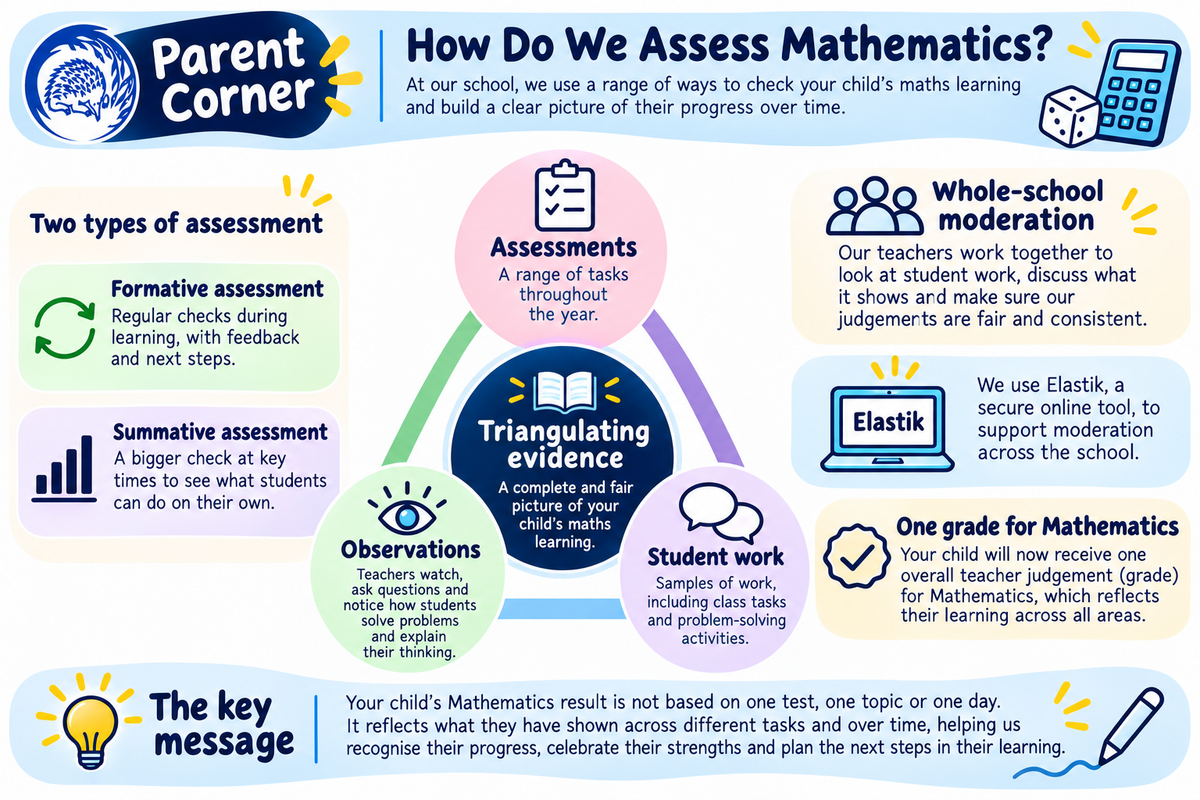
1. Mathematics assessments
Students complete a range of assessment tasks throughout the year. These help teachers understand what students already know, which skills they can use independently and what they need to learn next.
2. Teacher observations and conversations
During Mathematics lessons, teachers observe how students solve problems, explain their thinking and choose different strategies. These conversations help teachers understand how students reached an answer, rather than simply whether the answer was correct.
3. Student work samples
Teachers review work completed throughout the year, including number activities, problem-solving tasks and practical investigations. These samples show how students apply their mathematical knowledge in different situations.
Two Types of Assessment
Teachers use both formative and summative assessment to support student learning.
- Formative assessment – checking learning along the way: Regular classroom checks, questions, observations and feedback help teachers adjust their teaching and identify next steps.
- Summative assessment – checking what has been learnt: Assessment tasks completed at key points throughout the year help teachers understand what students have learnt and can do independently.
Both types of assessment are important in building a complete picture of student achievement.
Why Do We Assess Throughout the Year?
In line with the Victorian Teaching and Learning Model 2.0, students are given regular opportunities to revisit learning, practise skills in different ways and apply their knowledge to new problems.
By allowing time between learning and assessment, teachers can better understand whether students have remembered their learning and can use it independently.
Teachers also aim to provide fair, consistent and supportive assessment conditions so that students can demonstrate their knowledge and skills.
How Do Teachers Make Fair and Consistent Decisions?
Teachers work together to review assessment results and student work. This process is called moderation.
By discussing student achievement and comparing work samples against the Victorian Curriculum, teachers develop a shared understanding of what students are expected to know and do at each year level.
This helps ensure that reporting decisions are fair and consistent across the school.
An Important Change to Mathematics Reporting
Under the Victorian Curriculum 2.0, families will see one overall teacher judgement (grade) for Mathematics on their child's school report, rather than separate grades for different areas of Mathematics.
This overall judgement considers learning across all six areas:
- Number
- Algebra
- Measurement
- Space
- Statistics
- Probability
Although families will receive one overall Mathematics grade, teachers will continue to teach, assess and monitor progress across all areas of Mathematics, as outlined for each year level.
The overall grade is an informed teacher judgement based on a range of assessment information, rather than simply an average of test scores.
The key message for families: Your child's Mathematics result is not based on one test, one topic or one day. It reflects the knowledge, skills and understanding they have demonstrated across different areas of Mathematics and over time.
Our goal is to celebrate each child's growth and help every student become a confident, capable and independent mathematical thinker.
.