
Term 4 Learning Summary
English: InitiaLit
Reading, Viewing, Listening and Speaking
In Term Four, Year One students will continue to develop their literacy skills through the second semester of InitiaLit. Each week, they will engage in lessons that will introduce new trigraphs, graphemes that represent different sounds, prefixes and multisyllable words.
Students will also explore a range of text types through two Storybook lessons each week. These texts will include imaginative texts, poems and letters. Through these lessons, students will develop key reading comprehension skills, including questioning, predicting, exploring new vocabulary and summarising texts.
Key Vocabulary:
- multisyllable words
- trigraphs
- base words and prefixes
How can you support your child at home?
- Listen to your child read their reader each day and encourage them to record their reading in their Reading Diary.
- Encourage your child to read their reader, or another familiar text, more than once. During the first reading, encourage them to focus on decoding unfamiliar words and exploring their meaning. During a second reading, encourage them to focus on understanding the text and making connections to their own experiences.
- Pause at the front cover and at different points throughout a book or movie and encourage your child to predict what might happen next. After reading or viewing, talk about whether their predictions were confirmed and what clues helped them make their prediction.
Writing
In Term Four, students will continue to strengthen their understanding of Super Sentences and develop greater independence when writing. Students will focus on correct book expectations, including starting at the margin, writing from top to bottom and across the page, avoiding skipped pages, and beginning to write neatly within dotted thirds. They will also continue to consolidate their use of capital letters and full stops and develop early editing skills by rereading and improving their writing.
During the term, students will explore a range of poetry, including rhyming poems, couplets, acrostic poems and colour poems. They will experiment with descriptive language and word choice to make their poems interesting and engaging. Students will also explore letter writing, learning about the purpose and structure of a letter and including features such as a greeting, a clear message, questions or information for the reader, and an appropriate ending.
Key Vocabulary:
- capital letter
- full stop
- editing
- rhyme
- couplet
- acrostic
- letter
- greeting
How can you support your child at home?
- Encourage your child to reread a sentence they have written and check that it begins with a capital letter, ends with a full stop and makes sense.
- Read simple poems together and identify rhyming words or interesting descriptive words.
- Encourage your child to write a short letter to a family member or friend, including a greeting, a message and an appropriate ending.
Mathematics
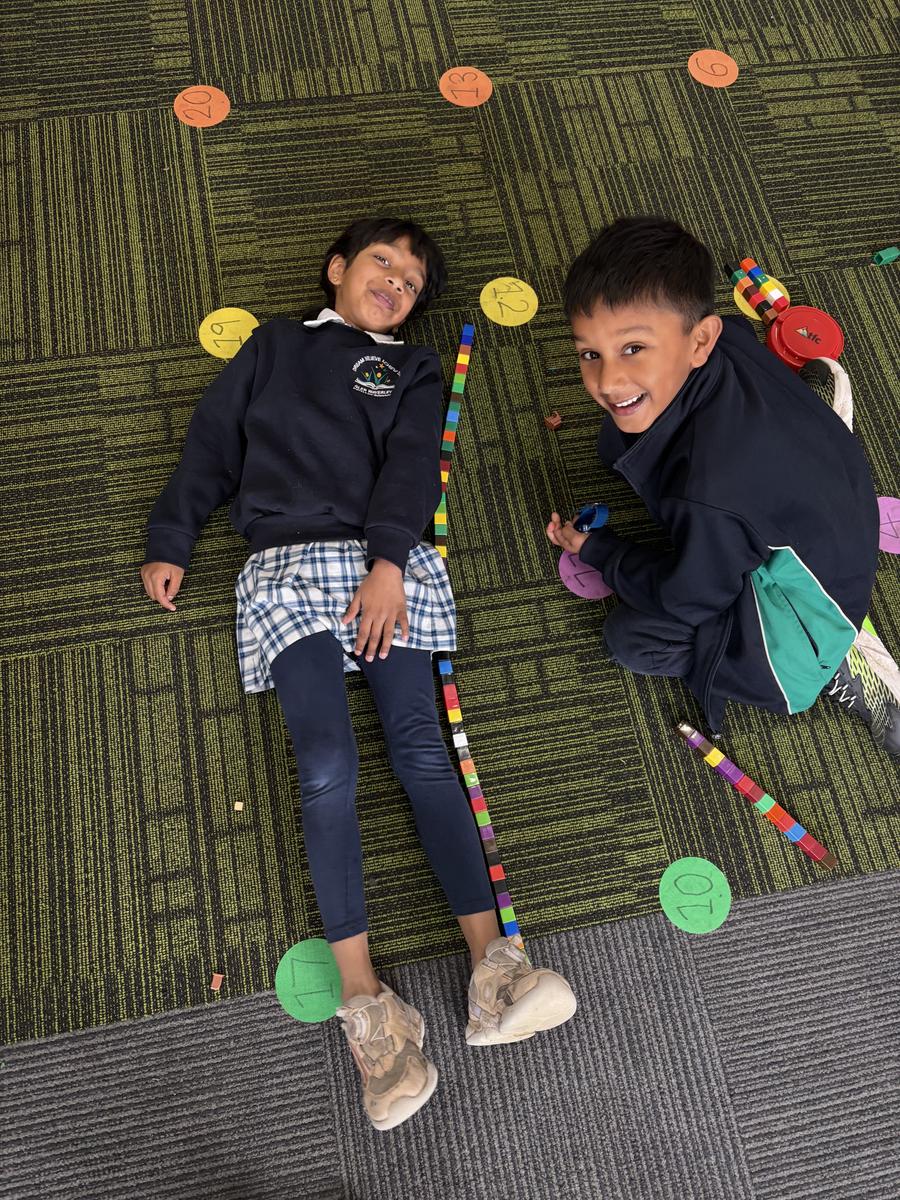
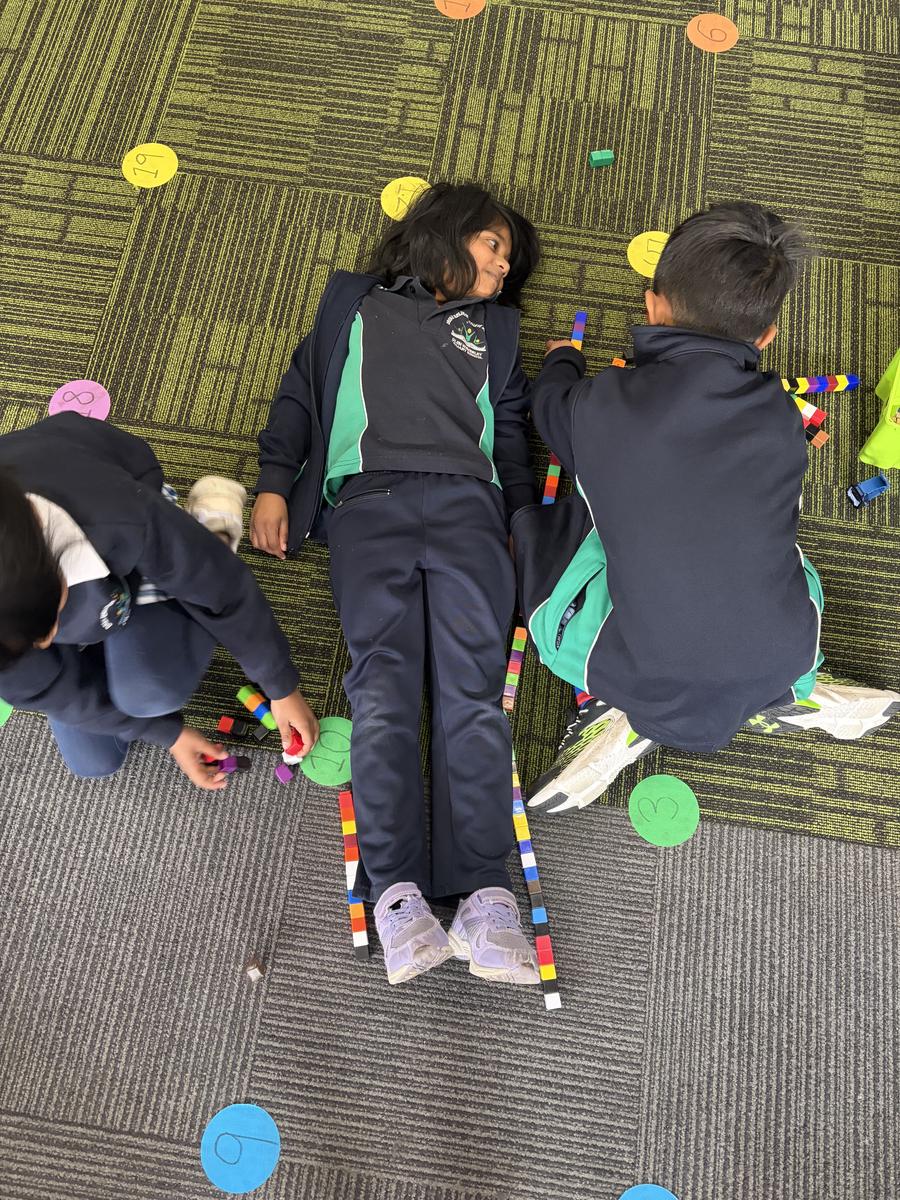
In Term Four, Year One students will investigate a variety of mathematical concepts through hands-on experiences, discussions and practical problem-solving activities. The focus areas will include Data, Location, Shape, Measurement (Time), and Addition and Subtraction, supporting students to build strong foundational skills in number, space and measurement.
In Data, students will explore strategies for collecting data by developing suitable survey questions and making observations. They will analyse the data they collect and use it to form statements.
In Location, students will give and follow instructions using positional language in real-life situations.
In Shape, students will investigate the features of two- and three-dimensional shapes and identify examples of these shapes in their environment.
In Measurement (Time), students will develop their skills in telling time using analogue clocks and explore the number of days and weeks in a year.
In Addition and Subtraction, students will deepen their understanding of equations and use number lines to solve addition and subtraction problems. They will also develop their understanding of partitioning two-digit numbers to support their calculation strategies.
Key Vocabulary:
- days
- weeks
- corner
- vertices
- surface
- face
- edge
- side
- forwards
- backwards
- left
- right
- data
- analogue
- digital
- addition
- subtraction
- number line
How can you support your child’s Mathematics learning at home?
- Identify two- and three-dimensional shapes and objects around your home. Talk about the features you notice, such as sides, faces, edges and vertices.
- Create an obstacle course at home and encourage your child to use positional language to guide a family member through it. You could use words such as forwards, backwards, left and right.
- Practise telling the time using an analogue clock. Talk about the time shown and connect it to familiar daily activities, such as getting ready for school, mealtimes or bedtime.
Inquiry
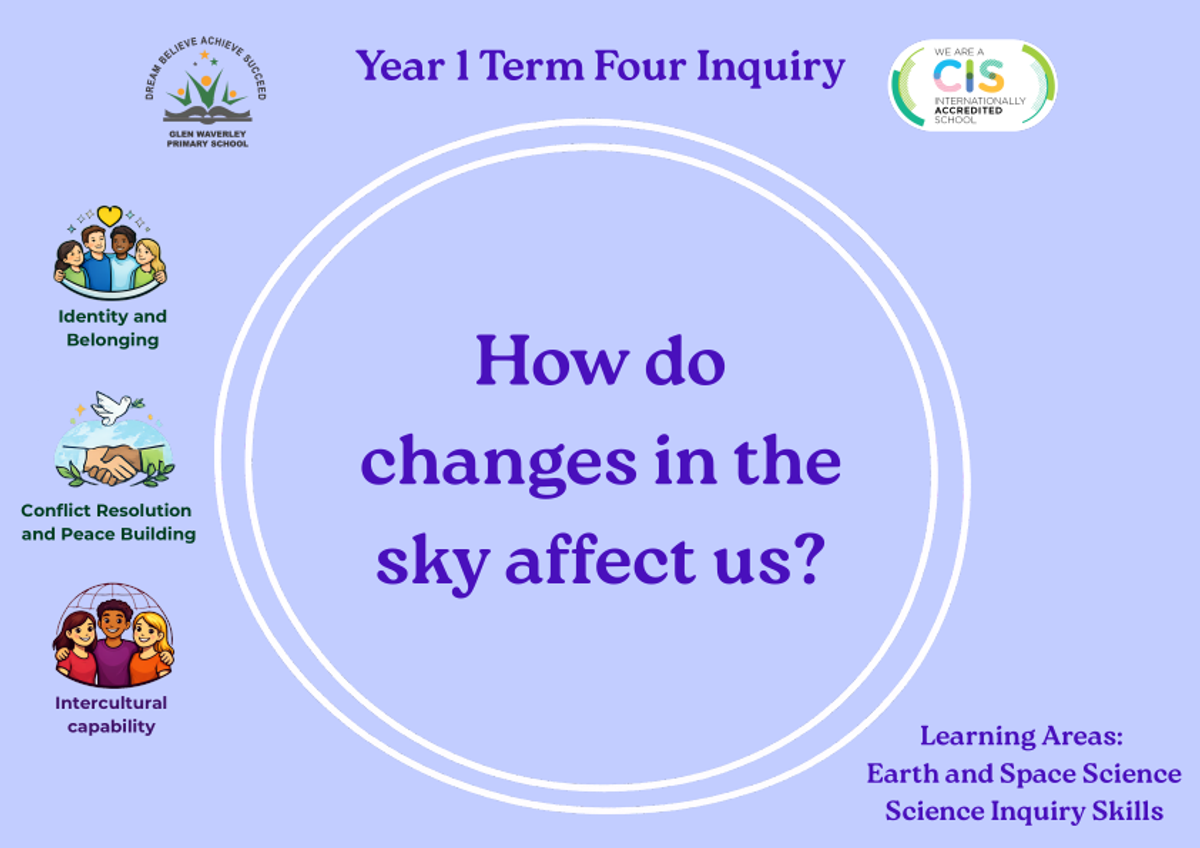
In Term Four, Year One students will explore the inquiry question, “How do changes in the sky affect us?” They will observe the Sun, Moon, stars and weather patterns, identifying different celestial objects and describing patterns they notice in the day and night sky.
Students will investigate the role of the Sun and observe changes in the Moon’s appearance. They will examine and describe how daily and seasonal changes influence our everyday lives, routines and environment, including how plants, animals and people adapt to these changes. Students will keep sky journals to track seasonal changes, make observations and develop predictions about the weather. They will also explore cultural perspectives, including how First Nations Australians use astronomy to understand the sky and how different cultures celebrate and respond to seasonal changes.
Key Vocabulary:
- Sun
- Moon
- celestial objects
- sky
- stars
- patterns
- season
- weather
- clouds
How can you support your child’s Inquiry learning at home?
- Spend time outside with your child observing the sky. Look at the clouds, Moon, stars or sunset together and talk about what you notice.
- Share stories, traditions or festivals from your culture (or other cultures you know about) that are connected to the Sun, Moon, stars or seasons.
- Talk about how seasonal changes affect your daily life. For example, discuss the clothes you wear, the food you eat or the outdoor activities you enjoy at different times of the year.
Wellbeing
In Term Four, students will continue to develop their social and emotional skills through The Resilience Project, with a focus on recognising and expressing emotions, gratitude, empathy and mindfulness. They will explore strategies such as belly breathing to help regulate their emotions and will begin using a Habit Tracker to reflect on positive habits and wellbeing routines. Towards the end of the term, students will reflect on their Year One journey and prepare for the transition to Year Two by revisiting routines and expectations and discussing strategies they can use to manage new experiences and challenges.
Students will also continue their learning through the Cyber Safety Project, developing their understanding of how to make safe, healthy and responsible choices when using digital technologies. They will explore how online experiences can make them feel, the importance of maintaining a healthy digital balance, and the difference between creating and viewing online content.
Key Vocabulary:
- emotions
- Gratitude
- Empathy
- Mindfulness
- resilience
- habits
- Cyber Safety
- transition
How can you support your child’s Wellbeing learning at home?
- Encourage your child to identify and talk about how they are feeling and what may have caused that emotion.
- Practise simple calming strategies together, such as belly breathing, when your child is feeling worried, frustrated or overwhelmed.
- Talk positively about the transition to Year Two and encourage your child to share what they are excited about or wondering about.
- Discuss healthy and safe choices when using digital devices at home, including ways to maintain a healthy balance between screen time and other activities.
Our families also have access to:
- The Resilience Project: TRP@HOME – resources to support families to continue conversations and activities around Gratitude, Empathy and Mindfulness at home.
- Cyber Safety Project: Home Resources – resources to support safe and respectful technology use at home.