Term 4 Learning Summary
English
Throughout Term Four, students will continue to engage with a rich range of narrative and persuasive texts through Ochre Education’s English resources.
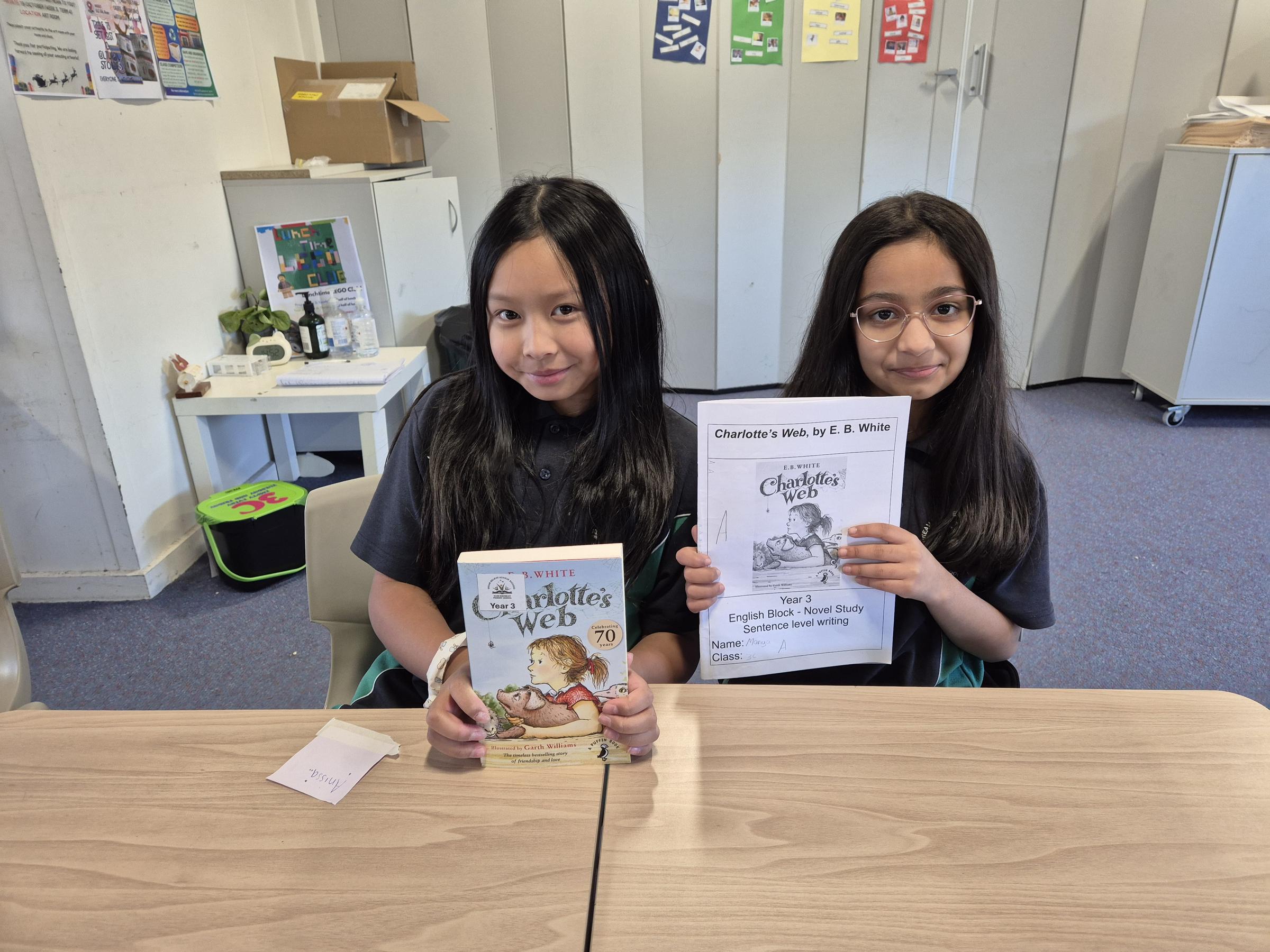
In Reading, students will explore the novel Charlotte’s Web with a focus on narrative features and developing their comprehension skills. They will identify key ideas, analyse text structures, and make meaningful connections between characters, settings and events to deepen their understanding of imaginative texts. Students will explore how authors develop characters, create engaging settings and use language to build mood, convey emotions and communicate ideas.
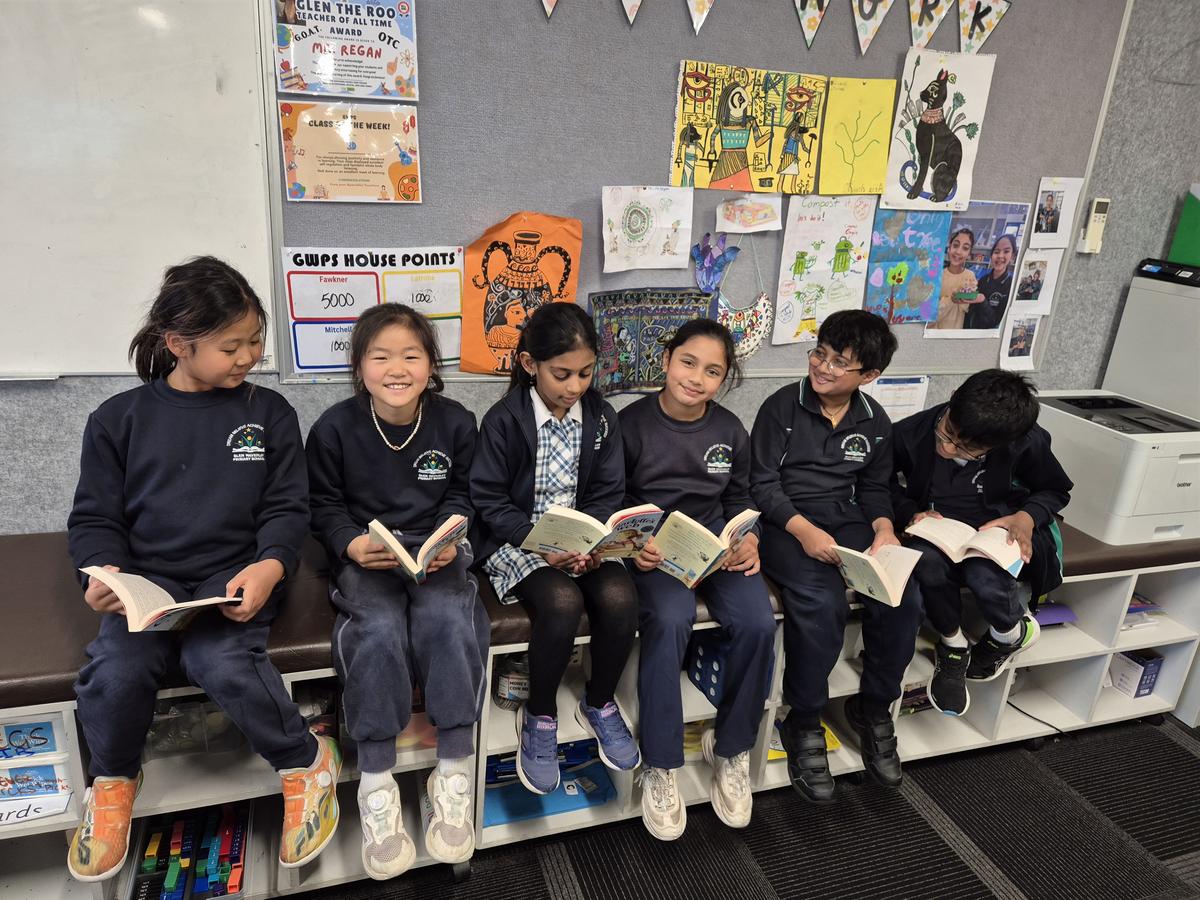
Students will also engage with the text The One and Only Ivan to develop their understanding of persuasive texts and the ways authors communicate opinions and viewpoints. They will examine how persuasive texts are organised to present ideas, influence audiences and encourage responses. Students will be explicitly taught to identify purpose, audience and key persuasive language features, including emotive language, modality, rhetorical questions, supporting evidence and persuasive text structures. They will practise these skills through guided discussion, text analysis and regular retrieval activities.
Explicit teaching of key vocabulary will support students to confidently understand, use and apply new words across both narrative and persuasive texts, strengthening their reading, speaking and writing skills. Students will explore vocabulary connected to characters, emotions, perspectives and themes, as well as topic-specific and persuasive language.
In Writing, students will plan, draft, revise and edit their own narrative and persuasive texts, focusing on creating clear and logical structures, selecting precise and engaging vocabulary, and applying accurate spelling patterns, punctuation and grammar. They will apply their understanding of narrative writing through Charlotte’s Web, developing characters, settings, dialogue and coherent story structures. Students will also develop persuasive writing skills inspired by The One and Only Ivan, learning to communicate a clear viewpoint, support opinions with relevant reasons and evidence and use persuasive language to influence their audience.
In Speaking and Listening, students will participate in structured discussions, share their ideas and responses to texts and practise speaking clearly and confidently for different purposes and audiences. They will build their ability to listen actively, ask and answer questions, explain their thinking and respectfully engage with others’ ideas through partner, small-group and whole-class activities, drawing on the themes, characters, perspectives and ideas explored in both texts.
Lessons are underpinned by evidence-based practices from the Science of Learning, including explicit instruction and regular checking for understanding to support all learners in building confidence and success in English.
Key Vocabulary:
- Characterisation
- Perspective
- Theme
- Audience
- Modality
How can you support your child’s English learning at home?
- Read stories together and ask questions about the characters, setting and events.
- Encourage your child to share their opinions and explain why they think that way.
- Look at advertisements or persuasive texts together and discuss how they try to convince the reader.
- Encourage your child to write at home, such as a short story or persuasive letter.
Mathematics
This term, students will participate in a structured and engaging Mathematics program designed to build strong foundational skills and deepen their understanding of key concepts. Learning experiences will be carefully sequenced to support all learners, with a focus on developing confidence, accuracy and problem-solving abilities. Teaching will incorporate a range of evidence-based strategies, including explicit instruction, regular review, and opportunities for practice and application. Students will be exploring a variety of engaging topics, building their skills and confidence.
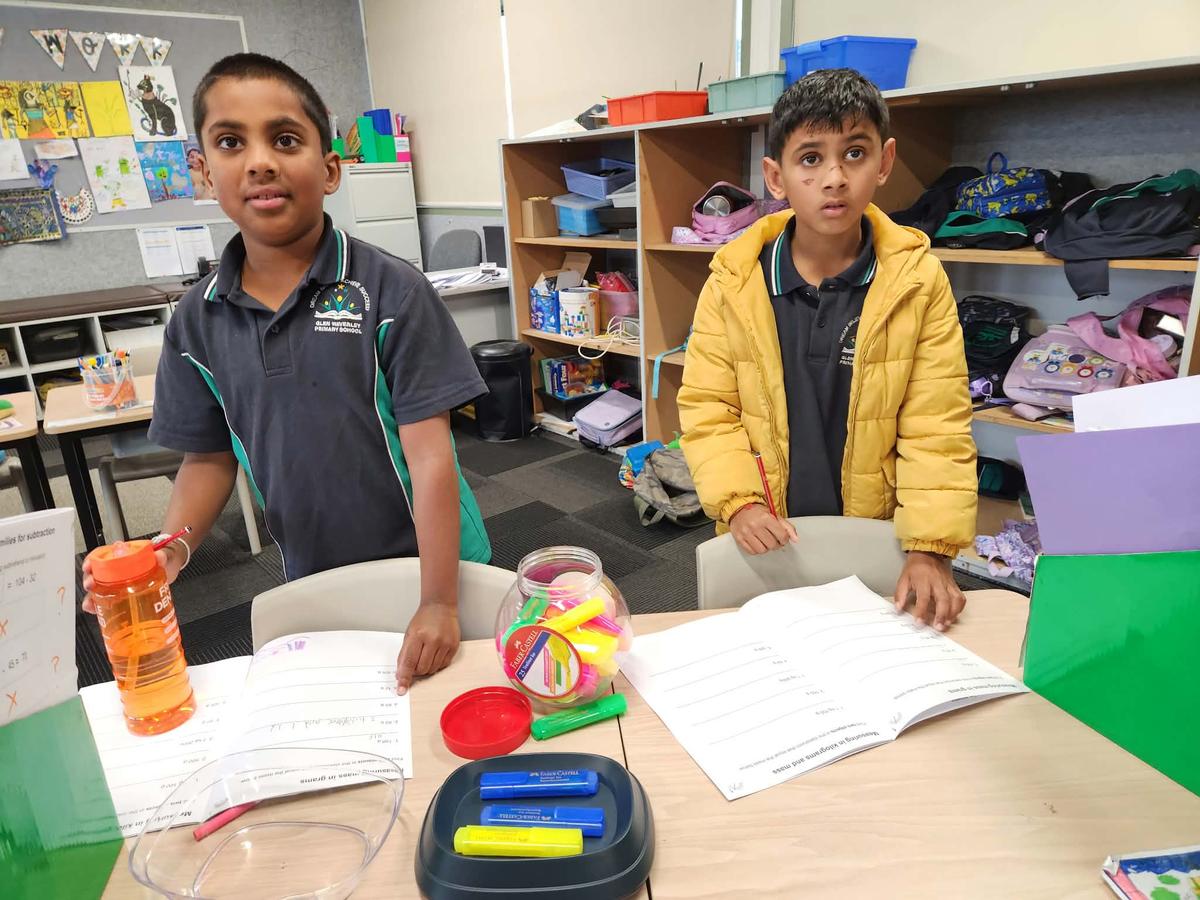
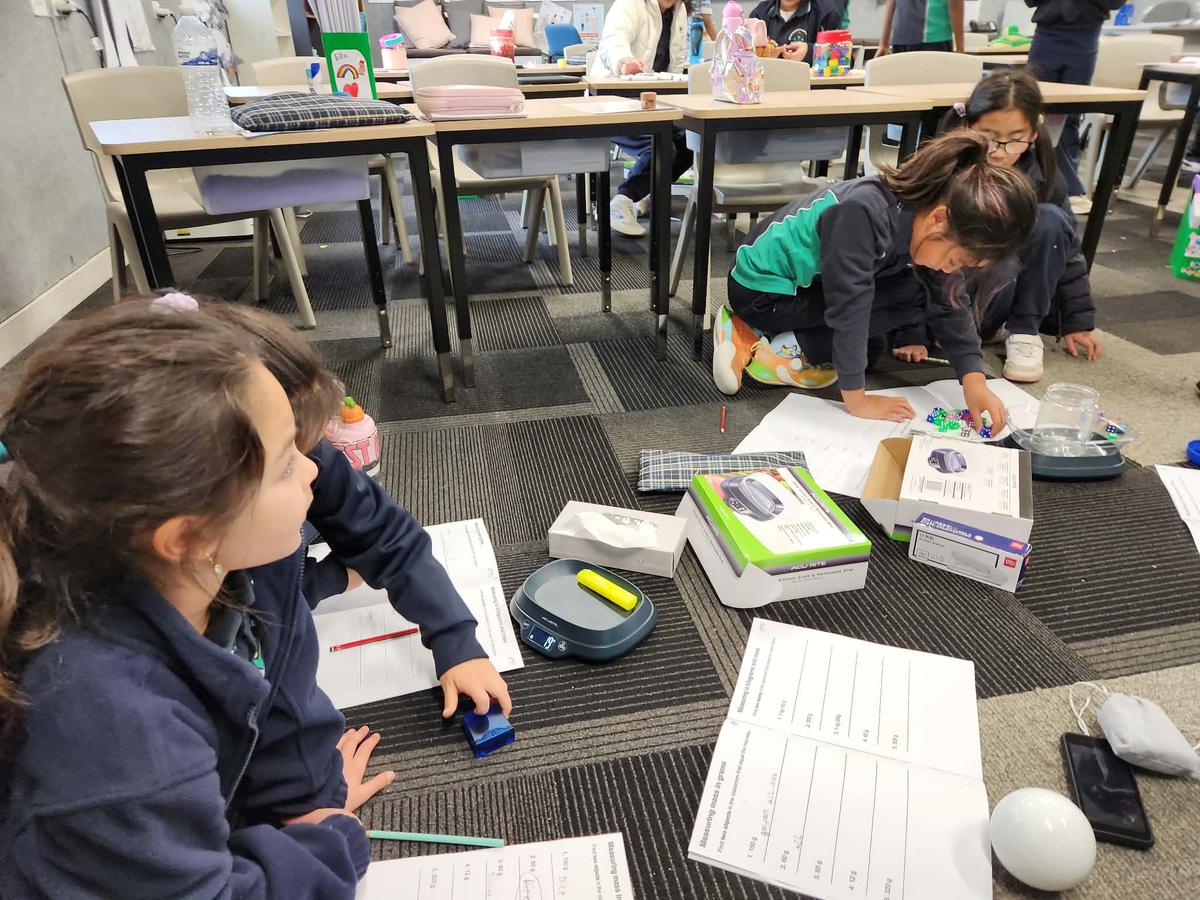
Mass and Capacity: Students will investigate mass and capacity by estimating, measuring, comparing and ordering objects and quantities, using appropriate units and measuring tools. They will develop an understanding of standard units and apply their knowledge to solve practical problems involving mass and capacity in everyday contexts.
Data Investigation: Students will explore the process of collecting, representing and interpreting data. They will develop skills in asking questions, gathering information and organising data in tables and graphs. Students will analyse and discuss data, identify patterns and use their findings to answer questions and draw conclusions.
Location: Students will develop their understanding of location and position by using directional language, maps and grids to describe where objects and places are located. They will explore movement, direction and position and use their skills to follow and give instructions, interpret maps and communicate locations clearly.
3D Objects: Students will identify, describe and classify three-dimensional objects based on their properties, including faces, edges and vertices. They will explore how three-dimensional objects can be compared, sorted and described using mathematical language and investigate how these objects are represented and used in everyday contexts.
Probability: Students will explore the language of chance and probability to describe how likely events are to occur. They will conduct simple chance experiments, make predictions and compare outcomes. Students will use terms such as impossible, unlikely, even chance, likely and certain to describe and communicate their understanding of chance events.
Multiplication and Division: Students will continue to develop fluency and confidence with multiplication and division facts. They will explore a range of efficient strategies for solving multiplication and division problems and apply their understanding to real-world situations. Students will use mathematical representations and reasoning to explain their thinking and solve increasingly complex problems.
Key Vocabulary:
- Estimate
- Properties
- Probability
- Position
- Data
How can you support your child’s Mathematics learning at home?
- Encourage your child to use mathematical skills in real-life situations, such as measuring ingredients, reading timetables, comparing prices or estimating quantities.
- Encourage your child to explain their thinking by asking questions such as, “How do you know?”, “What strategy could you use?” or “What do you notice?”
- Play games involving multiplication facts, chance, data, directions and 3D objects to build confidence and fluency in an enjoyable way.
Inquiry
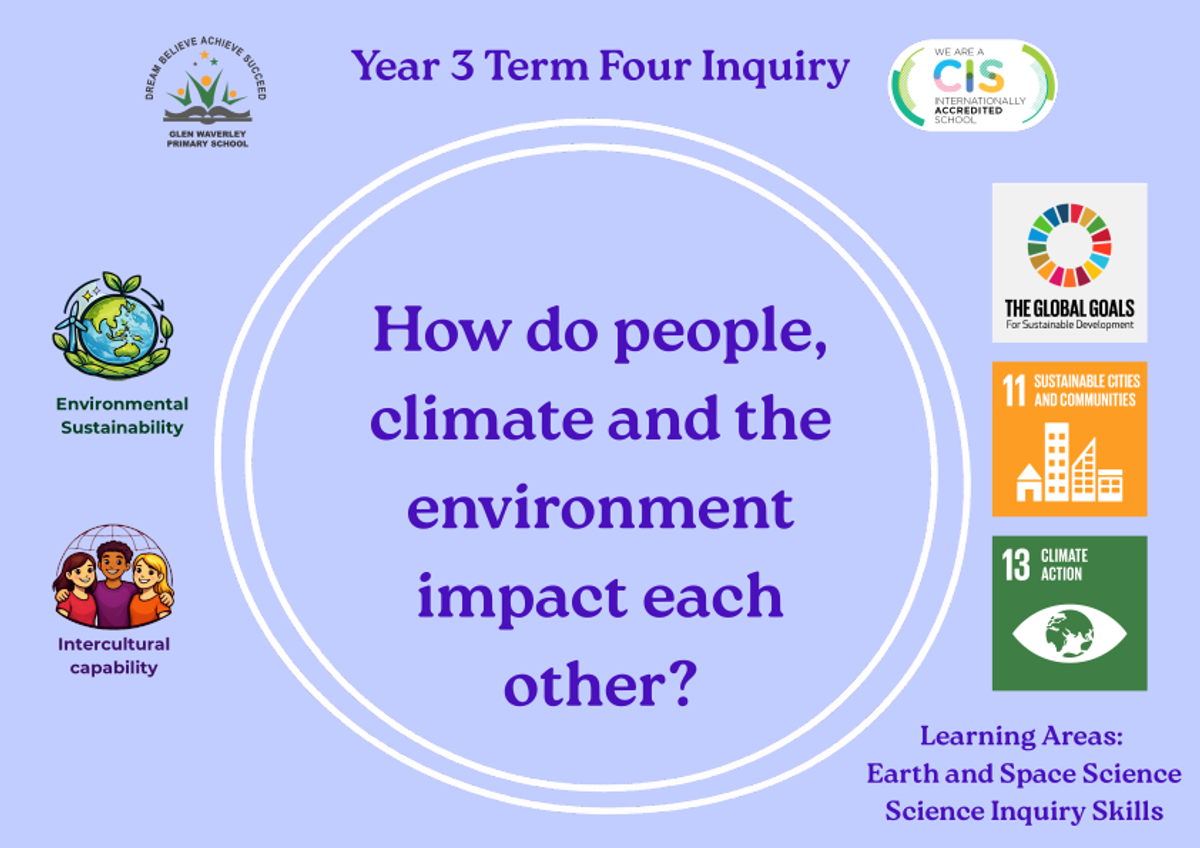
In Term Four, students will be exploring the Inquiry question ‘How do people, climate and the environment impact each other?’ whilst making connections to our Global Goals of ‘Sustainable Cities and Communities’ and ‘Climate Action’. In this Earth and Space Science unit, students will firstly analyse different types of natural disasters and how they occur. They will then explore the impact these disasters have on our Earth and how individual people, communities and cultures respond in differing ways to a disaster. Students will then be investigating how to prepare for a natural disaster, the aftermath and the way humans come together to rebuild. Finally, they will transfer their new knowledge of natural disasters and human reactions by creating a project at school and presenting it to their Level Three peers.
Key Vocabulary:
- Disaster
- Reactions
- Bushfire
- Floods
- Climate Change
- Droughts
- Cyclones
How can you support your child’s Inquiry learning at home?
- Watch the news and look out for natural disasters occurring around the world – what questions do they have?
- Assist with researching answers to any questions regarding their chosen project disaster.
- Consider solutions to natural disasters – For example, what can we do to reduce the impact of global warming?
Wellbeing
The Resilience Project
This term we will be continuing with The Resilience Project. Students will be focusing on developing their knowledge and skills within Gratitude, Empathy, Mindfulness and Emotional Literacy. They will develop strategies they can apply to everyday life. Students will be able to apply their learning to all aspects of their life including social situations.
Key Vocabulary:
- Responsibility
- Resilience
- Self-regulation
- Perseverance
- Adaptability
How can you support your child’s Wellbeing learning at home?
- We encourage parents and families to engage in GEM (Gratitude, Empathy, Mindfulness) conversations at home. For example, you might ask, "What has made you feel happy today?" These are in Home Learning.
- Talk to your child about what they've been learning during TRP/Cyber Safety/Friendology sessions which are held on Monday mornings after assembly.
- Ask them how they've demonstrated gratitude, empathy, and mindfulness at school, using key terms like responsibility, resilience, self-regulation, perseverance and adaptability in your discussions.
Cyber Safety
In Cyber Safety lessons this term, students will learn about the key traits of being a responsible digital citizen. They will explore what it means to show kindness and respect in online spaces, and how their words and actions can impact others. Students will practise ways to demonstrate empathy online, recognising and responding thoughtfully to the feelings of others. Through discussions and practical activities, they will develop strategies for positive communication and problem-solving in digital environments. By the end of the term, students will reflect on how they can contribute to creating safe, supportive, and inclusive online communities.
Key Vocabulary:
- Digital citizen
- Digital empathy
- Online community
- Digital footprint
- Privacy
How can you support your child’s Wellbeing learning at home?
- Ask your child how they feel when they are using technology.
- Talk about what they can do if something online makes them feel uneasy.
- Support healthy screen time routines and show balance through your own habits.
- Remind them of the importance of being kind and respectful in online spaces.
Friendology
The Friendology program empowers children with the skills, language and strategies they need to build and maintain healthy, positive friendships. In Term Four, our focus will be on understanding friendships and learning how to navigate tricky situations that can arise with friends. Each class will continue to use their ‘Friend-O-Meter’ as a visual tool to support discussions about friendship. Students will explore different friendship situations, consider how our words and actions can affect others, and share different perspectives about what can make friendships feel tricky. We will practise strategies for managing disagreements, solving friendship problems, communicating our feelings and making positive choices when things don’t go as planned. Students will also develop their understanding of the difference between accidental and intentional unkind behaviour, including exploring when a situation may be considered bullying. The goal is to help students feel confident and equipped to manage friendship challenges and build respectful, supportive relationships with others.
Key Vocabulary:
- Perspective
- Empathy
- Conflict
- Compromise
- Assertive
How can you support your child’s Friendology learning at home?
- Encourage your child to share about their friendships and discuss what makes a healthy, respectful friendship.
- Ask your child how they might respond to common friendship challenges, disagreements or misunderstandings.
- Support your child to use empathy, communicate their feelings, compromise and solve problems calmly and respectfully.