Term 3 Learning Summary
English
Reading and Viewing
Throughout Term Three, students will explore narrative, information report and persuasive texts through Ochre Education’s English resources, aligned with the Victorian Curriculum 2.0. These units of learning will encompass Language, Literacy and Literature studies and will be underpinned by evidence-based practices from the Science of Learning, supporting students to build confidence and success in English.
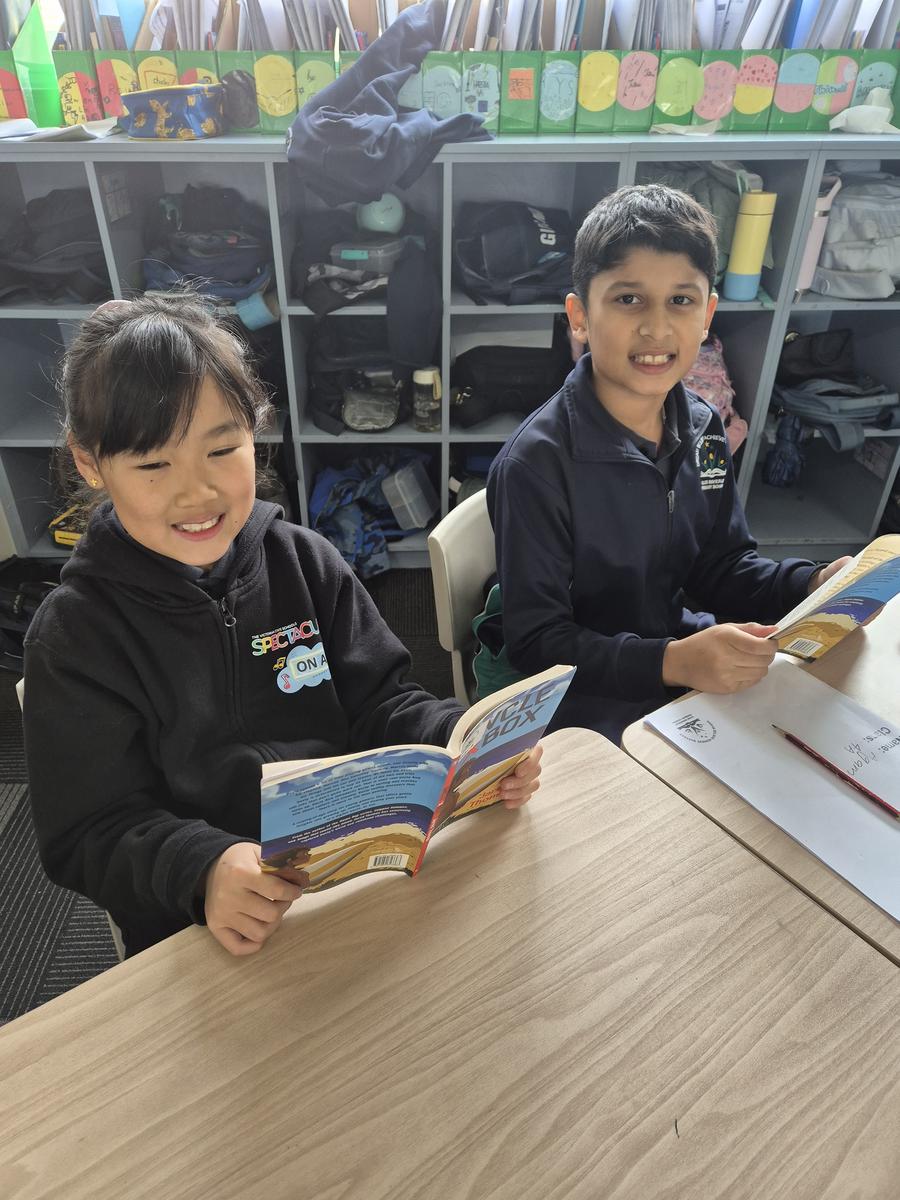
Students will explore the novels The Arrival, and Storm Boy to develop their reading skills. Learning experiences will be anchored in these rich literary contexts through analysing images, building literal and inferred meanings, and summarising the main ideas of texts. Students will practise reading aloud with increasing fluency, using their knowledge of punctuation to support dialogue and phrasing. They will explore how literary devices, such as wordplay, build meaning and analyse the framing and composition of images within texts.
Writing
Students will adapt their ideas from modelled texts across a variety of topics, including narrative, information report, persuasive and poetry texts. They will construct narratives and edit their work to improve both content and structure. Students will plan and draft coherent paragraphs using topic, thesis, supporting and concluding sentences. Drawing on examples from the novels, they will analyse and edit various sentence structures, including compound, expanded and summary sentences.
Speaking and Listening
Students will practise applying expanded vocabulary to the sentences they construct. While interacting with their peers, they will share their ideas and opinions on a range of topics during structured learning experiences. When presenting to an audience, students will make deliberate language choices and use digital tools to express their knowledge. Through class discussions and collaborative learning tasks, they will continue to develop their speaking and listening skills, building confidence in communicating their ideas effectively.
Key Vocabulary:
- Narrative
- Character
- Setting
- Orientation
- Theme
- Recount
- Grammar
- Phoneme
- Grapheme
- Morpheme
- Suffix
- Prefix
- Base
- Persuasive
- Analyse
- Infer
- Summarise
How can you support your child’s English learning at home?
Read with your child
Set aside time to listen to your child read at home and support them by analysing new or interesting vocabulary. Ask them questions about the text to assist them to understand on a deeper level.
Talk about the words authors use
When reading together, chat about how things are described in the book. Ask questions like, “What do you picture when you read that?” or “Why do you think the author used that word?”
Practice using the five senses
Help your child describe places or objects using their senses — what they see, hear, smell, feel, and taste. For example, describing a beach might include “the salty smell in the air” or “the warm sand underfoot.”
Discuss past experiences
Encourageyour child to think about events that have occurred in the past as a family and discuss your shared recollection of them. Support them to write a rich recount of the event, including details about who, when, where and what happened.
Mathematics
In Term Three, students will engage in regular mathematics retrieval through Daily Reviews and follow the research-backed Science of Learning approach, with explicit, scaffolded practice and a strong focus on repetition.
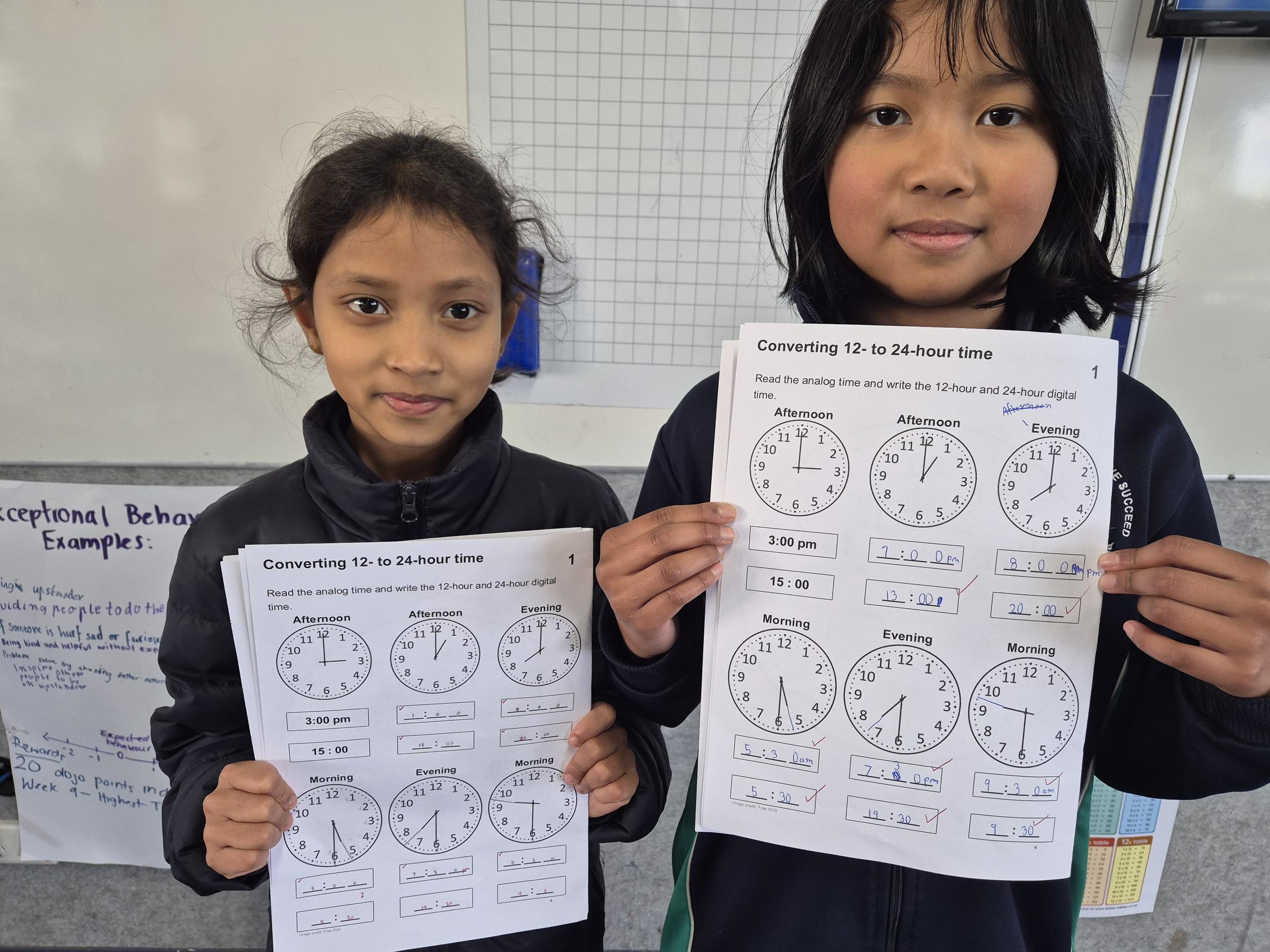
In Measurement, students will develop their understanding of 12- and 24-hour time, learning how to convert between the two formats and apply this knowledge when interpreting timetables. They will measure angles using protractors, construct shapes with specific angles and use angle properties to make appropriate estimates of angles in the world around them. Students will also use metric units when measuring length, capacity and mass, then apply their understanding to select appropriate units of measurement for different situations and estimate the length, capacity or mass required to complete a task.
In Number, students will develop their understanding of fractions by exploring the addition and subtraction of fractions. Through real-world problems, they will investigate how fractions relate to everyday life while deepening their understanding of partitioning, equivalent fractions and the concept of a whole. Students will extend this knowledge by investigating decimals, including representing and comparing decimals to thousandths, to support greater accuracy and a deeper understanding of number parts.
In Space, students will explore the accurate plotting of coordinates on a Cartesian plane using grid references and will use these coordinates to construct two-dimensional polygons. They will engage in activities focusing on the translation of shapes, such as reflecting (flips), rotation (turns) and transformation (slides).
Key Vocabulary:
Time | Fractions | Angles | Decimals |
12-hour time 24-hour time am pm schedule timetable
| denominator numerator improper fraction mixed numeral
| net face edge vertex/ vertices surface prism
| tenths hundredths thousandths decimal point place value |
Measurement | 2D Shapes | Location | |
chance experiment equally likely fair possible outcomes probability unfair | anti-clockwise clockwise half turn horizontal quarter turn reflect rotate symmetrical transform translate vertical |
| |
How can you support your child’s Mathematics learning at home?
Perimeter and Area: Use building blocks or LEGO to create shapes and calculate their perimeter and area.
Fractions: Follow a recipe, taking note of the different measure cups and spoons that are needed.
3D Shapes: Identify different examples of 3D objects you can find around your home.
Decimals: Identify examples around home and at the shops where decimals are used (e.g. temperature, prices, distances.
Probability: experiment with different examples of probability such as, flipping a coin or rolling a dice
2D Shapes: Identify different examples of 2D shapes you can find around your home.
Time: Practice reading the time on different analogue and digital clocks.
Inquiry
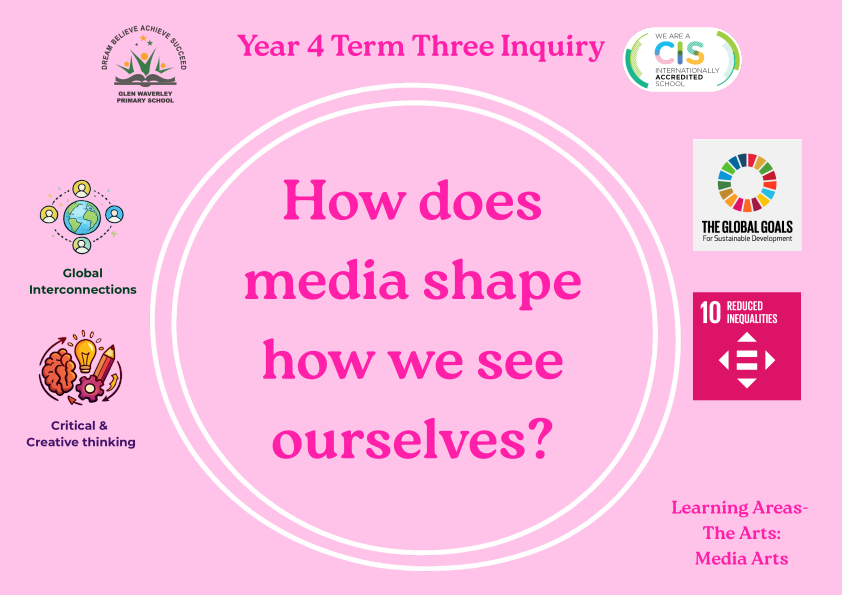
During Term Three, learners will explore the interconnected concepts of identity, media, and design through inquiry, critical thinking, and hands-on learning experiences. Learners will investigate self-image and self-perception, reflecting on how they view themselves and others while considering the influence of personal experiences, bias, and societal perspectives. They will examine how language and media can shape opinions and will explore both traditional and contemporary forms of media, developing an understanding of responsible and respectful media engagement. Through discussions, inquiry tasks, and an excursion to ACMI, learners will investigate how media influences the way people see themselves and others over time. They will demonstrate their understanding by creating personal websites that showcase their identity, experiences, and digital communication skills.
Key Vocabulary: Media, Blog, Podcast, Broadcast, Production, Informal and formal language (for the media), Technologies, Perspectives (positive and negative).
How can you support your child’s Inquiry learning at home?
To support your child at home this term you could:
- Have open discussions with them about screen times
- Talk about what they are watching/playing
- Discuss what to do if they see something inappropriate
- Discuss different media types – perhaps what you used to use as child (newspaper, magazine, watching the News on TV, radio)
Wellbeing
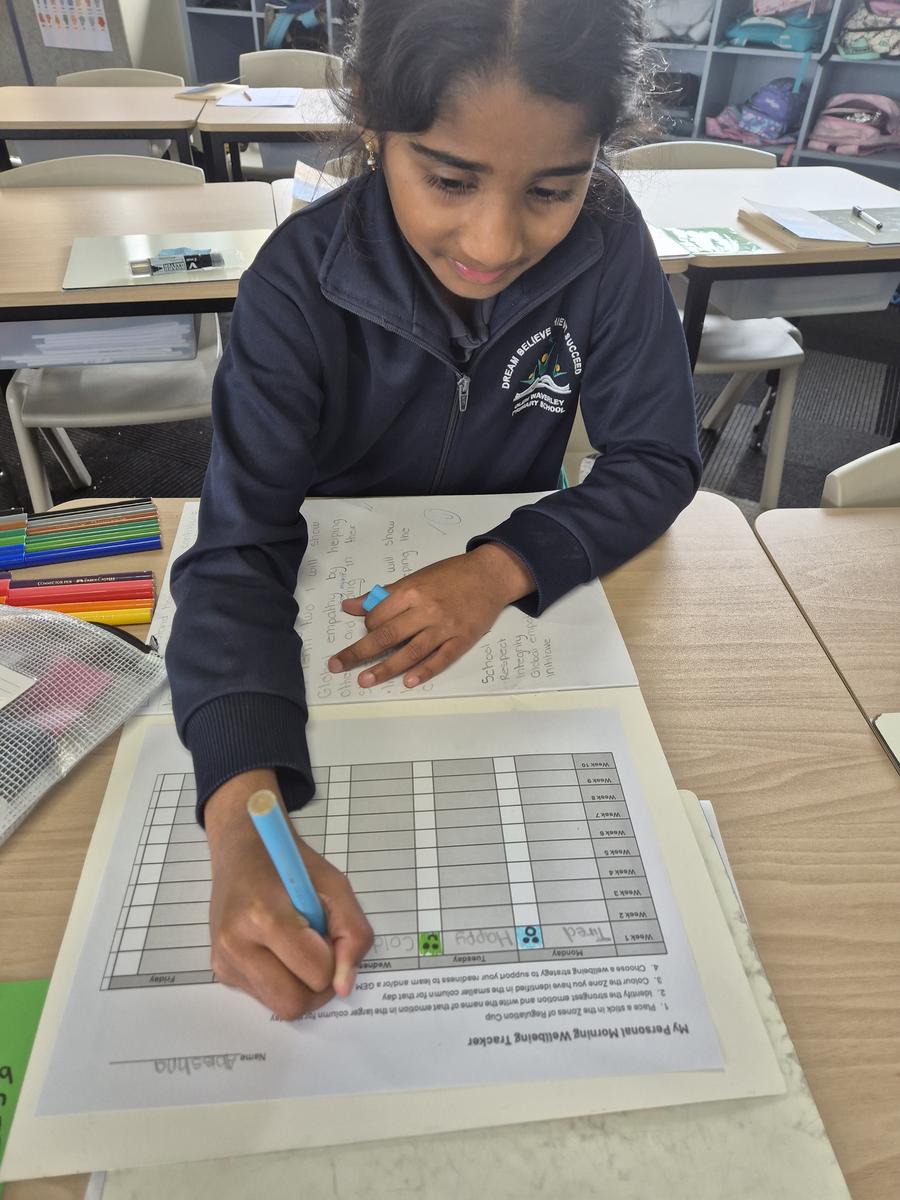
Throughout Term Three, Year Four students will continue to explore the five key pillars of wellbeing—Gratitude, Empathy, Mindfulness, Emotional Literacy, and Connection—through The Resilience Project. They will engage in lessons focused on developing Emotional Literacy and Empathy. In Emotional Literacy sessions, students will expand their emotional vocabulary by exploring both new and familiar emotions. Students will participate in and establish wellbeing practices such as classroom routines, daily wellbeing check-ins, and GEM Chats to support emotional wellbeing and strengthen classroom connections. Students will also engage in the Friendology learning, which will include lessons designed to build skills that foster stronger connections with others, as well as strategies to self-regulate during everyday social challenges.
Students will also participate in a series of Cyber Safety Project lessons designed to build their confidence and responsibility when navigating the digital world. They will explore ways to recognise and manage their emotional responses to different online experiences. Students will discuss how to respond thoughtfully rather than react impulsively, helping them develop emotional awareness and self-regulation in digital spaces. They will investigate the concept of peer pressure, considering how the influence of others can affect their choices online. Through guided conversations, students will learn strategies to stay strong and make decisions that align with their values.
Students will participate in role-plays that highlight how online inclusion and exclusion can impact emotions. This will help them develop empathy and resilience while exploring the concept of FOMO (Fear of Missing Out). Students will also reflect on their digital habits by categorising their online activities as either creation or consumption. They will then create a balanced plan to support healthy and purposeful technology use. Through these experiences, students will continue to develop positive digital behaviours that support their wellbeing and safety online.
Students will engage in activities that promote growth in these areas throughout the term. These activities will be incorporated into classroom routines and discussions, providing students with the tools to enhance their emotional wellbeing. Each Home Learning will include GEM chat prompts for you and the rest of your family to discuss and, hopefully, become part of your regular routines.
Cyber Safety Project
In Term 3, The Cyber Safety Project will build on the theme of personal Strength when using digital devices. With ideas such as recognising the feelings that come up when seeing certain content online, self-managing screen time, setting routines and positive wellbeing strategies, and acknowledging the strength it takes to be true to themselves in the face of peer pressure, students will be well set to know how to face online challenges.
In addition to the core lessons from The Resilience Project and Cyber Safety Project, extra wellbeing sessions will be planned based on the specific needs of the cohort and what the teachers may observe throughout the term. These sessions will allow for targeted support in areas where students may require additional guidance or practice.
Key Vocabulary:
- Emotion – A feeling such as happiness, sadness, anger, or fear.
- Empathy – Understanding how someone else feels and showing care or support.
- Gesture – A small action that shows kindness or thoughtfulness.
- Expression – The way we show our emotions through words, actions, or facial cues.
How can you support your child’s Wellbeing learning at home?
Celebrate small gestures
Notice and praise small acts of kindness within the family to reinforce the value of caring for others.
Encourage Daily Gratitude Practices
You can help your child build a habit of gratitude by encouraging them to reflect on one thing they are grateful for each day. This could be shared during family meals or written down in a gratitude journal. This simple practice will help your child focus on the positive aspects of their day and build a more optimistic mindset.
Model Empathy and Active Listening
You play an important role in helping your child develop empathy. By modelling how to listen actively and respond thoughtfully to others, you can show them the value of considering other people’s feelings. Discuss real-life situations where empathy makes a difference and even try role-playing different scenarios to help them practise these skills at home.
Promote Mindfulness and Calmness
You can guide your child through simple mindfulness activities like deep breathing exercises or moments of calm during their daily routine. Helping them practice staying calm, focused, and present will be especially beneficial when they’re feeling stressed or overwhelmed.
Discuss Digital Safety Practices
As your child begins using their iPad and digital tools in class, it’s important to reinforce the importance of digital safety at home. Discuss responsible online behaviour, the importance of respecting others, and keeping their personal information private. Setting clear guidelines for screen time and encouraging safe online choices will help them use technology in a responsible and secure way.
Our families have access to the Resilience Project Home - TRP@HOME portal along with the Cyber Safety Project home Resources - Cyber Safety Project.
By supporting these practices at home, you’ll help your child strengthen their emotional resilience and develop the skills they need to thrive both at school and in everyday life.