Term 3 Learning Summary
English
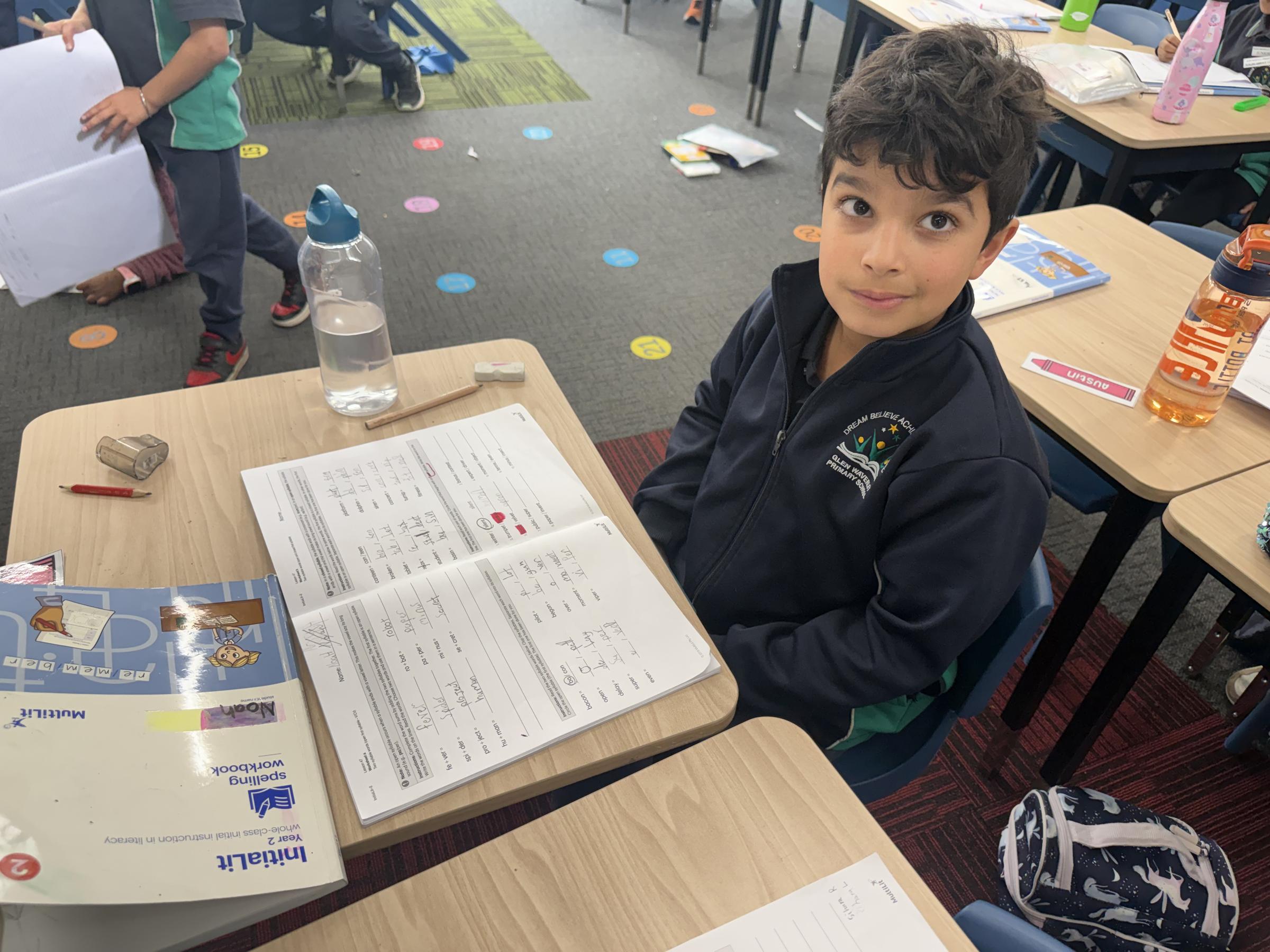
Initial Lit
Reading: Students will continue to develop their comprehension with explicit instruction focusing on inferring, summarising and monitoring text. Further, a focus on reading fluency and learning new vocabulary through our Read and Discuss (RAD) sequence, will enhance comprehension of texts. Students will participate in a range of learning activities linked to shared texts across both narrative and informative genres. Students will also explore persuasive texts, practising skills such as asking questions and using evidence from the text to support their understanding.
Spelling: Students will continue to build their phonemic knowledge of sounds this term as well as develop their understanding of suffixes and how they are added to base words. They will continue exploring spelling rules for digraphs, trigraphs, long vowels and learn more "Tricky words” that do not follow regular spelling patterns.
Story Book sessions: Students will engage with quality children’s literature, such as The Day the Crayons Came Home by Drew Daywalt, Collecting Colour by Kylie Dunstan, Zoo by Anthony Browne and The True Story of the three little pigs by Drew Daywalt and Oliver Jeffers. These sessions will deepen vocabulary, oral expression, and be tied writing tasks.
Writing
In Writing, students will explore two key text types: persuasive and information texts. During the persuasive writing unit, students will learn how authors use language to influence an audience by expressing opinions and supporting them with reasons and evidence. They will explore the purpose, structure and language features of persuasive texts before planning and creating their own writing.
During our information writing unit, students will learn how to communicate factual information clearly and accurately. They will investigate the purpose, structure and language features of information texts and explore how headings, labelled diagrams, topic-specific vocabulary and organised paragraphs help readers understand a topic. Students will apply their learning by creating informative texts based on topics they have investigated, making connections to authentic examples such as fact files, reports and articles.
Grammar: Students will learn about types of adjectives, such those describing appearance, texture, sound, taste, smell and emotions. Understanding adjectives is crucial as they help enrich writing by providing vivid details and creating a clearer picture in the reader's mind. Additionally, they will practice identifying and constructing noun groups, which enhances their ability to structure sentences and communicate ideas more precisely.
Key Vocabulary:
- Opinion
- Convince
- Information
- Evidence
- Proper nouns
- Common nouns
- Pronouns
- Adjectives
- Digraph
- Long vowel
- Tricky Words
To support your child’s learning at home, you can:
- Ensure your child reads for 10-15 minutes from their school readers daily and out loud to an adult or older sibling at least once a week.
- Ask your child what their “Tricky Words” are for the week and test them on spelling these orally.
- Point out and discuss examples of verbs, adverbs, nouns, pronouns and adjectives in books, signs, and other reading materials.
- Involve your child in cooking from recipes at home, drawing attention to the single words or phrases that are the instructions.
- Practicing handwriting and letter formation. Encourage your child to write for enjoyment (writing letters, stories) and help them to focus on their handwriting when completing Home Learning tasks.
Mathematics
This term, students will develop their understanding of Data by learning how to collect, organise, represent and interpret information. They will explore different ways of displaying data, ask and answer questions about the information they collect, and use their findings to draw simple conclusions. Throughout this unit, students will also strengthen their understanding of skip counting and number patterns, recognising how these skills support efficient counting and mathematical reasoning.
Students will also participate in a Multiplication and Division unit, where they will develop their understanding of these related operations and the connections between them. They will learn how multiplication can be represented through equal groups, repeated addition and arrays, and how division can be used to share and group quantities. As their understanding grows, students will apply these concepts to solve a range of number and word problems, helping them make meaningful connections between mathematics and everyday situations.
Key Vocabulary:
- Skip count
- Number pattern
- Number line
- Hundreds chart
- Pattern
- Digit
To support your child’s learning at home, you could:
- Race to 100: Take turns rolling two dice and adding the numbers to a running total. The first player to reach exactly 100 wins.
- Skip Count Walk – When walking, ask your child to skip count by 2s, 5s, 3s, 10s saying the next number each step they take. For an extra challenge, ask your child to start from an odd number.
Inquiry
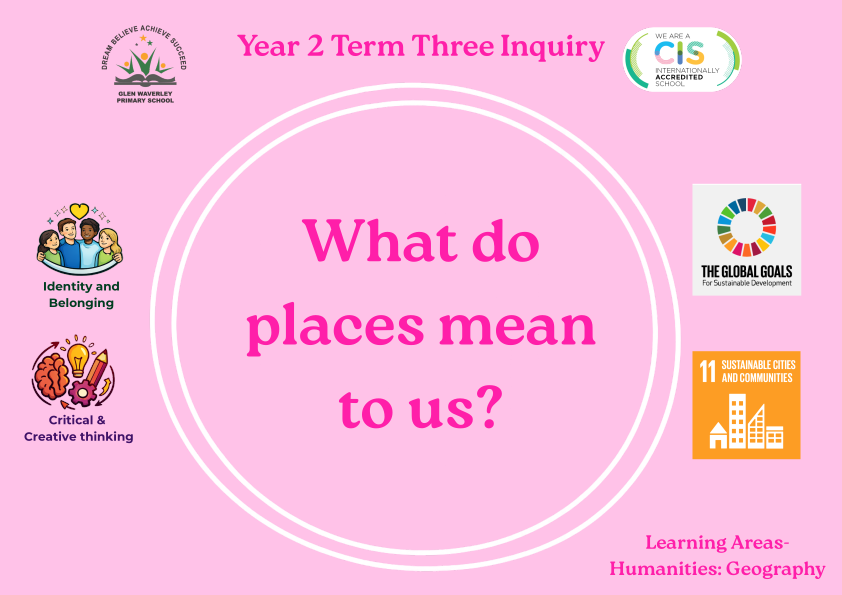
In Term Three, learners will explore the concepts behind the inquiry question, “What do places mean to us?” Students will be exploring the significance of important local landmarks. They will learn about how different places are important to different people and draw personal connections to places around them. Throughout the term, students will learn about different geographical landmarks and think critically about the contexts around them. We will also make connections to Mathematics and Writing through the focus of geography. As a final transfer, students will choose a landmark that is significant to them and create an informative text to demonstrate their understanding.
Students will embark on an excursion on Puffing Billy. This will closely align with our Inquiry Question, “What do places mean to us?” This experience will provide opportunities for students to explore how places can hold historical, cultural and environmental significance. As they travel through the Dandenong Ranges, students will investigate how the railway has shaped the local community over time and consider the different ways people value and connect with places. The excursion will encourage students to reflect on how places can influence our experiences, identity and sense of belonging.
Key Vocabulary
- Geography, Landmark, Local, Global, Significant, Connection, Location, Heritage, Indigenous.
How can you support your child’s Inquiry learning at home?
- Ask your child to give directions to familiar places around them verbally/in written form.
- Visit a local park, landmark or place of interest and discuss why it is important to the community.
- Share family photos from places that hold special memories and talk about why they are meaningful.
- Explore a map of your local area together and identify familiar landmarks.
Wellbeing
The Resilience Project
In Term 3, we will explore the importance of Emotional Literacy. Emotional Literacy is the ability to recognize, understand, and express our feelings, and it’s a vital part of building strong, positive relationships and developing resilience.
Students will engage in activities to identify their emotions and practice strategies for managing them. Through group discussions, collaborative and creative tasks, they will learn how to express their feelings in words, listen to others with empathy, and build a toolbox of strategies to calm their minds during challenging times.
One of our favourite activities has been “GEM Chat” where students focus on fostering positive connections and building emotional awareness. Students will continue to share moments of gratitude, practice understanding others’ feelings, and engaged in mindful reflection, creating a safe and inclusive environment.
Key Vocabulary:
- Empathy
- Gratitude
- Mindfulness
How can you support your child’s Wellbeing learning at home?
- Showing Gratitude and being grateful for what we have.
- Practicing Mindfulness at home like mindful breathing and colouring.
- Showing Empathy such as being an active listener.
Cyber Safety
In Term 3, students will continue their journey navigating through the Cyber Safety Project, with emphasis on safety and integrity. This will help our students develop essential digital literacy skills, while also encouraging them to think critically about their actions and well-being in the online world. This terms focus includes digital citizenship, respecting others online, and maintaining privacy and security when using technology in the classroom.
Key Vocabulary:
- Internet
- Online
- Device
- Website
- Digital Footprint
- Cyberbullying
How can you support your child’s Cyber Safety learning at home?
- Keep devices in open, shared family areas like the lounge or kitchen rather than private bedrooms.
- Tell them to come to you right away if a game, pop-up, or message makes them feel worried or uncomfortable.
- Set clear time limits for screen use and build tech-free zones, especially during meals or before bedtime.
- Co-create simple family rules about asking an adult before downloading any new games or apps.
- Remind them to keep personal information private, such as their full name, address, school, passwords and phone number and talk about why this is important.
- Encourage kindness and respect when communicating online, just as they would in person.
Our families have access to the Resilience Project Home - TRP@HOME portal along with the Cyber Safety Project home Resources - Cyber Safety Project.
By supporting these practices at home, you’ll help your child strengthen their emotional resilience and develop the skills they need to thrive both at school and in everyday life.