Principal's Update
Angelika Ireland













 Greenvale Primary School

Principal's Update
Angelika Ireland
Remembrance Day in Australia is a National Day of Commemoration observed on 11 November at 11.00 am each year to honour all military personnel who have died or suffered while serving in wars, conflicts, and peace operations to keep us safe.
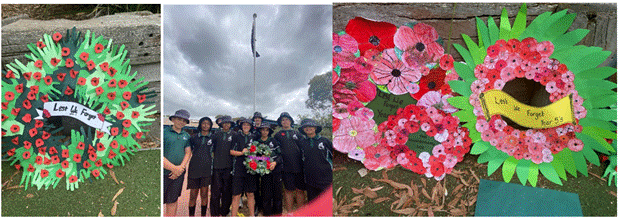
Thank you to Jessica Wynd and the JSC for the delivery of the commemoration, and to the students and staff for making the poppy wreaths and for their respectful participation, especially during the one minute of silence.
The information below was directed to me by one of our staff who read this online.
This is a good approach to support your child.
When your child comes home and shares an incident from school, it is natural to feel concerned and protective. But remember, children sometimes misunderstand situations, miss important details or share only the part they have experienced. It is always better to listen patiently, reassure your child that you are there for them, and then verify the matter with the school or their class teacher before forming an opinion. A simple conversation can prevent unnecessary misunderstandings and negative assumptions.
Don’t let an incomplete version of a story change your trust in a teacher or school. Supporting your child does not mean always agreeing with everything they say. Sometimes it means helping them understand the complete situation, accept their mistakes and learn from them.
This was our Year 4 students first camp. They left on the bus on Monday morning with excitement and anticipation! What a great adventure was had by all!
The weather was perfect, allowing all camp activities to proceed as planned. The rotational camp activities included the giant swing, archery, low ropes, radio rogaine, canoeing and risky kids.
I would like to thank the students for the manner in which they participated in the camp activities, and for their behaviour, demonstrating that they remembered our school values so making it a positive experience for all.
Thanks to the teachers, parent and pre-service teachers who attended and gave three days of their time to make the camping experience such a memorable one for all the students.
Thanks to the Year 4 teachers Daniel Wardan, Fabio Cardona, Joshua Howarth, Michelle Barton and in particular Nicola Dean who organised the camp. Also, a big thank you to our parent volunteer, Nicole Wall, and to the Pre-service t4
eachers, Angelica and Erin.
According to our school’s Attitudes to School survey results which our students in Year 4 to Year 6 completed earlier this year, 88% of these students felt that our school manages bullying well. This is 10% higher than responses across the whole State as well as Similar Schools to ours. It was also 12 % higher than responses within our local Network.
Continuing on from the last School Newsletter, please find further information about our school approach to managing bullying taken from our school Bully Prevention Policy.
Other distressing and inappropriate behaviours
Many distressing and inappropriate behaviours may not constitute bullying even though they are unpleasant. Students who are involved in or who witness any distressing and inappropriate behaviours should report their concerns to school staff and our school will follow our Student Wellbeing and Engagement Policy and/or this Bullying Prevention Policy where the behaviour constitutes bullying.
Mutual conflict involves an argument or disagreement between people with no imbalance of power. In incidents of mutual conflict, generally, both parties are upset and usually both want a resolution to the issue. Unresolved mutual conflict can develop into bullying if one of the parties targets the other repeatedly in retaliation.
Social rejection or dislike is not bullying unless it involves deliberate and repeated attempts to cause distress, exclude or create dislike by others.
Single-episode acts of nastiness or physical aggression are not the same as bullying. However, single episodes of nastiness or physical aggression are not acceptable behaviours at our school and may have serious consequences for students engaging in this behaviour. Example School will use its Student Wellbeing and Engagement Policy to guide a response to single episodes of nastiness or physical aggression.
Harassment is language or actions that are demeaning, offensive or intimidating to a person. It can take many forms, including sexual harassment and disability harassment.
Discrimination is behaviour that treats someone unfavourably because of a personal characteristic (for example, race, religious belief or activity, disability, sex or intersex status, gender identity or sexual orientation).
Discrimination, harassment, and any other inappropriate behaviour is not tolerated at our school and there may be serious consequences for students engaging in this behaviour. This includes any form of racism, religious or disability discrimination, sexism, homophobia, transphobia, or any other behaviour that targets an individual or group. Further information about discrimination and harassment, including definitions, is set out in our Inclusion and Diversity Policy
Bullying Prevention
Greenvale Primary School has a number of programs (e.g. School Wide Positive Behaviour, Respectful Relationships, Bully Prevention - Stop, Walk, Talk!) and strategies in place to build a positive and inclusive school culture and relationships to promote wellbeing. We strive to foster a school culture that prevents bullying behaviour by modelling, encouraging and explicit teaching of behaviour through our Social and Emotional Learning (SEL) programs that demonstrate acceptance, kindness and respect.
Bullying prevention at Greenvale Primary is proactive and is supported by research that indicates that a whole school, multifaceted approach is the most effect way to prevent and address bullying.
For further information, please visit our school website www.greenvaleps.vic.edu.au
Food for Thought:

Regards
Angelika Ireland