Homework Guidelines
















 Brunswick Secondary College

Homework Guidelines for Parents and Carers
At Brunswick Secondary College, we are all working towards the same goal: happy and balanced young people with an education that allows them to pursue rich and varied futures.
The research validates the importance of homework as an aspect of holistic education that is correlated with positive student outcomes.
‘What we want is to develop and refine intellectual skills- but when students don’t do homework, they may not perfect math skills, may not read as well, or may lack depth of knowledge for future learning. Quality homework tasks can play an important role in the development of those skills and the acquisition of that knowledge.’ (Cathy Vatterott, 2007)
Quality homework is facilitated by your child’s teachers to achieve depth and breadth of learning; it is linked to the curriculum. As your child progresses through their schooling, the expectation is that they take greater responsibility for their homework and study program with the aim of engaging in self-directed learning to deepen understanding.
Students with specific learning needs may have homework differentiated as per strategies outlined in their Individual Learning Plan.
Home Group Program
As part of the Home Group program, your child will be supported to further develop their time management and organisational skills through the effective use of a physical or online diary. They will be assisted to engage with learning resources that support their study and homework.
Students will be encouraged to:
- Record their homework in a physical or online diary
- Develop a repertoire of learning strategies linked to their learning goals
- Reflect on their learning processes, self-assess, and acknowledge the impact of effort on achievement
- Actively seek out feedback to improve understanding of how they learn
- Proactively take control of, and responsibility for, their own learning
Role of Parents and Carers
Parents and Carers can do the following to facilitate and support their child to engage with their homework.
Encourage a homework routine
- Ensure your child is actively engaged in creating their homework routine.
- Encourage your child to identify the times that best suit them for homework.
- Discuss the homework recorded in the diary or planner and encourage your child to seek feedback from classroom if and as required.
- Have a homework routine will set your child up with good study habits. This will help them throughout school and beyond.
- Encourage your child to stick to suggested time limits.
- For junior students, once the time is up, they finish, even if the task is incomplete. Over time, this encourages productivity during homework time, reinforces routines and provides an important ‘light at the end of the tunnel’ so that recreational activities can commence.
- For senior students, whilst we acknowledge they continue to learn time management skills throughout their secondary school years, there will be times during the academic year that they need to be flexible with their homework time limits.
Set up a comfortable space
Your child will find it much easier to do their homework if they have a comfortable space.
This could be a space in their bedroom, in your study or in the family room. If you don't have a space at home, you might consider using the school or local library, or other community facilities. See Merri-bek Council for more information.
A good homework space:
- is comfortable and quiet
- has good light: use a good lamp and/or overhead light if the space is dark
- has all the things they need to do their work and study
- is free from distractions such as the television or computer games
Homework and Study Timetable
You can help your child create a homework timetable so they can keep track of their work.
Use a diary or a calendar and encourage your child to:
- Enter the dates and times of your child's non-homework activities, like sport activities, housework, reading time
- List all their homework tasks for the week and when they are due
- Estimate how long each task will take to complete
- Break up big tasks into small chunks
- Colour-code each subject so they can see at a glance what they will work on
- Allow 10–15-minute breaks for every hour of study
- Allow breaks for mealtimes and to eat with the rest of the family, this should be away from their desk or workspace.
Student Guidelines
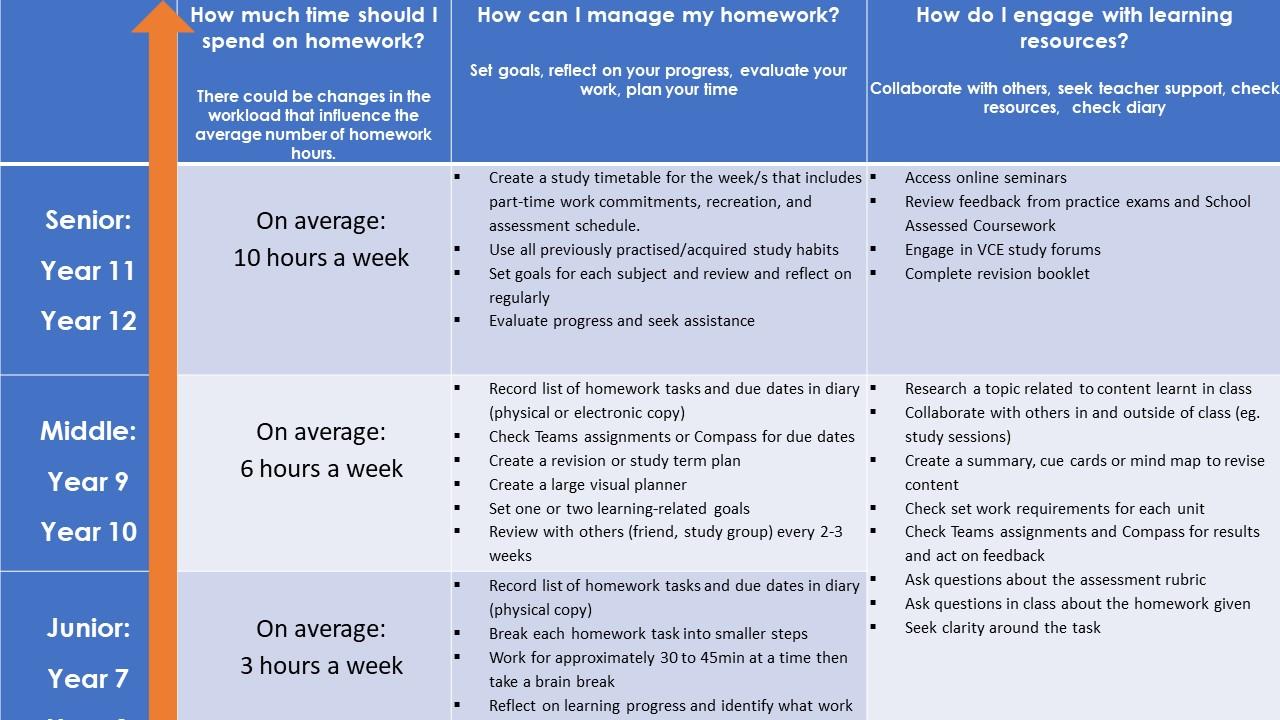
For an indication of your child’s time commitment to homework and for strategies to facilitate effective home learning, please refer to the Student Guidelines table shown below. Click on the image to enlarge it.
The arrow in the table below indicates that as students move up the year levels the previous identified strategies are carried over to the next year.