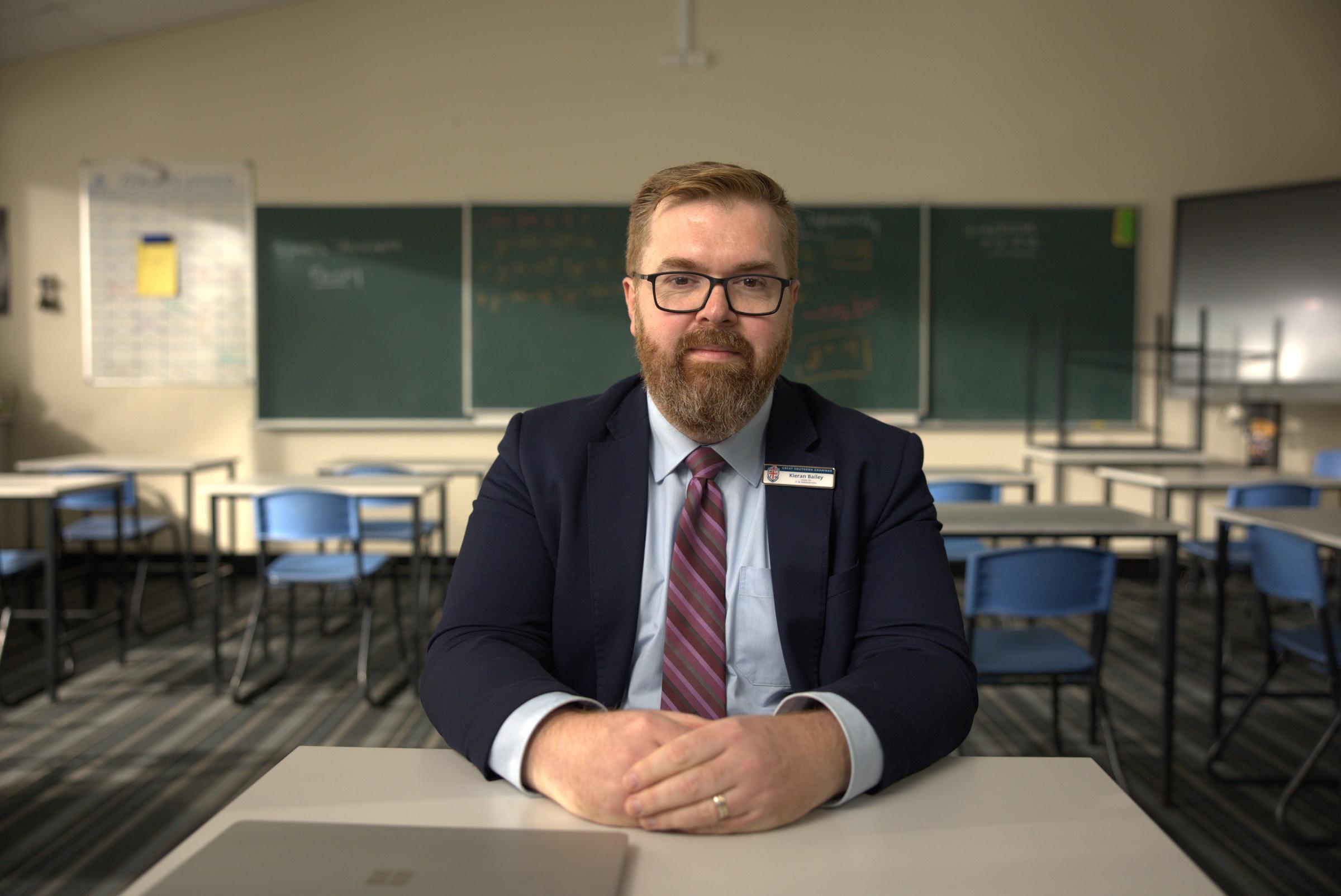
From the Head of IT & Innovation










 Great Southern Grammar
Growing up well in a digital world
Technology supports learning, creativity and connection, and occupies an increasingly significant part of our children's lives. The challenge for schools and families is no longer whether children will use technology, but how we help them learn to use it well.
This week we were fortunate to welcome Kayelene Kerr, founder of eSafeKids, to Great Southern Grammar. Kayelene worked with our Early Childhood and Primary staff, Secondary pastoral staff, and later with parents. We are particularly grateful to our Parents & Friends Association for organising Kayelene’s visit to GSG and these workshops, creating the opportunity for this important conversation within our community.
The scale of children's engagement with technology is worth reflecting on. Australian Bureau of Statistics data shows that almost a quarter of children aged 5–14 who use screens spend more than 20 hours each week on screen-based activities, while a further 40% spend between 10 and 19 hours. More recent Australian research suggests that, at the upper end, some children are spending as much as nine hours each day using screens.
Of course, some of this is productive and educational. Technology is an important part of contemporary learning. But much of children's screen use is outside of school and is increasingly occupied by gaming, messaging, social media and highly engaging short-form digital content. Indeed, recent eSafety research involving more than 3,400 Australian children aged 10–17 found that 96% used social media, 95% used communication platforms and 72% described using online spaces for fun or relaxation.
One of the strongest messages from Kayelene's sessions was that digital wellbeing is not really about technology. It is about habits, relationships and boundaries.
Sleep is a good example, and the one thing that Kayelene emphasised should be non-negotiable. Keeping phones, tablets and gaming devices out of children's bedrooms overnight is a relatively simple boundary. A family charging station somewhere outside the bedroom creates a natural point at which the digital day ends.
Kayelene also encouraged families to establish agreements around technology that reflect their family values. Rather than simply negotiating another hour of screen time, the conversation can be about what matters to us as a family: sleep, exercise, learning, relationships, being present with one another and having time for other interests.
Technology can also help us manage technology. Apple Screen Time and Microsoft Family Safety, for example, allow parents to establish age-appropriate restrictions across personal devices such as iPhones, iPads, Xbox consoles and family computers. Used transparently and alongside conversation, these tools can provide useful boundaries while those habits are developing.
Perhaps the most confronting discussion was around pornography and children's exposure to material they are not developmentally ready to understand. Kayelene Kerr describes children's unrestricted access to pornography as potentially ‘the child protection issue of our time’.
Filters, restrictions and parental controls matter, but none will remove every risk. Eventually, a child may encounter something online that shocks, frightens or confuses them, and how we respond matters enormously.
We want a child's instinct in that moment to be ‘I can tell Mum, Dad, my teacher or another adult I trust’, rather than ‘I'm going to get into trouble’. It is important to establish this trust and have these sometimes-difficult conversations before something happens. We cannot build a technological barrier high enough to remove every risk our children will encounter. We can build relationships strong enough that they know where to turn when they encounter one.
At Great Southern Grammar, our approach is not to position technology as inherently good or bad. It is about helping young people develop the judgement, habits and confidence to use it safely, responsibly and purposefully. Our own technology framework reflects this through its emphasis on student wellbeing, age-appropriate access, educational purpose and partnership with families.
This work will continue in 2027 through our IMPACT program, where digital literacy forms part of the broader foundations we want young people to develop for school and for life. We also look forward to continuing to support families through future workshops and opportunities to have these conversations together.
Thank you to Kayelene Kerr and eSafeKids, and particularly to our Parents & Friends Association for bringing this valuable conversation to our community. For more resources, please visit the eSafeKids website or the eSafety Commission.
Mr Kieran Bailey | Head of IT & Innovation