
In focus: Vocational Education and Training (VET)

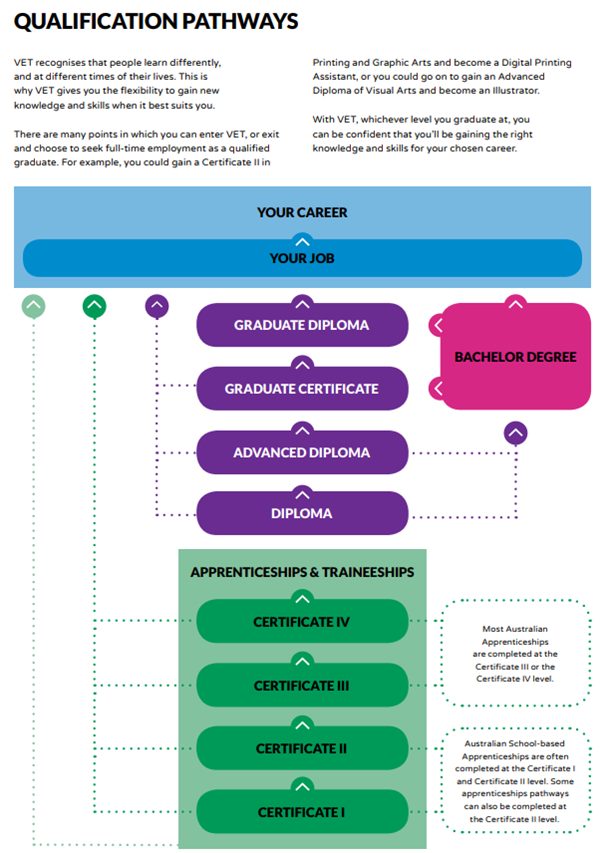
Source: Succeed p.9 https://www.myskills.gov.au/media/1827/succeed_accessible.pdf
Participation rates of secondary students in VET
The infographic below provides a relatively current snapshot of secondary student participation in VET.
Further to this a more recent research report via the NCVER in 2019 presents similar summary of information see the Key Messages starting on p.3 https://www.ncver.edu.au/__data/assets/pdf_file/0041/5579465/VET-for-secondary-school-students.pdf
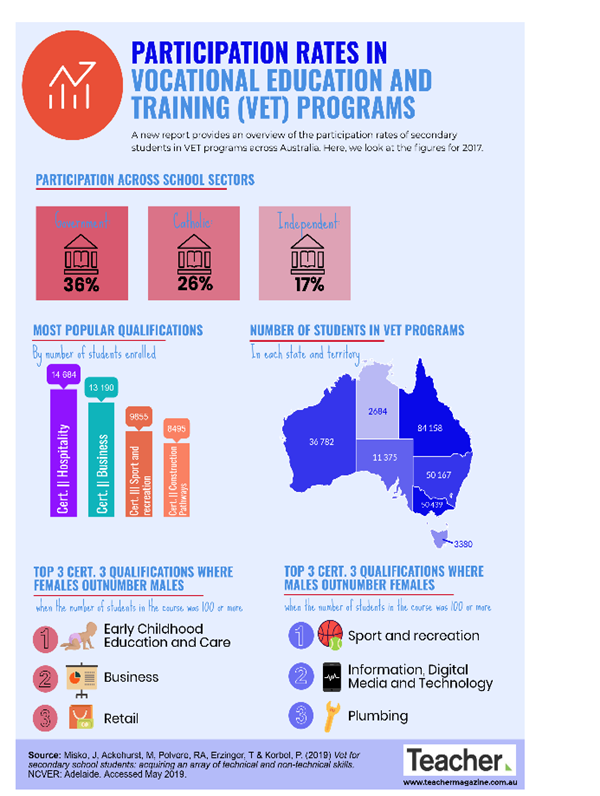
Source: Participation rates in VET by Teacher Magazine https://www.teachermagazine.com.au//articles/infographic-participation-rates-in-vet
More generally, at a national level…
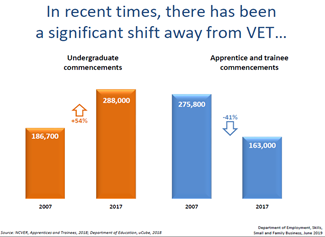
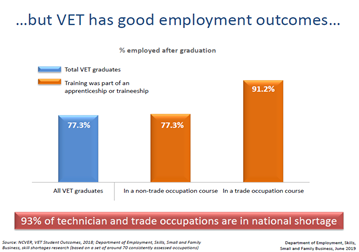
Vocational education and training (VET) includes employment-based training such as traineeships, apprenticeships and TAFE study.
VET stands for Vocational Education and Training, and vocation refers to work, employment or job role.
VET programs are designed to give students an exposure to practical skills and an understanding of what it is like to ‘learn through doing’.
Many young people don’t even consider studying a VET program/TAFE course due to incorrect perceptions or through lack of understanding of the sector.
Did you know that a significant proportion of occupations predicted to have the most jobs growth are in vocational training areas? There are a range of predicted skills shortages occupations which are reflected in the Victorian Government’s Free TAFE Initiative in Priority areas https://www.vic.gov.au/free-tafe
FYA partnered with the Federal Government Department of Education and Training to provide some excellent articles, videos and resources, including:
Exploring Career Pathways – A Toolkit for Parents and Carers https://www.fya.org.au/report/vet-toolkit-for-parents-teachers/ to support conversations with young people about how VET can help.
‘The 7 Biggest Myths About Vocational Education & Training (VET)’:
- VET is just for trades
- Studying a VET subject in high school means you can’t get an entry score for University
- VET is the option for low academic scores
- VET is a dead-end choice
- VET graduates cannot get a job
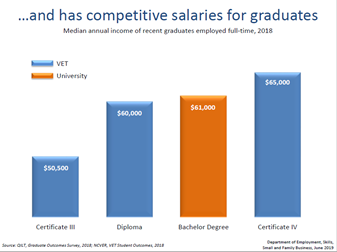
- VET grads earn low wages
- Jobs of the future need more than a VET education
‘9 Questions Everybody Asks about VET’
- What is VET?
- What kind of qualifications can you get?
- What are some things VET is good for?
- What’s the big deal about apprenticeships and traineeships?
- What’s the difference between an apprenticeship and a traineeship?
- What are school-based apprenticeships and traineeships?
- What is a RTO?
- How do you pay?
- Am I still eligible to get an ATAR if I do a VET course?
Source: https://www.fya.org.au/category/all-articles/video/how-i-got-the-job/ and https://www.fya.org.au/category/all-articles/get-a-job/so-i-heard/ and
Some benefits of TAFE courses during or after your secondary schooling include:
- Undertake applied learning
- Gain ‘industry ready’ experience
- Learn about industries and careers
- Obtain a qualification in a relatively short time frame.
- Higher level courses (e.g., Diploma) can provide a direct pathway into university courses with credit
- Can give you the opportunity to trial an industry or career area before you commit to university study
- Can give you a qualification you can use to gain part time work whilst undertaking university study.
VET resources
My Future VET Page
Comprehensive site with links to key VET resources, organisations and research. My Future VET Page
Vocational Education and Training Myth Busters Webinar for Parents
A webinar to let parents know more about work-related education and training opportunities in Australia, with the help of an expert panel, to mark National Skills Week 2020. See Vocational Education and Training Myth Busters Webinar for Parents
AATIS – VET and Apprenticeship Sector Cheat sheet and Podcast
If you haven't already, visit the VET Cheatsheet webpage and watch the recorded podcast as Cass Hoult and Ryan De Vincentis cover all the key terms in the apprenticeship sector and provide a cheatsheet for people wanting to know more about the industry You can download the VET cheatsheet here or Listen Now
Also:
- VCAA Get VET publication and video resources http://www.vcaa.vic.edu.au/getvet
- My Skills VET. It’s Right Now resources https://www.myskills.gov.au/career-info/advising-on-careers/vet-its-right-now/
- My Skills Succeed Publication https://www.myskills.gov.au/media/1827/succeed_accessible.pdf
- Victorian Free TAFE Courses - https://www.vic.gov.au/free-tafe?Redirect=1
- Victorian Skills Gateway website - http://bit.ly/2cPZDUF
- Australian Apprenticeship Pathways - https://www.aapathways.com.au/
- MySkills (Australia wide) - http://bit.ly/2gWp25g
- Private Colleges Australia, http://bit.ly/2fd3Moe
- Foundation for Young Australians, www.fya.org.au
VET at Marist-Sion
At Marist-Sion College, students can undertake VET via the following avenues:
- At Year 10 as part of the Year 10 Applied Learning Program
- At Year 11 and 12 as a compulsory aspect of the VCAL program
- At Year 11 and 12 students can incorporate a VET program as part of their VCE and, in most cases, the VET qualification contributes towards the VCE and the ATAR.
VET is a popular option at Marist-Sion College which has continued to show growth.
In 2022 students seeking to partake in VET as part of their school program include:
- 53 Year 10 students (48 in 2021)
- 55 Year 11 students (50 in 2021)
- 34 Year 12 students (23 in 2021)
In 2022 some interested Year 9 students will have the opportunity to participate in the Trade Pathways Program. This non-accredited program involves a term-based commitment and provides an opportunity for students to ‘taste’ one or more of the following vocational areas – carpentry, plumbing, automotive, engineering, electrical, hair and beauty, community care and rural studies.
The staff contact person for:
- Students currently completing or enrolled to complete VET is Mr Ben Cunningham.
- General enquiries about vocational pathways is Mrs Elly Martin.