
Parallel - Student News
Parallel – July edition
Editorial
Wow. Where did July go? Time flies when you’re trapped in the listlessness that is life during the COVID-19 pandemic. But so far, so good, right? Nossal has been doing as much as we can to employ as much safety measures as we can so that school is able to operate functionality. However, we can always do better- always remember physical distancing and keeping our masks on our faces.
It’s getting closer to the end of the year for all year levels, but Year 12 students only have weeks until their first exam. Even though I am sure that anxiety and stress is at its highest point all year currently (amplified by the stress of the pandemic), we can do this! We can push through and see it till the end. I hope you enjoy this edition of Parallel although it is short.
Just hold on for a little longer.
Ruth Jarra
Editor-in-chief
A review of The History of Literature, a podcast by Jacke Wilson
It was a Thursday afternoon when I found myself thinking about John Keats. In my Year 11 Literature class, we had studied a selection of his poetry and my friends and I were completely in love with them; we would quote lines and reference his poetry in random situations, tri-colons whispered and inside jokes shared. But the problem was, I couldn’t find any resources about John Keats that I could enjoy as thoroughly.
Until that Thursday afternoon. On a whim, I opened Spotify and typed ‘John Keats’ into the search bar and clicked on the first option that popped up: More John Keats, an episode of The History of Literature podcast. After the first couple minutes I realised that this was the follow up episode to John Keats. So I went back and listened to both.
Jacke Wilson, host of the podcast, was just as infatuated with Keats as I was. Having someone share a love for literature is as wonderful as it sounds (I am aware I am at risk of sounding pretentious).
With his soothing voice and enjoyable anecdotes combined with a generally beautiful way of phrasing his sentences. With 230+ episodes, The History of Literature is an accessible way for English students and literature lovers to listen to episodes about their favourite authors and books. As the title suggests, the podcast initially goes through the most fundamental works of literature known to the Western world before exploring authors through the centuries, from Sappho to Shakespeare to Steinbeck. Wilson also explores authors outside the Western sphere, creating a comprehensive resource covering most expanse of the world’s literary history.
I highly recommend this podcast. Wilson invites many co-hosts onto the show that add entertainment and provide dynamic discussion. Though you might not agree with everything said, it is still an informative and enjoyable experience. There’s also a good chance that your favourite author already has an episode but if there isn’t- well, I guess you’ll just have to wait a little longer. In the meantime, why don’t you sit down with a cup of tea and enjoy the show?
(Views expressed in this review are individual opinion and do not reflect the newsletter as a whole.)
Ruth Jarra
Editor-in-chief
My Thoughts on a Sad Horse, a look at BoJack Horseman
Whilst Disney and Pixar may be the first to come to mind when the word ‘animation’ is uttered, there is certainly a market for cartoons targeted towards older audiences. The Simpsons, Futurama and the less critically acclaimed Family Guy, may have established themselves as the founders of adult animation, but none of the aforementioned shows have achieved the same height as Netflix’s BoJack Horseman.
Presenting itself as a comedy with an astonishing 8.7 rating on IMDb, BoJack Horseman tackles a host of deeper issues that range from depression to addiction. Instead of merely referring to these in the form of an edgy joke, BoJack Horseman showcases the struggle of overcoming these issues, all to the tune of a peppy theme song and brightly coloured animation.
The titular character, BoJack, who just so happens to be half horse, is a celebrity has-been who struggles with depression and spends his life mourning his glory days. He lounges about his mansion; drinking and watching the sitcom he used to star in. The genius of the premise, however, is the fact that a majority of the show’s humour comes from BoJack’s coping mechanism: deflection. It is not his sadness that is funny, but rather the quips he makes when deflecting the genuine concern of his friends. One instant the viewer feels empathy, and yet they can also experience laughter in the same breath. However, these underlying issues are consistent, and beneath all the jokes and childish animation is a character who struggles with the simple desire to be a better person.
For all these reasons, I would highly recommend this show for anyone interested in seeing serious ideas and themes through the medium for animation.
(A content warning: depression and addiction)
(Views expressed in this review are individual opinion and do not reflect the newsletter as a whole)
Elijah Zaheen
Year 12
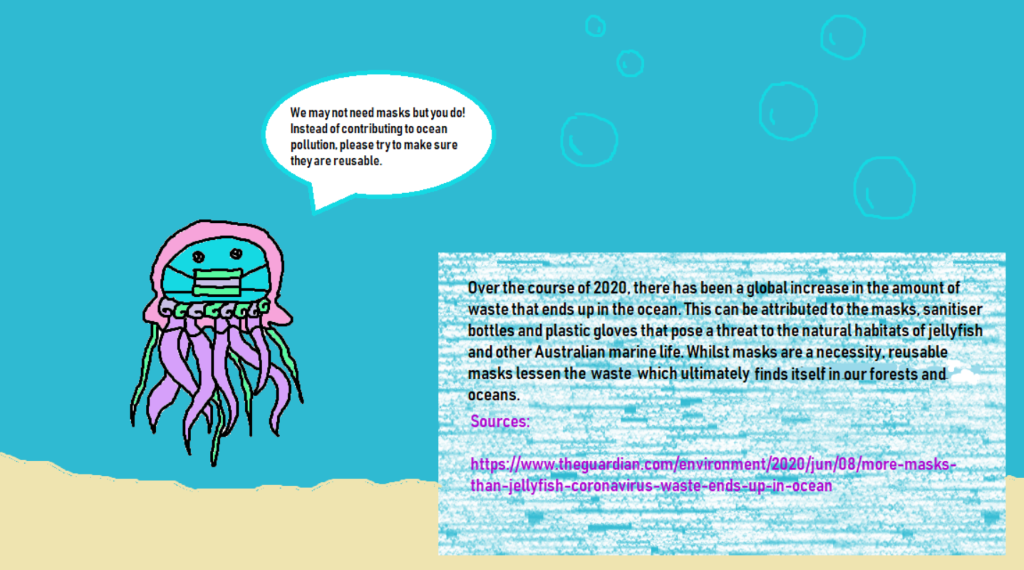
Reusable masks save our planet, an artwork
Elijah Zaheen
Year 12