
Notes from the Numeracy Specialist…
Focusing on one times-table at a time enables your child to develop familiarity with the multiples, and develop a sense of the numbers belonging together in a fact family. This makes division and finding factors easier.
The 5s Times-table
Many students feel confident about their 5x tables because they are able to quickly count by 5s. This strategy is effective for smaller numbers but 5x27 for example, becomes cumbersome and counting becomes unreliable. The following strategy aims to develop automatic recall of 5s facts which also helps with division.
Strategy 1 – Clock Facts
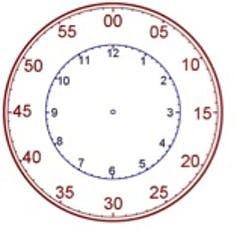
1. Look at an analogue clock face. How do we know how many minutes the long hand is indicating?
Often we refer to known markers/facts such as the 3, 6, and 9. We can use a known fact such as 6 =30 minutes then work backwards to 5 = 25 minutes or forwards to 7 = 35 minutes.
Using known facts to quickly calculate close facts is a quick way of developing fact fluency.
2. Draw a clock face and label the minutes for each numeral.
3. Use a pack of cards (or Uno cards) to practice fact fluency, multiplying each card by 5. Aim to complete the pack in less than 1 minute. Remember to think of the clock for efficient recall or use a known fact to work forwards/backwards to a close fact. Avoid counting by 5s if you can!
Using Clock Facts for Division
Once established, the clock association with the 5s facts also assists in building reverse facts/ division. For example “45 divided by 5” can be thought of as “What number is the long hand pointing at to indicate 45 minutes?” Practice some examples like…
- How many 5s in 40? (Think “What number would the long hand point to for 40 minutes?”
- 5 x ? = 60 (Think “What would the long hand point to for 60 minutes?”
- 35 divided by 5 = ? (Think “What would the long hand point to for 35 mins?”)
Tips for multiplying larger numbers by 5 in the next newsletter.
Penelope Dyson
Numeracy Specialist

Penelope Dyson
Penelope Dyson