Resources

AAPathways Update
Australian Apprenticeships Incentives: The linked article provides a fantastic summary of the new Australian Apprenticeship Incentives System which came into effect in July 2022. It is an easy and worthwhile read for employers, students, young people and their supporters.
Australian Apprenticeships Discussion and Feedback
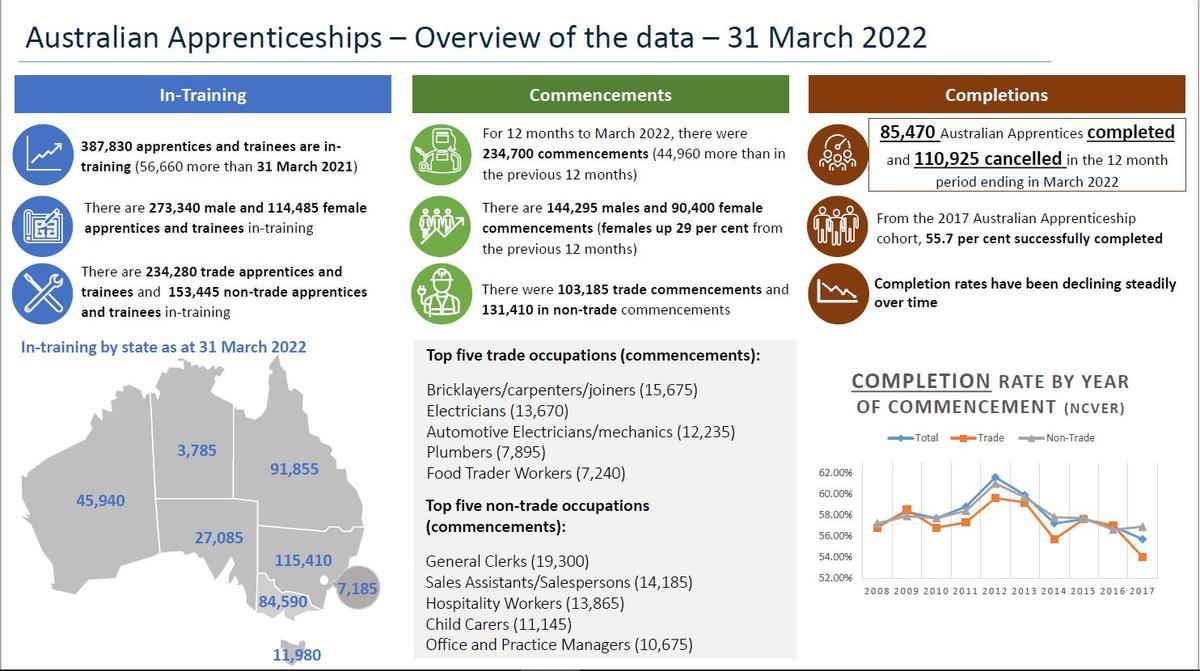
The Australian Government released the Australian Apprenticeship Services and Supports Discussion Paper on 16 November 2022 as part of the commitment made at the Jobs and Skills Summit to work with states, territories and stakeholders to improve the apprenticeship system and drive-up completions.
The discussion paper explores the current non-financial services and supports available to seek views on how to address three key questions facing the apprenticeships system:
- What changes are needed to drive up the completion rate?
- How can apprenticeship services better encourage and support apprentices from diverse background?
- How can support services be optimised to meet current and future needs of apprentices and employers?
Consultation is open until 16 December 2022. To get involved download the discussion paper (also attached) and submit your feedback. Your responses will inform future priorities within the Apprenticeship System.
myfuture update
Exploring post-school options
Apprenticeships: offer nationally recognised qualifications and paid training pathways to hundreds of different careers, from traditional trades to new and emerging occupations.
Vocational education and training (VET): Students wanting to gain practical work skills or a qualification towards a particular occupation can explore a wide variety of VET programs. VET offers flexible, targeted training options and can sometimes create a pathway to university.
Alternative pathways to university: In addition to VET, other pathways to university such as bridging or enabling courses may be available for students who don't think they'll qualify for direct entry.
Seeking employment: Students looking for work or considering an apprenticeship can learn how to produce quality applications, prepare for interviews, and more.
Still considering ideas: My career profile helps students identify their interests, skills and values, then explore a range of suggested occupations to find out about employment prospects, training pathways and more. Results can also be exported and shared to support further career conversations.
Occupational spotlight videos
Discover the growing range of videos in our new series designed to help young people learn about career pathways. We feature handy tips from real people working in a variety of occupations and industries, along with engaging accounts of their unique career journeys.
Watch the videos in myfuture’s new Occupational Spotlight Series to hear from Jade Louise, a counsellor/case manager, Tameeka, a mechanical fitter apprentice, Deb, a trainer and assessor and Renee, a mixed cropping irrigation farmer. Discover how they started their careers, the pathways they took to their current roles, and why they love what they do.
Study Work Grow Update
- School Leaver Quiz is out now - help your young person to know if they're ready for that next big step in life. It takes about 5mins and is available here.
- Teenage Volunteering Abroad with Projects Abroad
- Pathways to Nursing Guide 2022
- School Leaver Toolkit
- How to become…Veterinarian, Emergency Services Operator (answering 000 calls), Disaster Management Officer, Border Force Officer.
- Competitions, Scholarships, Work Experience, Parliamentary Apprenticeships, etc.
- The New Apprenticeships and Traineeships Guide, full of super helpful information for anyone exploring these pathways which combine formal training (usually VET) and on-the-job training (attached below)
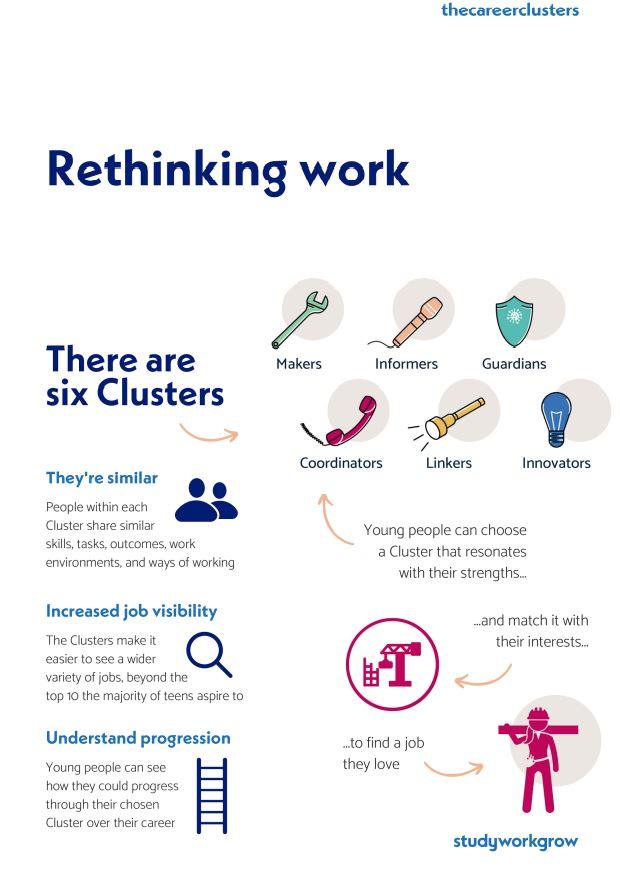
- SWG Cluster Report – you can’t be what you can’t see! The Cluster Report recognises that around half of all young people aspire to just 1% of jobs, predominantly because they don’t know what else is out there. The Cluster approach aims to rethink work and how we group roles. Here is a quick visual from the report.
Interested in forensic science careers?
Afterlife is a web series that explores what goes on behind the doors at the Victorian Institute of Forensic Medicine and the Coroners Court of Victoria.
Join Meshel Laurie and Catherine McClements as they interview Melbourne’s real Silent Witness and meet some of Australia’s top forensic and legal experts, including forensic pathologists, anthropologists, toxicologists, odontologists, molecular biologists, physicians and coroners, https://bit.ly/3eC56xc
Explore careers in forensic science and study pathways at https://bit.ly/2TbU4WS
Other career websites
- My Health Career is a fantastic website that has career resources such as information sheets and videos about careers in several health fields. www.myhealthcareer.com.au
- Student Edge features competitions, information on how to secure a job, occupation profiles, and advice on how to narrow down career interests based on study areas. https://studentedge.org/
- Skillsroad students can explore courses, occupations, and industries. They can also undertake a mini career quiz and research occupations based on their favourite subjects. www.skillsroad.com.au
- Good Careers Guide students can search over 400 different occupations narrowed down by the field or type of work they would like to do in the future (e.g., helping / advising, creative / artistic). They can also research ‘career ladders’ and take an aptitude test to assist in narrowing down career ideas. www.goodcareersguide.com.au/
- Course Seeker and Compareed contain a national course search and comparison tool which allows students to search, select and compare higher education courses and filter search results by ATAR, study area and location. www.courseseeker.edu.au and www.compared.edu.au
- Australian Public Service (APS) The APS offers a huge range of careers. As one of the biggest employers in Australia it offers careers to suit just about anyone. You can search for graduate opportunities and general entry jobs via the website. www.apsjobs.gov.au/s/
- MyGain check out this YouTube channel to watch videos about apprenticeships, traineeships, profiles of people working in different industries, employers, and apprenticeship and group training companies. http://bit.ly/1NC2fUS
- Science at Monash Your Essential Guide includes video tours of Monash facilities, handy links and course advice webinars. Students can also book a one on one appointment with Monash Science VTAC selection officers and our friendly Science Student Ambassadors. https://www.monash.edu/science/future-students/your-essential-guide-domestic-students
- The Australian Institute of Music (AIM) has developed a career guide for people passionate about pursuing a career in the music industry. The guide features over 75 occupations! You can access the guide via https://aim.edu.au/aim-music-careers-guide/
UAC ATAR Compass
Source: The Age, HSC students to get a more accurate ATAR calculator, 21 November 2022
The Universities Admissions Centre (UAC) will launch an online calculator on Monday to help students predict their ATAR with “a high degree of accuracy” by entering their chosen year 12 subjects and expected or actual exam marks. While the calculator, called the ATAR Compass, will produce a reliable estimate, it is based on the HSC (NSW) and experts say it should only be used as a guide.
A students’ ATAR is a rank that measures their overall performance compared to their year group, and is the number used by universities to select which school-leavers they allow entry to courses.
Worth noting, there are some long-standing misconceptions remain about results and scaling, largely because there can be “quite a difference” between how a student performs in a course/study and how a student ranks against their cohort. “An ATAR tells you how you’ve compared to everyone else in your year group when comparing to all courses/studies.”
“There are also many myths about certain courses/studies being scaled up and others scaled down. The reality is that for most students they should only be focused on the courses/studies they enjoy, are interested in and will perform best in, and less concerned about how a certain course scales.”
Supports for Young People wanting to access higher education
The following information was provided by the Lookout Centre which has the focus on supporting young people in out of home care situations, but there are also some supports that extend to all young people, so it is definitely worth sharing with the wider school community.
Financial support is available from the government and universities to help young people, including those with a care experience, to access higher education.
- Government payment of $1500 for education and living expenses.
- Support, services and financial assistance from Federation University, La Trobe University and Swinburne University.
- Scholarships from other universities and institutions.
- Youth Allowance for students between 16 and 21, or up to 25 if you are a full-time student. Find out whether you are eligible and how to apply.
- Study Assist for students to acquire a HELP loan or other funding.
- Saver Plus assists individuals and families on lower incomes to improve financial capability.
- ABSTUDY help for young Aboriginal people with study/apprenticeship costs.
Specific to those who are care leavers, you have access to 800+ no-fee TAFE courses via the Skills First Youth Access Initiative. This is a great way to get into university via a TAFE pathway and potentially get credits for a uni course. Or you can complete one or more TAFE qualifications to set you up in the career you want to get into. To be eligible, you need to:
- be an Australian or New Zealand citizen and aged 24 years or under; and
- have been or are currently on a Child Protection Order or a Youth Justice Order (but are not currently in custody); or
- be a resident of an Education First Youth Foyer.
If you are eligible, you can choose from 800+ courses, from Certificate through to Advanced Diploma level. For more information, read the guide and referral form. Click here to download our guide to Skills First and Free TAFE initiatives.
Most uni courses aren’t free, but did you know that a lot of them are subsidised? Or that you have the option to defer paying your course fees until a later date? Read up on your options here.
Other education supports and programs
- Skills First Reconnect supports learners aged 17 to 19 who have not completed year 12 or equivalent and are not in education, training or full time employment and those aged 20 to 64 who have not completed year 12 or equivalent and who are long-term unemployed.
- Learn Local: Learn Local providers offer a range of education and training programs designed to help learners gain the confidence and skills needed to look for a job or go on to further study. Find your local provider here.
- LLENS: Check out your Local Learning and Employment Network (LLEN) for education, employment and other supports and services including scholarships, health/wellbeing and accommodation. Find your LLEN here.
- Skills and Jobs Centres: These centres provide expert advice on training and employment opportunities for prospective students and job seekers. Find your local Centre here.
- Tertiary Information Service (TIS): A collective of universities, TAFE institutes and independent tertiary colleges helping students prepare for future careers through free events around Victoria.
Future You
Future You aims to inspire an interest in STEM (Science, Technology, Engineering and Maths) careers amongst children aged 8 to 12. STEM will be a major growth area for jobs of the future, but there is currently a shortage of people who have the skills we need to tackle our greatest challenges.
Children often decide what careers they will pursue early in life, with the ages between 8 and 12 being seen as a key stage in this thinking. Their decisions are influenced by attitudes expressed towards these careers by the important adults in their lives – their carers, their families and teachers.
Future You aims to show children the world of opportunities awaiting them through STEM and other vital skills. Through films, short stories, posters, downloadable activities and competitions, Future You provides inspirational role models for children, whilst offering practical advice on what they can do now to start their journey.
Research and information to ponder…
Future of Work Report from The Prince’s Trust was released recently – they identified three key trends:
- Young people are interested in sustainable jobs;
- They want the future skills they need to work in those jobs; and
- They are also keen to explore entrepreneurship.
This handy and concise (less than 2min) YouTube video summarises the report.
NCVER released a media release and paper relating to outcomes for VET and Higher Education in the same occupation – the key points are of note:
- VET graduates more job ready, with university graduates having more career opportunities;
- VET and higher education qualified individuals in the same occupation are equally satisfied with their job, including work life balance, hours of work and job security; and
Employers actively recruit for and employ both VET and higher education qualified individuals. For them, experience, skills and fit with the company are often more important than the qualification when assessing candidates for positions.
Australian Skills Classification
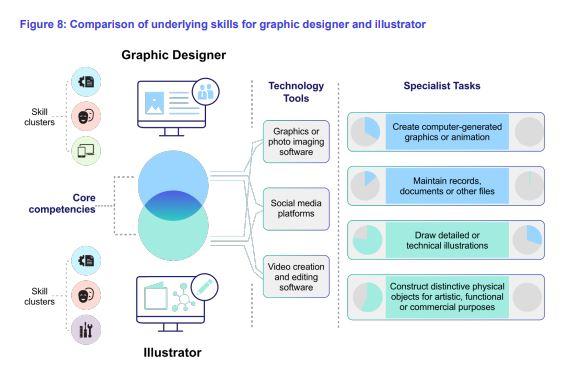
The ASC offers a way to explore the connections and transferability between skills and between jobs. This data is next level in terms of detail, covering core competencies, specialist tasks, technology tools, clusters and emerging areas within an occupation. This date also powers the helpful website Your Career and there is a new tab called Similar Occupations which encourages exploration beyond a single job.
Below is a visual example of a comparison of skills for graphic designer and illustrator: