In focus: Careers Expos, Open Days, Information Events and Early Entry Programs

It is coming to that time of the year again – where career expos, open days and information events are happening thick and fast.
Institutions are working hard to make information and support readily available to those keen to find out more about options and pathways. Students are encouraged to make use of these opportunities and where possible chat to current students, course experts, support staff, admissions experts, and where possible attend workshops and tours.
Here are some questions to consider asking at any opportunity you get, whether it be an online Course Information Session or an Open Day.
Questions to ask course experts
Course experts are academics, course coordinators and lecturers. Basically, they know the details about each course on offer.
Ask them:
- What does the course cover?
- Is study abroad an option and would it count towards the degree?
- How many hours a week will I get face-to-face teaching?
- What’s the split between lectures, tutorials and self-directed study?
- What size are tutorial groups?
- How does the subject at this uni compare with the way it is taught at other unis?
- What links does the faculty have with employers?
- Do you build employability skills into the curriculum?
- Are there opportunities for work experience and placements?
- Does this uni help find the placements and are they paid?
- What kind of jobs do graduates get?
Questions to ask support staff
Support staff facilitate a range of great services to help you achieve your study and career goals.
Ask them:
- Who can help me if I’m struggling with my studies or need help?
- What if I have a disability? Is there any support for me?
- Can you tell me about student accommodation options at this campus?
- Are there any options to get help developing my career or finding work?
- I’m an Aboriginal and/or Torres Strait Islander – are there any services available for me?
Questions to ask admissions staff
Admission staff know all the ins and outs of applying to uni. They are the people who actually process applications, so they’ll be able to give you some great tips.
Ask them:
- What scholarships are on offer?
- Can I get any help with my fees and university costs?
- Can you tell me about admissions pathways to my course, for example adjustment factors or entry schemes?
- Can you tell me what options I have if I don’t meet the entry requirements?
- How do I apply to my course, and what are the deadlines?
- Do you have any advice for preparing my application?
Questions to ask current students
Current students know all about life at university, and they’ll be able to answer questions about the university experience from a personal perspective.
Ask them:
- What clubs and societies are available?
- How do you find studying at this university?
- What are the best things about being a university student?
- What are the biggest challenges about being a university student?
- How is university different from high school?
- What are your tips for fitting work around study?
- Do you have any advice for me?
Source: Adapted from https://www.openday.acu.edu.au/stories/best-questions-to-ask-on-open-day
Normally at this time of the year I would have an Open Day Resource to publish with this newsletter, but it has been problematic with institutions delaying announcements about key events.
I anticipate an up to date Open Day and Key Information Resource will be available with the June Career News. Apologies for the delay.
Next best option is this link from My Future https://myfuture.edu.au/assist-others/open-days
Research your university and TAFE course options
Tertiary Admission Centres
State-based Tertiary Admission Centres process course applications on behalf of universities, some TAFE institutes, and some private providers.
You can research courses, prerequisites, selection criteria and ATAR profiles for the 2023 intake.
Courses for the 2023 intake will be updated mid-year but you can use the Archived Course Information Search as a guide.
Websites are listed below
Victoria www.vtac.edu.au
NSW & ACT www.uac.edu.au
QLD www.qtac.edu.au
SA & NT www.satac.edu.au
Tasmania www.utas.edu.au
Australia wide search
Course Seeker is a fantastic website that enables students to be able to explore courses for each state in the one website.
You can research courses, prerequisites, selection criteria and ATAR profiles for the 2022 intake. Course information for the 2023 intake will be updated later in the year.
VTAC – Important dates
VTAC – Victorian Tertiary Admissions Centre.
Year 12 students interested in further study (in Victoria) are strongly encouraged to frequent and familiarize themselves with the VTAC website www.vtac.edu.au
VTAC have recently released some key dates for the 2022 year
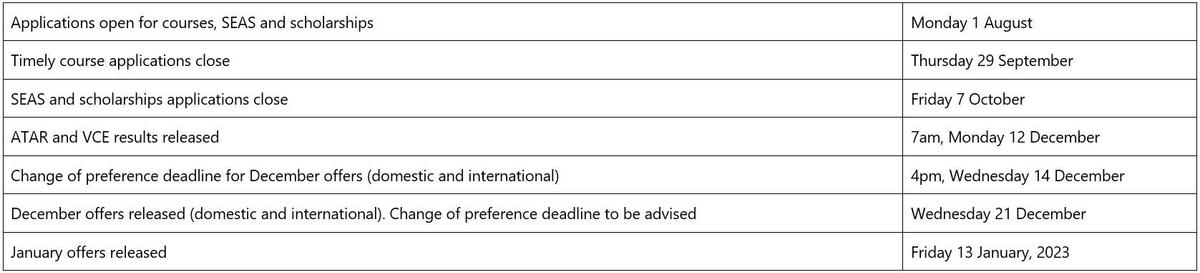
The change of preference period between ATAR release and the December change of preference deadline has been extended to be as long as possible while still allowing tertiary institutions the time they need for course selection. Applicants will also have the opportunity to change their course preferences between the December and January rounds. Dates for this and further information will be made available as it is confirmed. Please keep in mind that dates may be subject to change.
TAFE
MySkills is the national directory of vocational education (VET) organisations and courses.
You can search for courses or occupations and use a location search.
You can also browse courses and occupations by industries such as health & community services, manufacturing & engineering, and arts & culture.
Students are also encouraged to keep an eye on the Free TAFE website as this outlines VET programs which are Free and deemed priority areas.
Financing Further Study – Student Contributions towards University Degrees
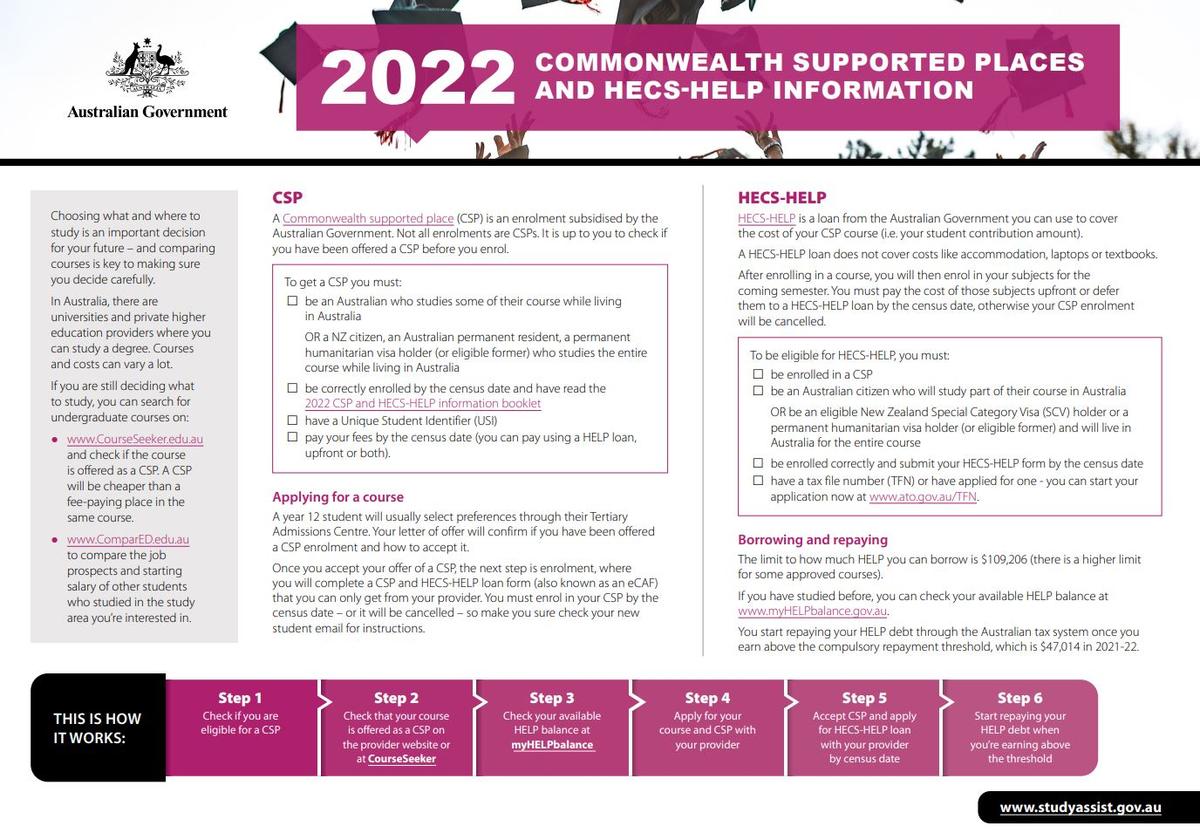
When Australian students go to university they are eligible for a Commonwealth supported place (CSP), whereby the Australian Government pays some of the university fees and the student pays the rest, this is called the 'student contribution amount'.
Students are encouraged to browse Study Assist to familiarise themselves further about the costs of university study.
This factsheet is a great resource: 2022 Commonwealth supported places and HECS‑HELP information (studyassist.gov.au)
I have no idea about what you are talking about – glossary of terms
Sometimes the terms and language used in careers and pathways can be so new and obscure to students and parents. So, if in doubt, maybe get the glossary out J
Here are some helpful ones:
- Victorian Senior Student terminology - https://www.vcaa.vic.edu.au/studentguides/where-to-now/Pages/Glossary.aspx
- Australian Government My Skills Glossary (for VET-related terminology) - https://www.myskills.gov.au/more/help/glossary/
- VTAC (Vic Tertiary Admission Centre) Terms and Definitions - http://www.vtac.edu.au/help/glossary.html
- University terminology - https://www.sydney.edu.au/students/glossary.html
Early Entry Guide from Study Work Grow - attached
Knowing what university course you’re going to be studying next year can make it much easier to focus on finishing your Year 12 studies. Even if it’s an unconfirmed offer (or conditional offer), it can help take the pressure off you. But finding and applying for these programs can be confusing.
That’s why you need the University Early Entry Guide
Containing 36 pages, the latest annual edition of our popular Study Work Grow guide will help you:
- Find an early entry pathway at every participating Australian university
- Discover what each program offers and any application requirements
- Understand what you need to have achieved to apply (or what to aim for in your Year 12 results)
- Apply, or prepare to apply early so that you can focus on your studies
University Early Entry Programs take students based on their skills, attributes and experiences, not just your ATAR. This means the university has more control over who is admitted to their programs, and in return you can get a place without needing to rely on (or wait for) your ATAR.
Only around 1 in 4 people get into uni based solely on their ATAR – everyone else uses a combination of other experience, external test results, interviews and references to get a spot. So the Early Entry Guide is a great way to find out all of the options available to you.
Interested Year 12s (and their parents/guardians) are encouraged to download the attached guide.
Additional information or updates about Early Entry Programs will be included in future Career Newsletters via the Tertiary Updates section.