CHILD SAFETY IS EVERYONE'S RESPONSIBILITY
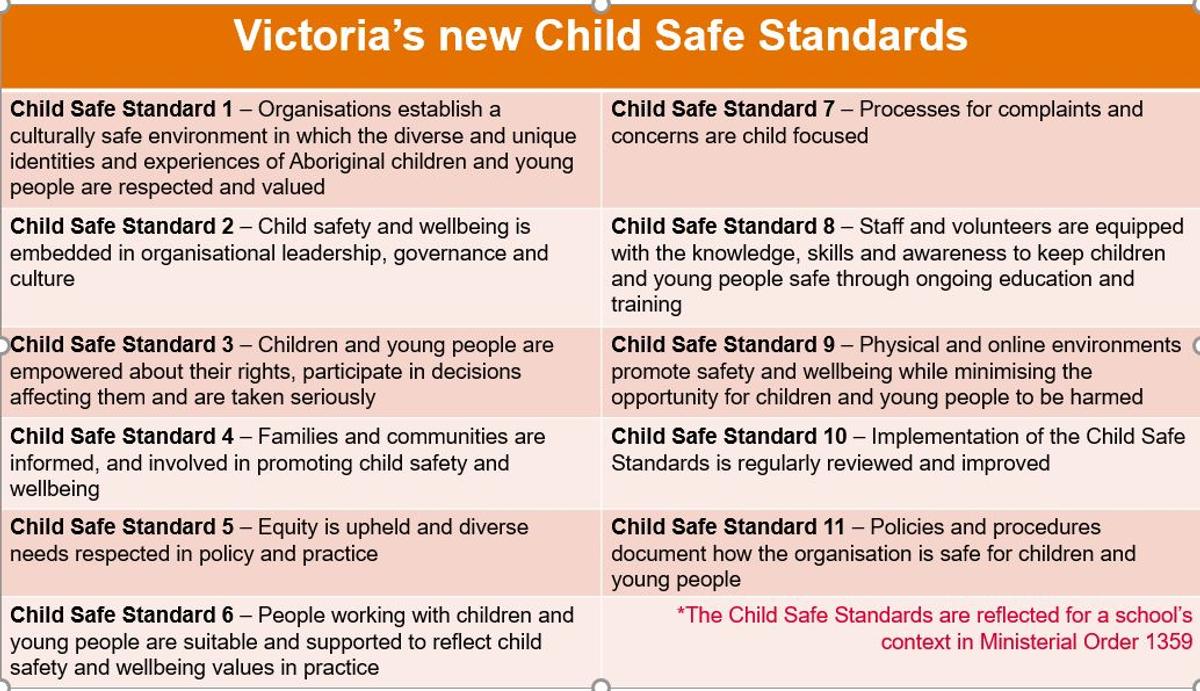
CHILD SAFE STANDARD 1
Organisations establish a culturally safe environment in which the diverse and unique identities and experiences of Aboriginal children and young people are respected and valued
In complying with Child Safe Standard 1
The school council, parents and carers, visitors, staff and principal will ensure:
1.1 A student's ability to express their culture and enjoy their cultural rights is encouraged and actively supported.
1.2 Strategies are embedded within the school which equip all members to acknowledge and appreciate the strengths of Aboriginal culture and understand its importance to the wellbeing and safety of Aboriginal children and young people.
1.3 Measures are adopted by the school to ensure racism within the school is identified, confronted and not tolerated. Any instances of racism are addressed with appropriate consequences.
1.4 The school actively supports and facilitates participation and inclusion within it by Aboriginal children, young people and their families.
1.5 All of the school's policies, procedures, systems and processes together create a culturally safe and inclusive environment and meet the needs of Aboriginal children, young people and their families.
Ripponlea Primary School does the following to adhere to Standard 1:
Build a culturally safe environment/cultural inclusion
- Acknowledges and celebrates the cultural diversity of all students and their families.
- Encourages students and families to share their cultural values, histories, traditions and celebrations.
- Begins the school day with an acknowledgement of Country in each classroom as decided by the class. School leaders facilitate these discussions.
- Begins events, assemblies and meetings with an Acknowledgement of Country as a standing agenda item. We will use this as an opportunity to pause and reflect or open a discussion.
- Fly the Aboriginal and Torres Strait Islander flags on school grounds.
- Display plaques and signs to Acknowledge Country and Traditional Owners - Bununrong people of the Kulin Nations.
- Make Aboriginal voice part of decision-making in matters that affect Aboriginal students.
- Celebrate the community in communications with students, staff, volunteers and families. Share this information through school newsletters and school assemblies.
- Learn more about Aboriginal histories and cultures, both locally and across Australia.
- Speak with respect and confidence about Aboriginal culture, knowledge systems and people.
- Build schoolwide knowledge of Aboriginal histories, cultures, perspectives, values, skills and attitudes.
- Has developed a Reconciliation Action Plan.
Provide a welcoming environment for Aboriginal children
- Acknowledge and draw on the existing knowledge of Aboriginal students and their families.
- Use Koorie Engagement Support Officers (KESOs) to provide advice to our school about creating culturally inclusive learning environments.
- Engage with local elders in the community to support transitions of Aboriginal students to the school.
Actively address racism
- Express zero tolerance of racism in our statement of commitment to child safety included in our Child Safety and Wellbeing Policy and other documents.
- Address racism from students, staff, volunteers or visitors directly. Make sure racist speech or actions are always dealt with, and the culture of the school works to prevent incidents from occurring.
- Put student and school leaders at the front of anti-racist action. Discuss racism and work to address unconscious bias and racism in the school community.
- Encourage school leaders and teachers to commit to ways they can work as effective allies to Aboriginal students, their families and communities.
Standing Together Against Racism: Our Commitment to a Safe and Inclusive School Community
At Ripponlea Primary School, we are unwavering in our commitment to fostering a safe, inclusive, and respectful learning environment for every student, staff member, and family.
As a public school, we proudly uphold the values of equity, diversity, and cultural safety — and we know that racism has no place in our community.
Recently, the Department of Education launched a new Anti-Racism Policy as part of its broader strategy to build culturally safe and inclusive schools across Victoria. This policy recognises that racism — in any form — is harmful, unacceptable, and must be addressed directly. It provides a clear framework for schools to prevent, respond to, and report incidents of racism, while promoting a whole-school culture of respect and belonging.
What the Policy Means for Our School
The new policy supports our ongoing work to:
- Call out racism when it occurs and provide culturally appropriate support for affected students.
- Educate our school community about the impact of racism and the importance of allyship.
- Empower students and staff to speak up safely, confidently, and respectfully.
- Implement clear processes for reporting and addressing racist behaviour in line with the Department's expectations.
We are working with staff and students to ensure everyone understands what racism can look like — from explicit comments to unconscious bias or exclusion — and how to respond appropriately. Education is a powerful tool for change, and we are committed to equipping our students with the knowledge, empathy, and courage to be respectful and active citizens.
A Shared Responsibility
Addressing racism is not the responsibility of a few — it requires a shared commitment from all of us. Families play a crucial role in reinforcing respectful attitudes and speaking with children about inclusion, fairness, and standing up for others. We encourage you to read the Department’s Anti-Racism Policy and discuss it with your child at home.
As a school, we will continue to:
- Celebrate the diverse cultural backgrounds of our students and families.
- Provide professional learning for staff in cultural responsiveness.
- Ensure students from all backgrounds feel seen, valued, and safe.
If your child experiences or witnesses racism, please don’t hesitate to speak to your child’s teacher, a member of the leadership team, or use our established student wellbeing channels. We are here to listen, to learn, and to act.
Together, we can ensure that every child grows up in an environment free from racism — one that uplifts and honours their identity, culture, and potential.
Guide and train staff and volunteers
- Train staff and volunteers to understand the importance of Aboriginal culture to the well-being and safety of Aboriginal students.
- Work with the local Aboriginal community to build staff, volunteer and student knowledge and respect for Aboriginal culture and to promote cultural inclusion.
- Ensure all staff have completed CUST - Community Understanding Safety Training.- https://www.vaeai.org.au/community-understanding-safety-training-online-information-session/
Build knowledge of Aboriginal culture in school planning and curriculum
- Find out about the Traditional Owners of the land/s where the school is situated at the Map of Indigenous Australia and learn about the importance of acknowledging Traditional Owners.
- Include Aboriginal history and culture in professional learning for staff and volunteers and in curriculum planning for students.
- Develop a resource bank of digital, hardcopy print and other artefacts that support the inclusion of Aboriginal content across the curriculum.
Partner with Indigenous communities
- Engage with Bunurong Land Council and other indigenous communities across Victoria.
- Engage with Indigenous Outreach Projects.
- Engage with cultural programs from www.biikbundjil.com.
- Partner with Ripponlea Kindergarten and Glen Eira City Council to establish community grants and engage with an Indigenous Artist in Residence program.
Review and assess how the school supports cultural inclusion
- Use the Victorian Aboriginal Child Care Agency cultural safety continuum reflective tool to make a tailored learning and development plan focused on staff cultural competence learning needs.
- Develop and implement a Reconciliation Action Plan in partnership with Ripponlea Kindergarten.
Recognise key events and anniversaries with our COMPASS calendar
- National Sorry Day
- Harmony Day
- National Reconciliation Week
- NAIDOC Week
- National Aboriginal and Torres Strait Islander Children’s Day
- Mabo and other key dates