Principal Team Update
Term 1 - Edition no: 03, 2026
Principal Team Update
Term 1 - Edition no: 03, 2026
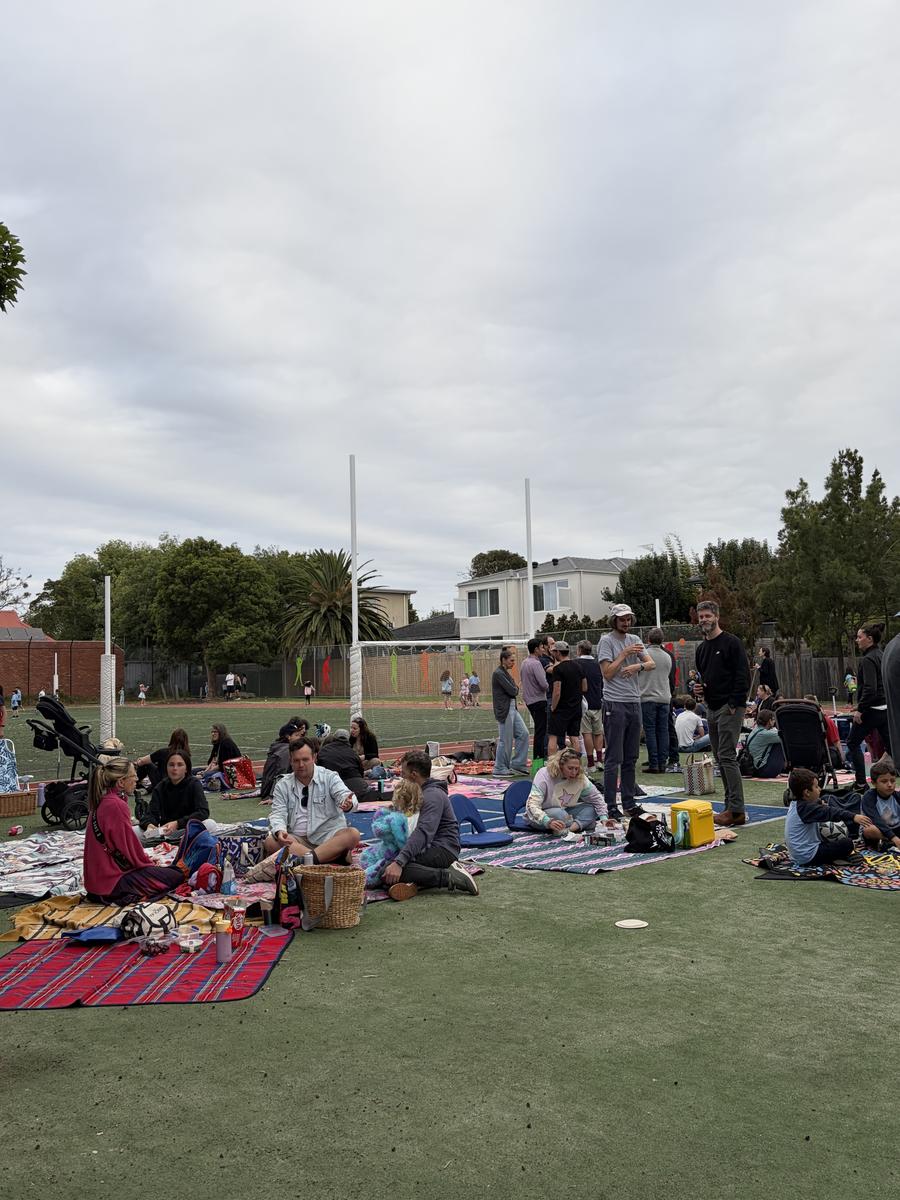
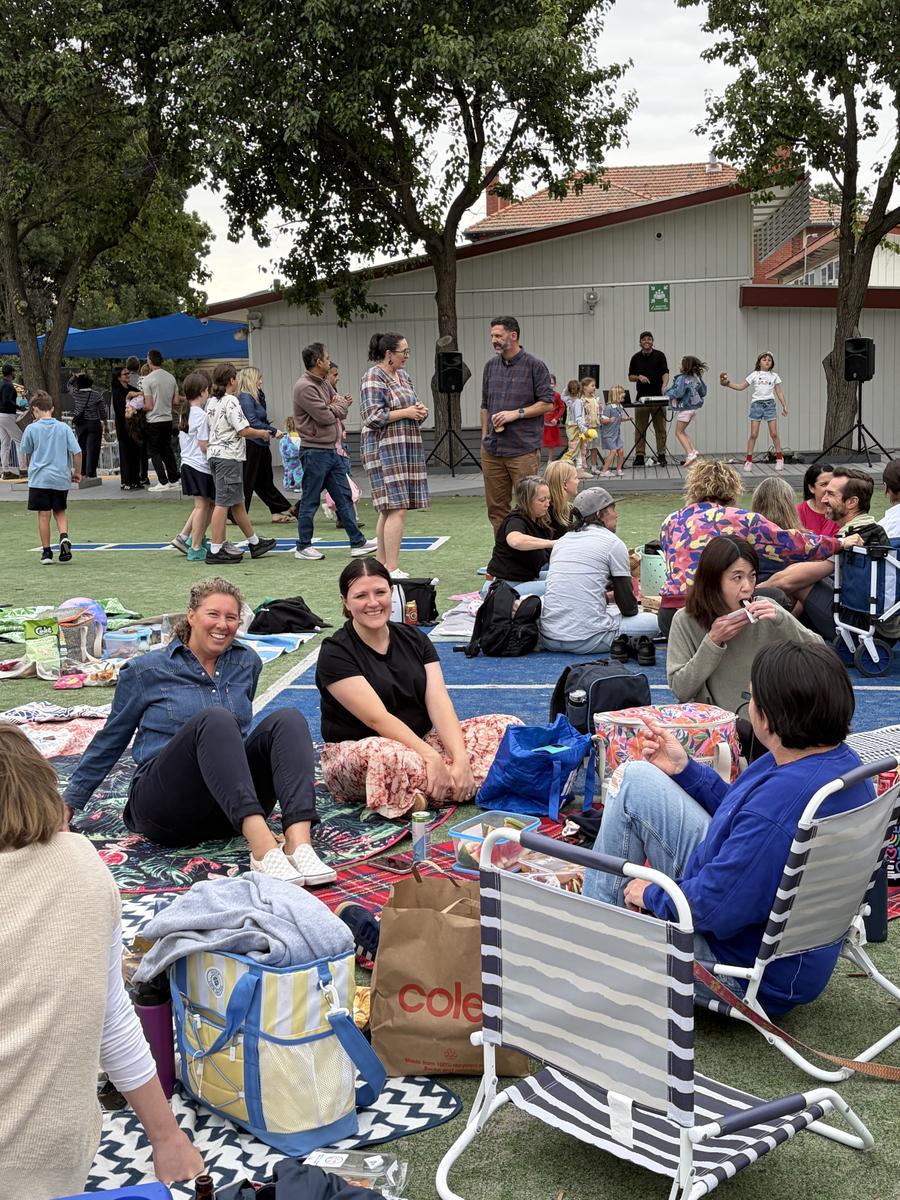
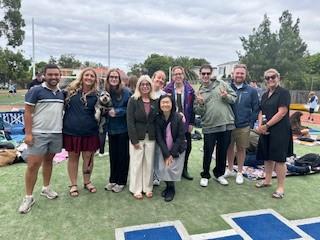
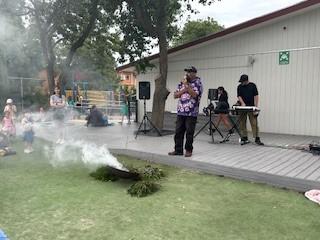
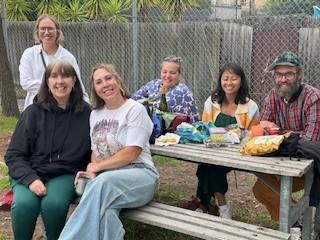
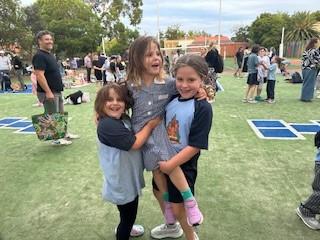
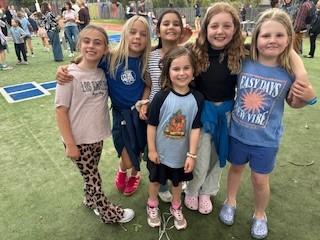
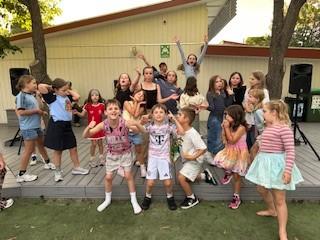
What a beautiful evening we shared at our annual Ripponlea Primary School Welcome Picnic last night. It was truly heartwarming to see so many familiar faces alongside the many new families joining our community this year, including those from our wonderful local kinder community. The weather was kind to us, with not a drop of rain in sight, allowing everyone to relax and enjoy the evening together with great enthusiasm.
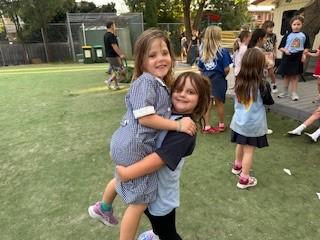
Students certainly made the most of the opportunity to enjoy their whole school. With the freedom to move around the playgrounds, courts and open spaces, children played happily with friends old and new while staff and families mingled, chatted and shared food together. It was wonderful to see our school alive with laughter, connection and a strong sense of belonging.
We have many people to thank for helping make the evening so special. We were deeply honoured to have Uncle Mark Brown join us to deliver a Welcome to Country and conduct a Smoking Ceremony. Uncle Mark reminded us of the deep cultural significance of the land on which our school stands and the importance of acknowledging and respecting the ongoing connection of the Bunurong people to Country. As a school community, we value this opportunity to learn and reflect. Racism will never be tolerated at Ripponlea Primary School, and we are very proud of our strong and respectful connections to Bunurong people and their lands.
A heartfelt thank you must also go to the many volunteers who helped make the night possible. Events like this simply cannot happen without the support of our community. To our wonderful bakers you truly outdid yourselves. The delicious cakes, slices and treats were enjoyed by all and certainly kept many of our tummies very happy throughout the evening.
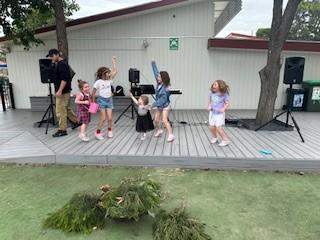
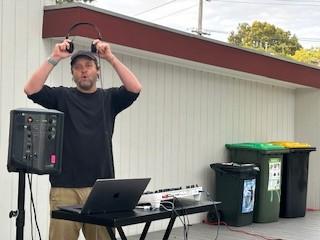
A special thank you also goes to Alec, the parent of Frances, for sharing his DJ talents with us. His music kept the energy high and had students and families dancing, singing and enjoying the festive atmosphere together.
It was also particularly special to see many past students returning to join the celebrations. Some are now in various year levels of high school, yet their connection to Ripponlea remains strong. Seeing them return and reconnect is a wonderful reminder of the lasting community bonds that our school creates.
There were a few sleepy faces arriving at school today, but the joy and sense of community created last night will remain with us for a long time. Moments like these remind us just how special the Ripponlea Primary School community truly is. Thank you to everyone who came along and helped make the evening such a memorable one.


For the past seven years, Ripponlea Primary School has proudly implemented a School Wide Positive Behaviour Support (SWPBS) framework. This is not a program we “add on”; it is the foundation that guides how we build culture, relationships, expectations and support systems across our school.
At RPS, student wellbeing and learning are inseparable. When students feel safe, valued and supported, they thrive academically, socially and emotionally.
Over the coming months, we will be sharing step by step how our wellbeing and engagement practices work, what curriculum we teach, and how we ensure every student is supported through a structured, evidence-based approach.
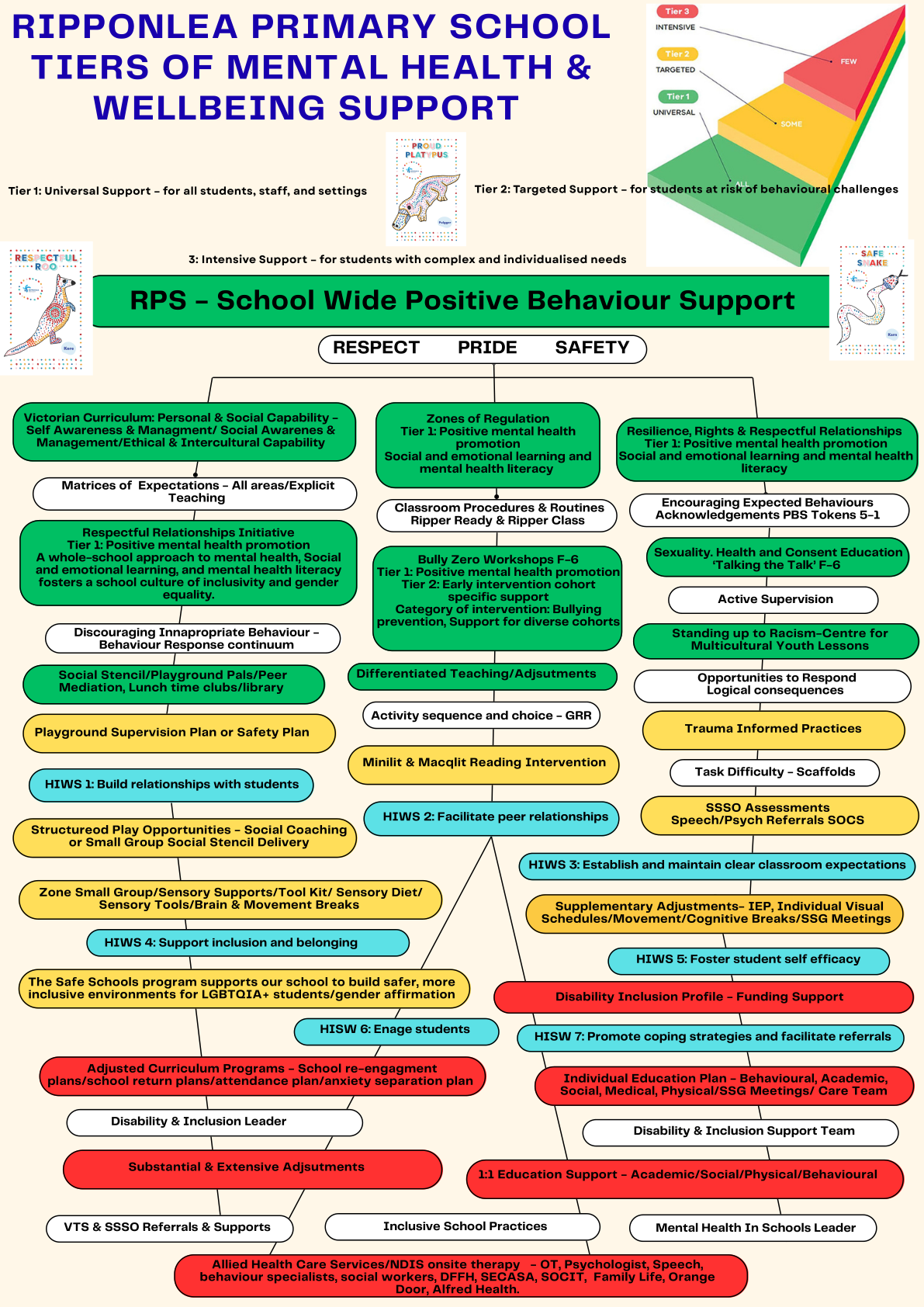
In simple terms, MTSS means:
'Every student receives the support they need when they need it'.
Think of MTSS as a three-layer support system:
Our MTSS model is not a single program. It is a whole-school system that connects:
It ensures that support is layered, proactive and responsive.
This is the foundation of our school.
At Tier 1, all students receive:
Approximately 80–90% of students thrive with Tier 1 supports alone.
Some students may need additional support at certain times.
Tier 2 can include:
These supports are designed to be early, preventative and responsive.
A small number of students may require more intensive, personalised intervention.
This may involve:
Tier 3 ensures no student “falls through the cracks.”
Our School-Wide Positive Behaviour Support (SWPBS) framework sits at the heart of Tier 1.
It ensures:
SWPBS is why students can articulate:
MTSS means:
✔ We do not wait for issues to escalate
✔ We respond early
✔ We use data, not guesswork
✔ We provide layered support
✔ We partner with families
✔ We maintain high expectations with high support
This framework allows us to balance compassion with accountability, ensuring students feel safe, capable and responsible.
Here we are at the beginning of a new school year and the beginning of a new
Strategic Planfor Ripponlea Primary School.
Many of our families will remember that last year we undertook a School Review. In simple terms, a School Review is when an independent panel works alongside the school to reflect on the past four years looking at:
It is not about “passing or failing.” It is about asking:
What are we doing well? What impact is it having? And where can we improve next?
Following our School Review, we developed a new four-year Strategic Plan. This is our roadmap for where we are heading as a school and how we will continue to grow.
The review confirmed that Ripponlea is a strong school with high achievement, strong wellbeing systems and a positive culture. Our next step is not to “fix” things but to refine, strengthen and stretch ourselves further.
Over the next four years, our focus is on two big goals:
We want every student regardless of their starting point to make strong progress each year.
This means:
We know wellbeing and learning are deeply connected.
Over the next four years, we will:
In simple terms:
We are building a school where expectations are high, learning is explicit, wellbeing is strong, and every child is challenged and supported.
And as always, everything is grounded in our vision:
They care. They create. They connect.
While the Strategic Plan sets our four-year direction, the Annual Implementation Plan (AIP) outlines what we are doing this year.
In 2026, we are focusing on:
What families might notice:
In 2026, we are:
What this means for students:
Students told us they feel happy and connected but they want to be challenged.
So in 2026 we are:
Students will:
In 2026 we are focusing on:
Families will notice:
We believe families should know:
Improvement is not accidental — it is deliberate.
2026 is our first strong step in this four-year journey.
Together, we are building:
Over the coming weeks, our Year 3 and Year 5 students will participate in the 2026 NAPLAN assessments.
For our Year 3 students, this is their very first experience with NAPLAN — an exciting milestone in their learning journey. Our Year 5 students are already familiar with the online platform and will approach the assessments with growing confidence and maturity.
We are incredibly proud of the calm, capable way our students approach new challenges.
NAPLAN is just one snapshot of learning, and we encourage our students to focus on doing their best, persisting when tasks feel challenging, and taking their time to think carefully.
Families can support by reminding children to:
At Ripponlea, we know that learning is about growth over time. These assessments are just one small part of the rich learning experiences happening every day in our classrooms.
We wish all our Year 3 and Year 5 students confidence, calm minds and proud smiles as they give it their best go.
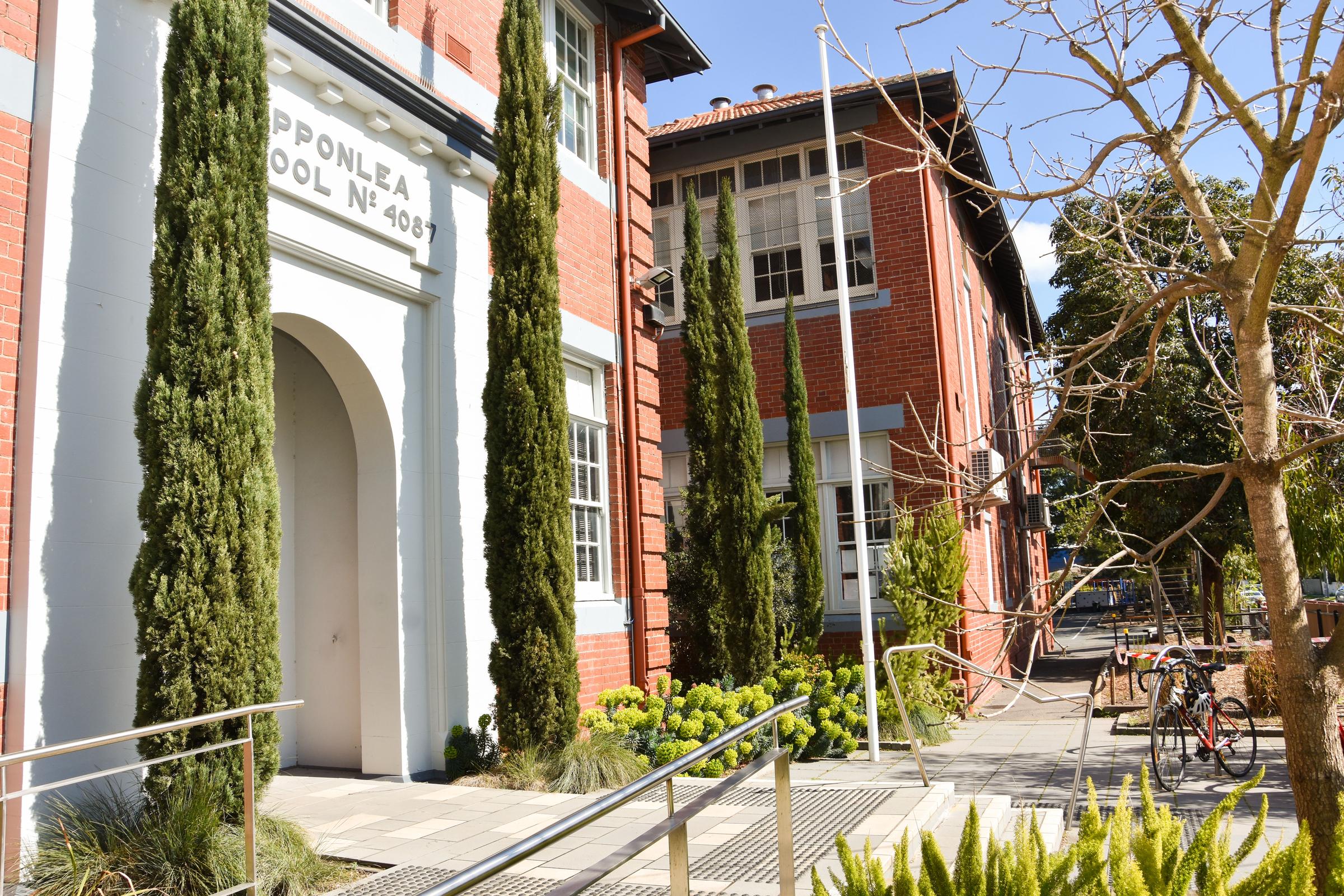
Did you know that Ripponlea Primary School is officially 104 years old?
For more than a century, our school has been at the heart of our local community nurturing generations of learners and living out our vision and values. While we are incredibly proud of our rich history and strong community presence, our classrooms, playgrounds and corridors have also become famous in other ways… on television screens across Australia!
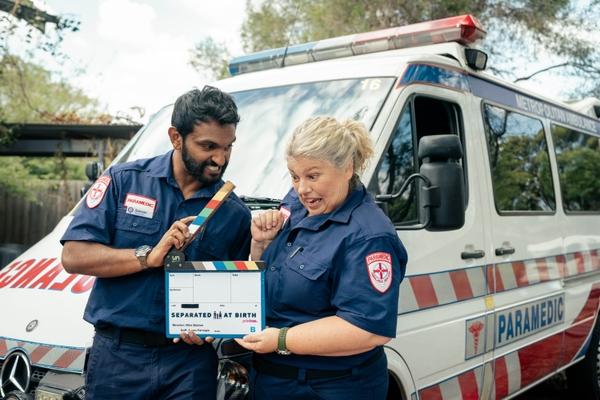
Following the success of The Drop Off, developed by Mike McLeish and Fiona Harris, Ripponlea Primary School has once again been chosen as a filming location this time for a brand-new ABC television series, Separated at Birth, starring the brilliant Urzila Carlson and Nazeem Hussain.
On Friday 20th March, a cast and crew of hundreds will transform our school grounds as they film an episode right here at Ripponlea!
Rippers, while it is certainly exciting to have the buzz of television production on site, this day will be a Curriculum Day. That means there will be no interruptions to student learning, as students will not be on site and our staff will be engaged in professional learning throughout the day.
Although we won’t get to see the scenes come together in real time, we can look forward to spotting our beloved school on screen when the series airs. No doubt we will all be watching with big smiles, proud that our little school continues to shine in so many ways.
Here’s to 104 years of history and now, a little bit of Television magic too!
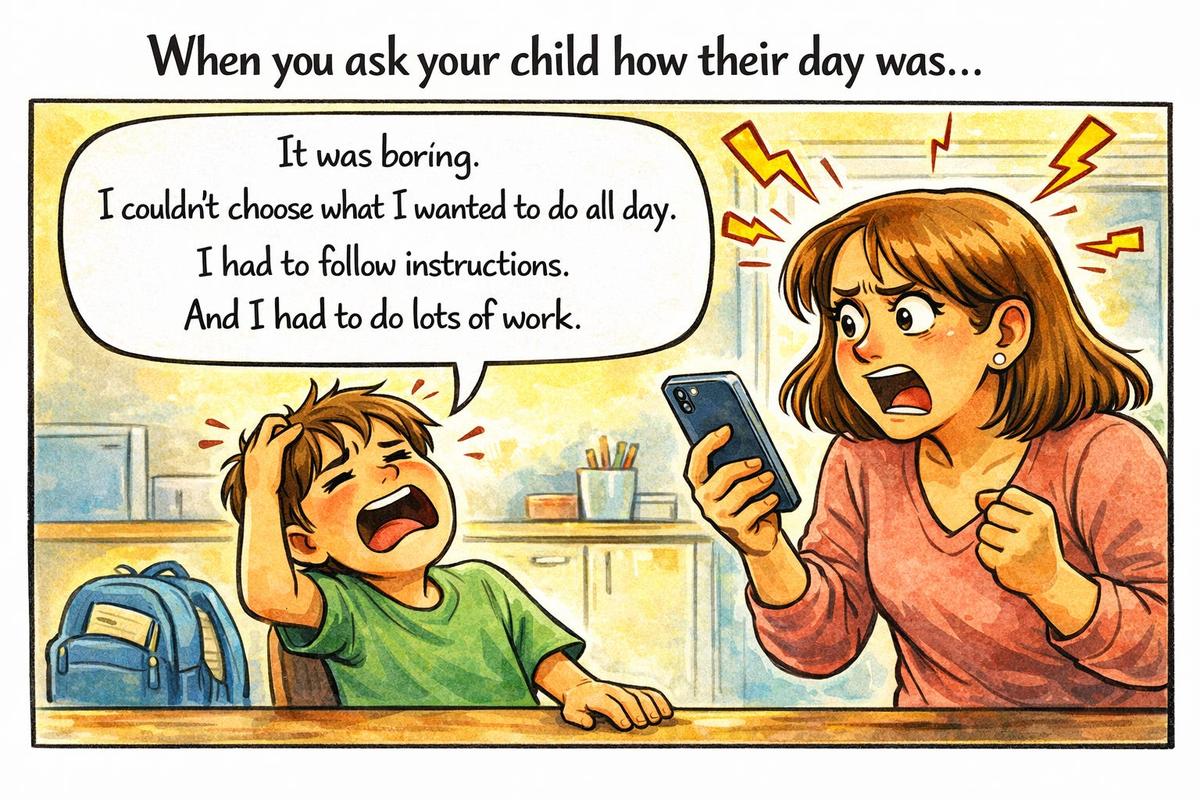
You could be forgiven for looking at some contemporary classrooms and interpreting what you see as a step back in time. Calmer walls, desks in rows, teacher at the front… more structured lessons… children sitting, listening, practising, thinking.
From the outside, it can look like a case of ‘back to basics’. How school used to be. Older practices resurfacing under new names.
Many families are starting to ask questions, and there is an uncomfortable ‘rumbling’ going on in the background
“What has happened to the joy and creativity?”"
“My child says school is boring.”
These reactions are understandable. They deserve to be taken seriously.
For teachers, this moment can feel particularly vulnerable. Many of the visible signals once used to communicate care, such as colourful displays, flexible layouts, and constant activity, are being replaced with something quieter and less immediately reassuring.
Without explanation, that quiet can easily be misread. So let us be clear. What you are seeing is not a step backwards. It is a step forward, informed by what we now understand about how children learn.
When children say they are bored, it is tempting to assume something has gone wrong. Research suggests something more nuanced.
In Why Don’t Students Like School?, cognitive scientist Daniel Willingham explains that people do not dislike learning. They dislike thinking hard. Thinking requires effort. It draws on working memory, which is limited. When thinking is unavoidable, sustained, and structured, it can feel uncomfortable at first.
So when a child says, “School is boring,” what they are often really saying is:
That is not disengagement.
That is cognitive effort.
Explicit instruction, when done well, reduces unnecessary distractions so students can direct their mental energy toward learning itself. Effortful thinking does not always feel enjoyable in the moment, particularly while students are still learning what is expected of them.
As routines become familiar and skills strengthen, learning often becomes more fluent, more confident, and more rewarding.
It is also important to say this plainly. Some family concerns are understandable.
When routines and expectations are new, classrooms can feel more structured and, at times, even rigid. From the outside, this can look like an overemphasis on rules or compliance. It is reasonable to wonder whether this signals a narrowing of learning or a loss of warmth.
Let us reassure you. This is not about creating a generation of robots.
Clear routines, rules, and expectations are essential conditions for learning. They reduce uncertainty, minimise distractions, and create the cognitive space students need to concentrate, practise, and think deeply. When students know what is expected, they can devote more mental energy to learning itself rather than working out how to behave, where to sit, or what comes next.
These structures are not the end goal. They are the foundation.
By establishing predictable routines, teachers create the space to build rich knowledge, stretch thinking, and engage students in meaningful discussion. Structure supports learning so that creativity, inquiry, imagination, collaboration, and play, particularly in the early years, have something solid to rest on.
That said, this phase can feel wobbly at first.
Teachers are adjusting alongside students. As classroom practices shift, teachers’ cognitive load increases. They are thinking carefully about lesson sequencing, attention, routines, expectations, and student understanding all at once. In the early stages of adjustment, classrooms can appear less relational, not because connection is no longer valued, but because teachers are building the systems that will ultimately protect it.
This is where we need to extend some grace. These routines are not designed to reduce connection with students. They are designed to create more space for it.
Over time, something important happens. When classrooms are calmer and more predictable, teachers spend less energy reacting to constant interruptions, low-level behaviours, and repeated resets. Less time is spent managing the room, and more time is freed for teaching and for connecting.
This creates more time for settled beginnings, meaningful interaction, rich discussion, and dynamic, responsive teaching that emerges once strong structures are in place, allowing teachers to engage deeply with students’ thinking and respond in the moment to stretch and support them toward their best potential.
For families wondering where the connection has gone, the reassurance is this: Connection has not disappeared. It is being protected.
By reducing the daily friction of persistent low-level behavioural issues that drain both teachers and students, we are making room for deeper, more dynamic relationships to grow.
Dear families… while your child’s classroom may look quieter than you expected, and the routines may feel more structured or even rigid at first glance, we want to reassure you that something important is happening.
At a deeper level, these changes reflect more care, not less.
They signal a refusal to accept the status quo. Australian schools have let too many children down for too long by quietly accepting that some will fall behind, fall through the cracks, or be written off as needing something ‘different’ instead of being taught to read, write, and work confidently with numbers. We are no longer willing to accept that. All children deserve the opportunity to develop deep knowledge, strong literacy, and numeracy, and to think critically, reason carefully, learn from history, and understand the complex systems shaping the world they are growing into.
These are not optional extras. They are the foundations young people need to become informed citizens, creative thinkers, problem solvers, and leaders in a complex future.
So while the walls may look calmer and the routines more deliberate, there is real magic happening beneath the surface. Knowledge is being built. Thinking is being stretched. Ideas are forming, connecting, and deepening. Your child is learning how to concentrate, how to persist, and how to make sense of the world.
And when we understand that the conversation changes. Instead of asking why this looks different, we begin asking how we can support children as they adjust, practise, and grow.
That is a conversation worth having. Together.
Thanks for reading Knowledge Nest - by Jo Griffin!
At Ripponlea Primary School, we are incredibly proud of the rich cultural diversity within our community. Over the past few weeks, a number of our families have been celebrating significant cultural and religious festivals that mark important moments of reflection, joy and renewal.
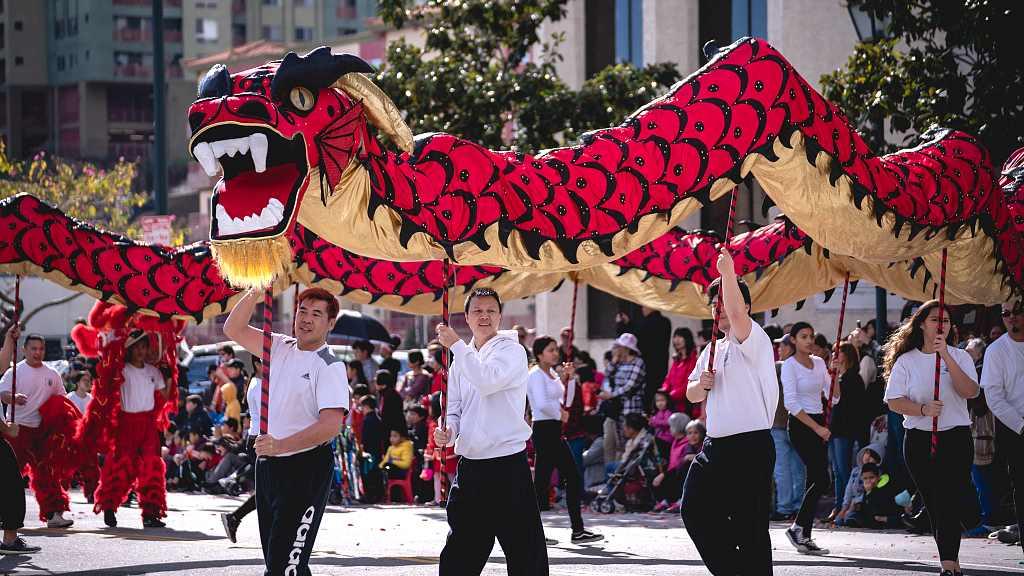
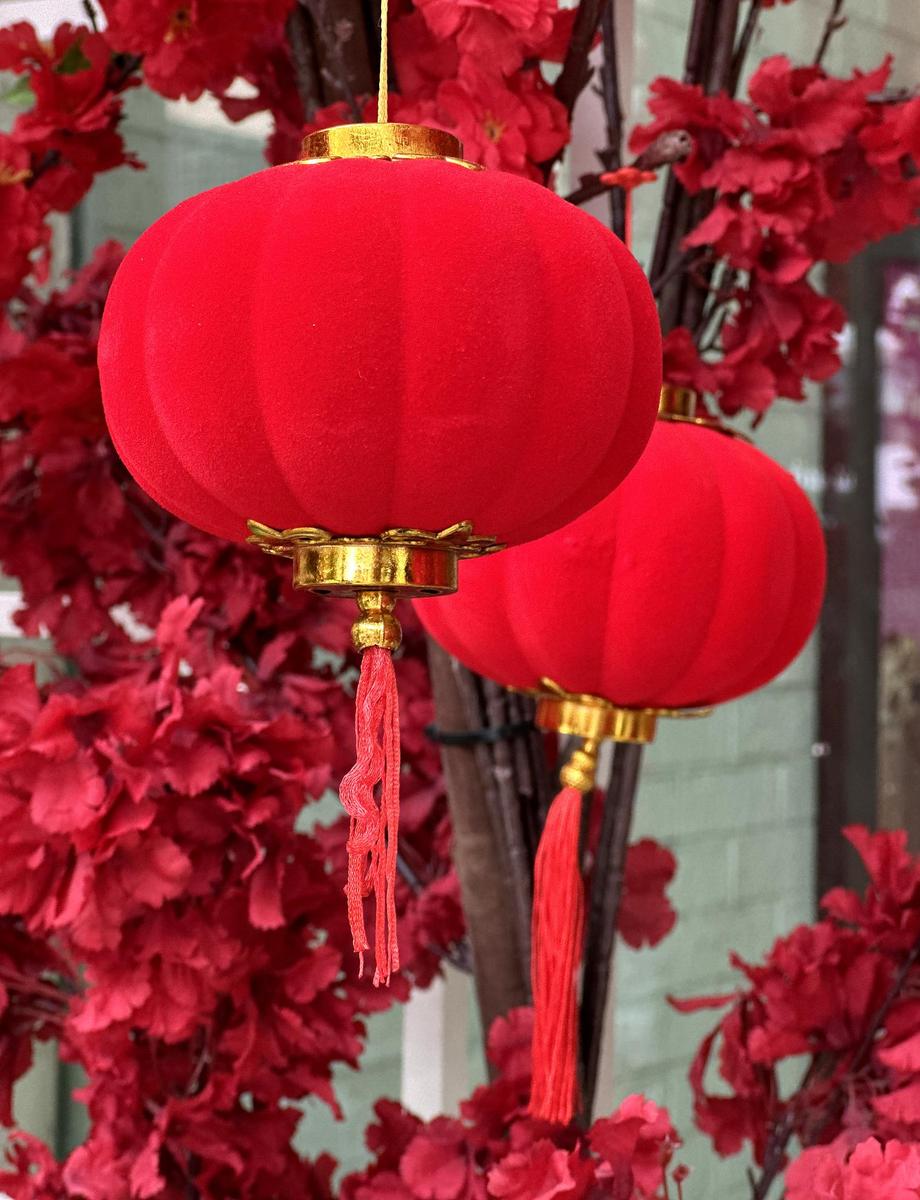
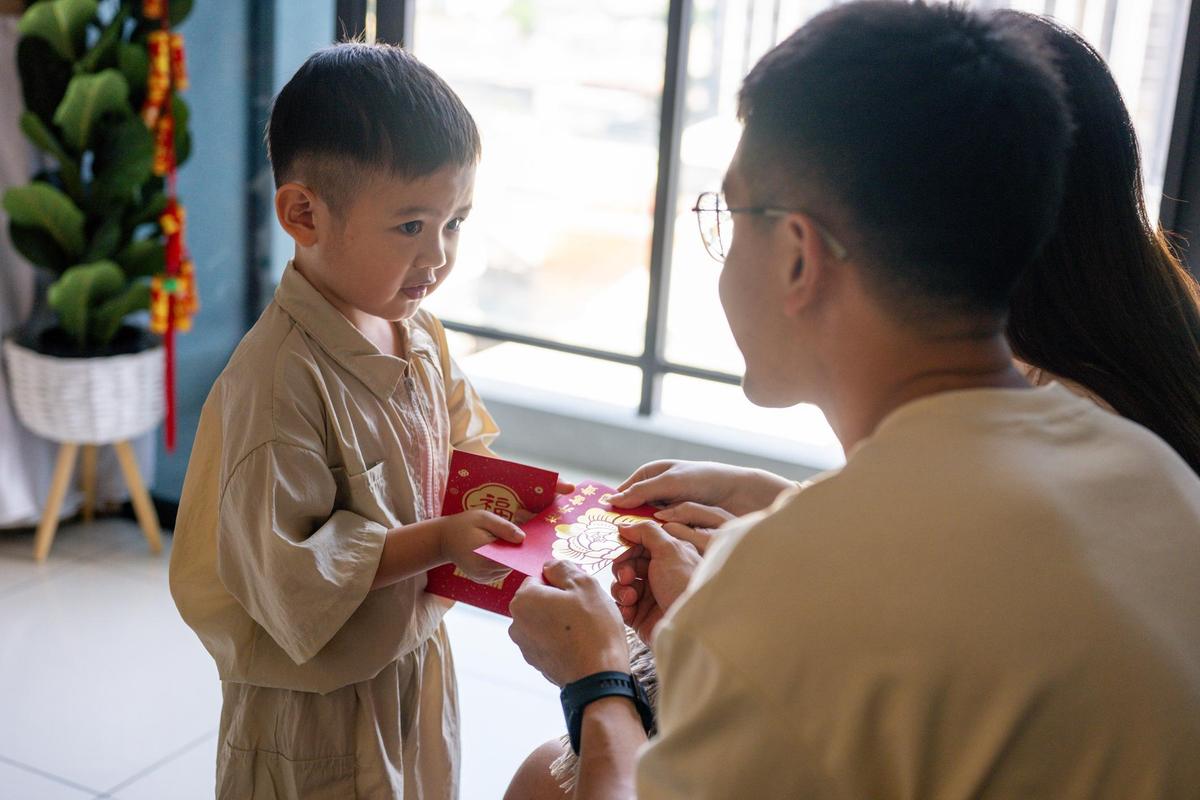
Many of our families recently welcomed the Lunar New Year, a celebration observed across a number of Asian cultures, including China, Vietnam, Korea and others. Also known as the Spring Festival, this special time symbolises new beginnings, family unity, good fortune and prosperity for the year ahead.
Traditions often include family reunion dinners, red decorations symbolising luck and happiness, dragon and lion dances, and the giving of red envelopes as a gesture of good wishes. It is a joyful time centred around gratitude, hope and connection with loved ones.

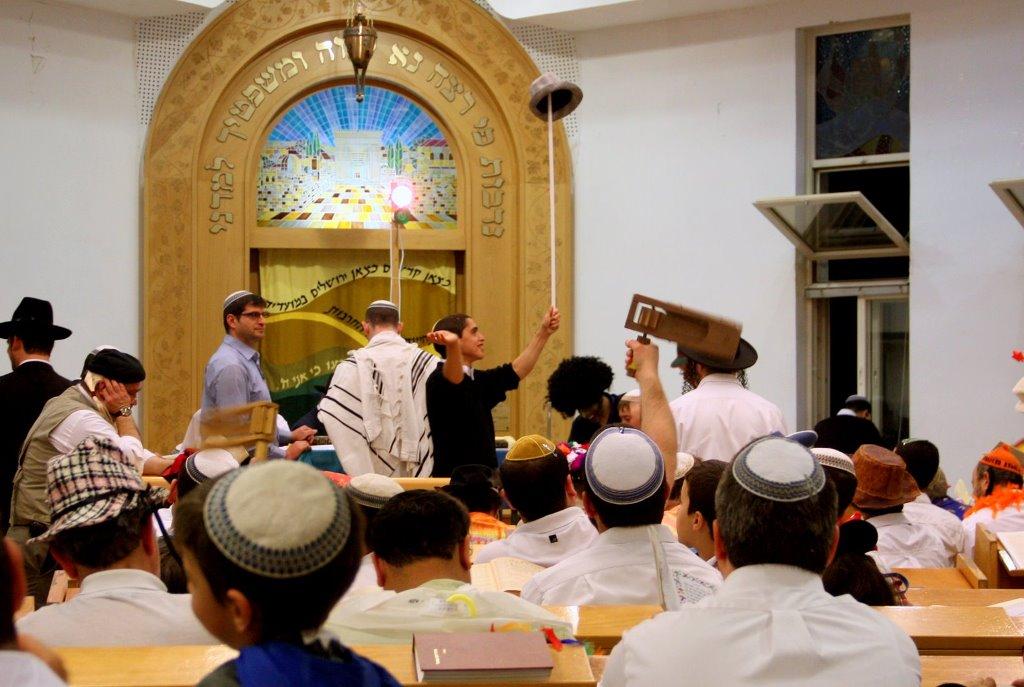
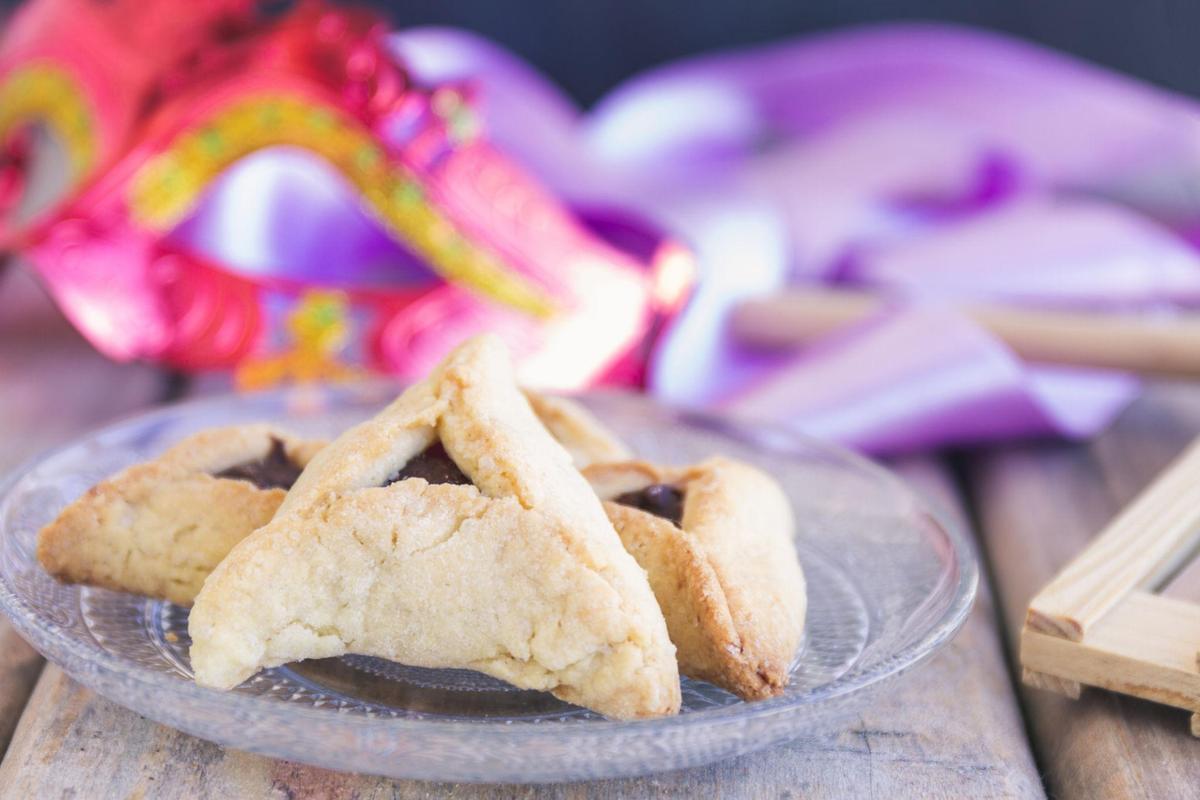
More recently, some of our Jewish families are celebrating Purim, a vibrant and joyful festival that commemorates the story of Queen Esther and the saving of the Jewish people in ancient Persia. Purim is a celebration of courage, resilience and standing up for what is right.
Traditions include dressing up in costumes, reading the Megillah (the Book of Esther), giving gifts of food to friends (mishloach manot), sharing festive meals, and acts of charity. It is a time filled with fun, laughter and strong community spirit.
March is a particularly rich month for cultural observances across many traditions. In the weeks leading up to Easter, families within our community may also be observing:
Each of these occasions carries deep meaning for the families who observe them — whether through prayer, reflection, celebration, fasting, feasting or time spent together.
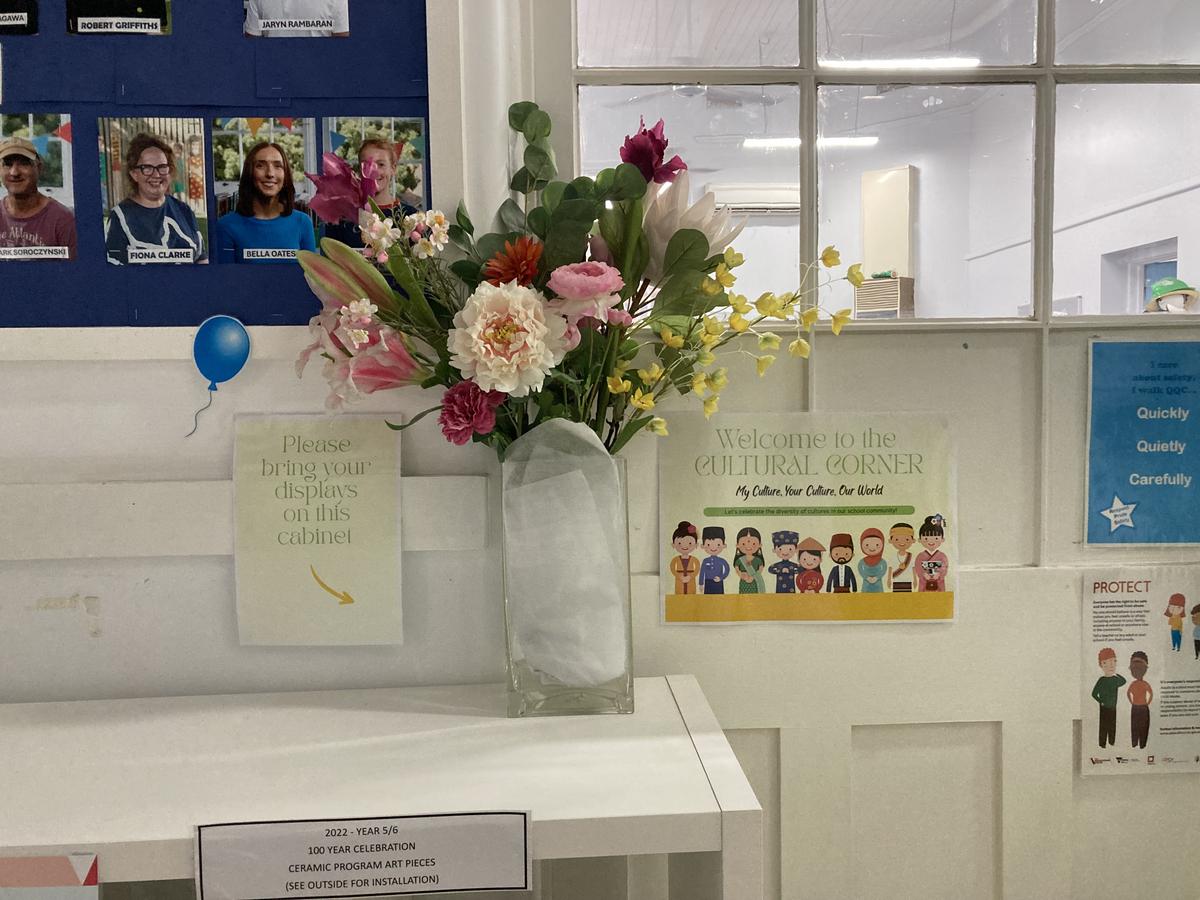
To honour and celebrate the many traditions within our community, we have created a Cultural Corner just outside the school office. This space is dedicated to recognising the diverse cultural and religious events that are meaningful to our families.
We warmly welcome families to contribute artefacts, decorations, books, traditional items or small displays to mark special occasions throughout the year. Sharing these items helps our students build understanding, curiosity and respect for the many cultures that make Ripponlea such a vibrant and inclusive community.
At Ripponlea, our diversity is one of our greatest strengths. These celebrations provide wonderful opportunities for our children to learn about one another and live out our values of Respect, Open-mindedness and Community.
If your family is celebrating a special cultural or religious event, we would love to hear from you.
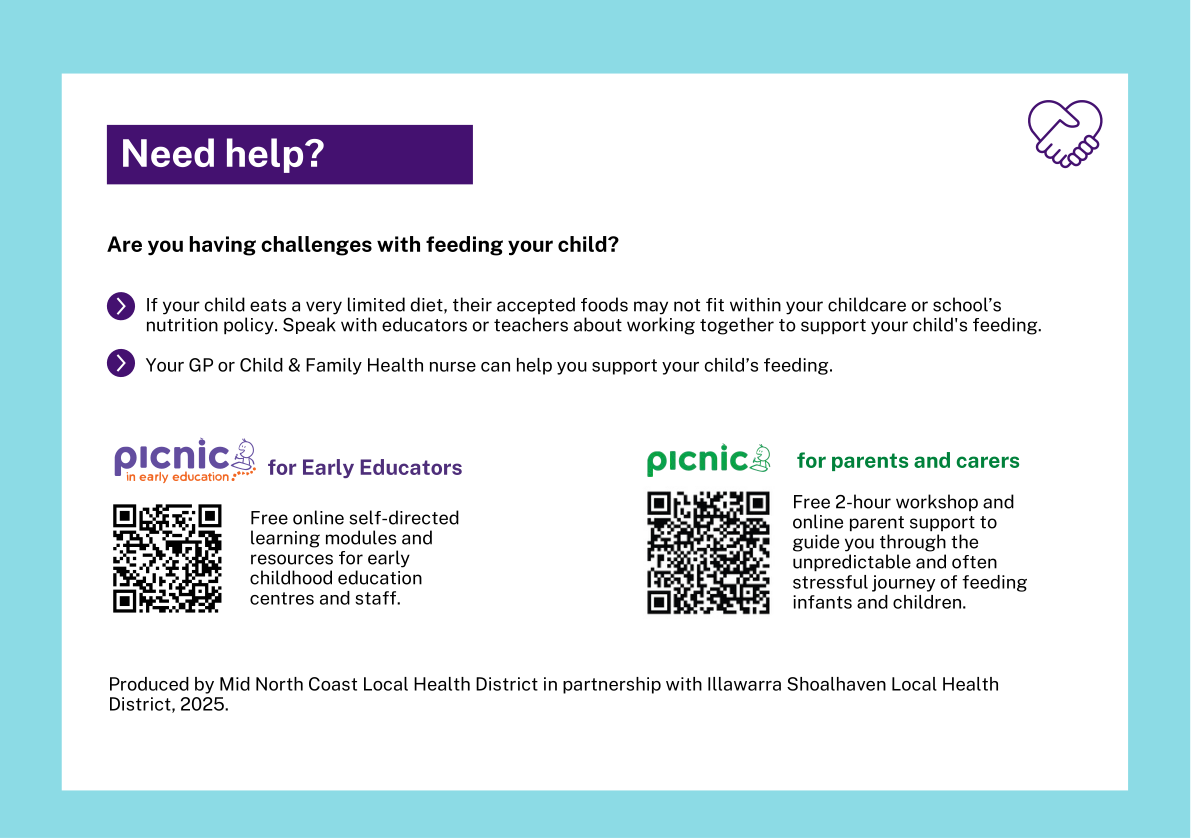
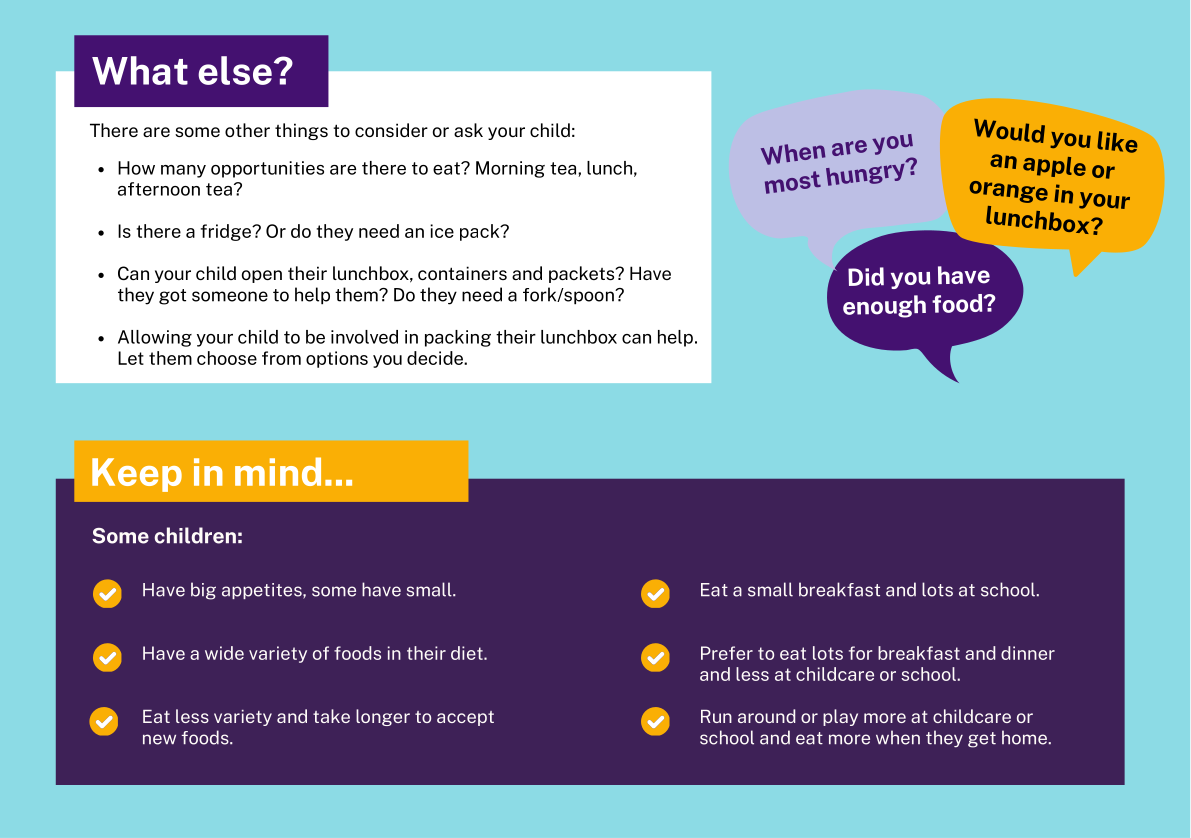
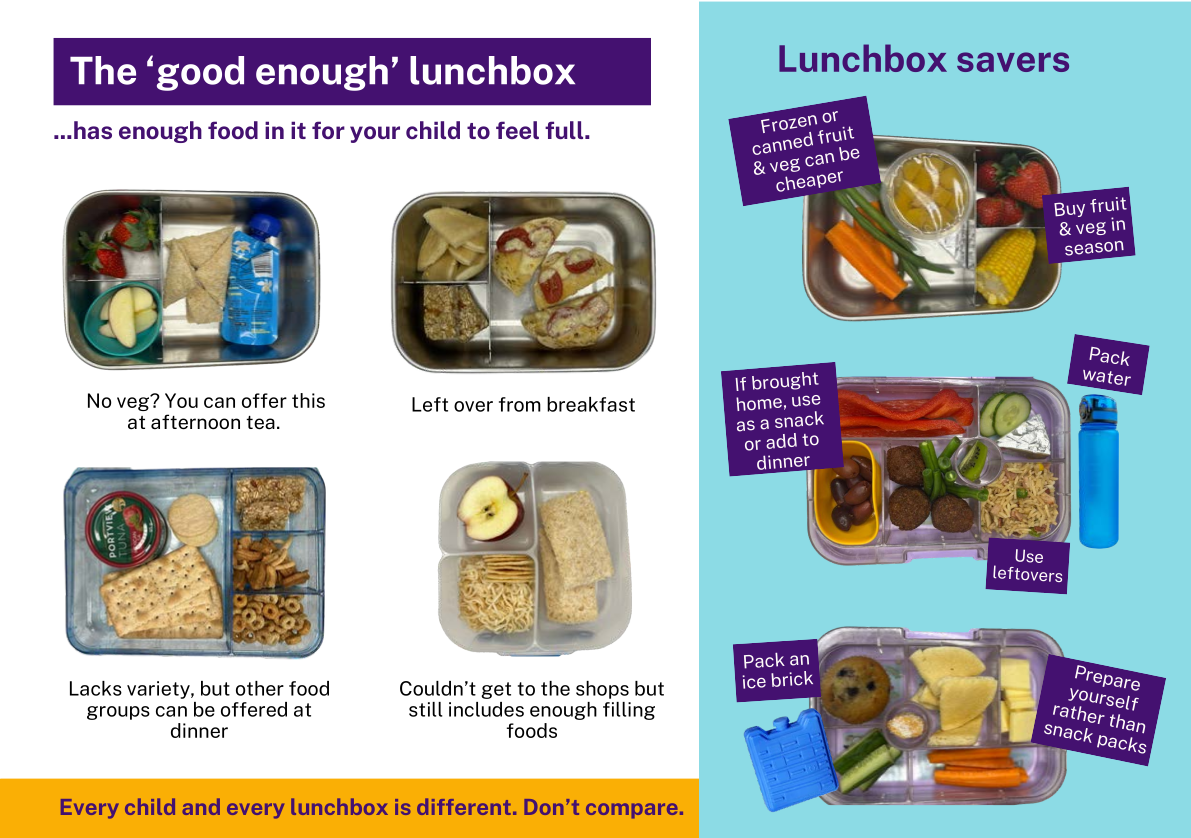
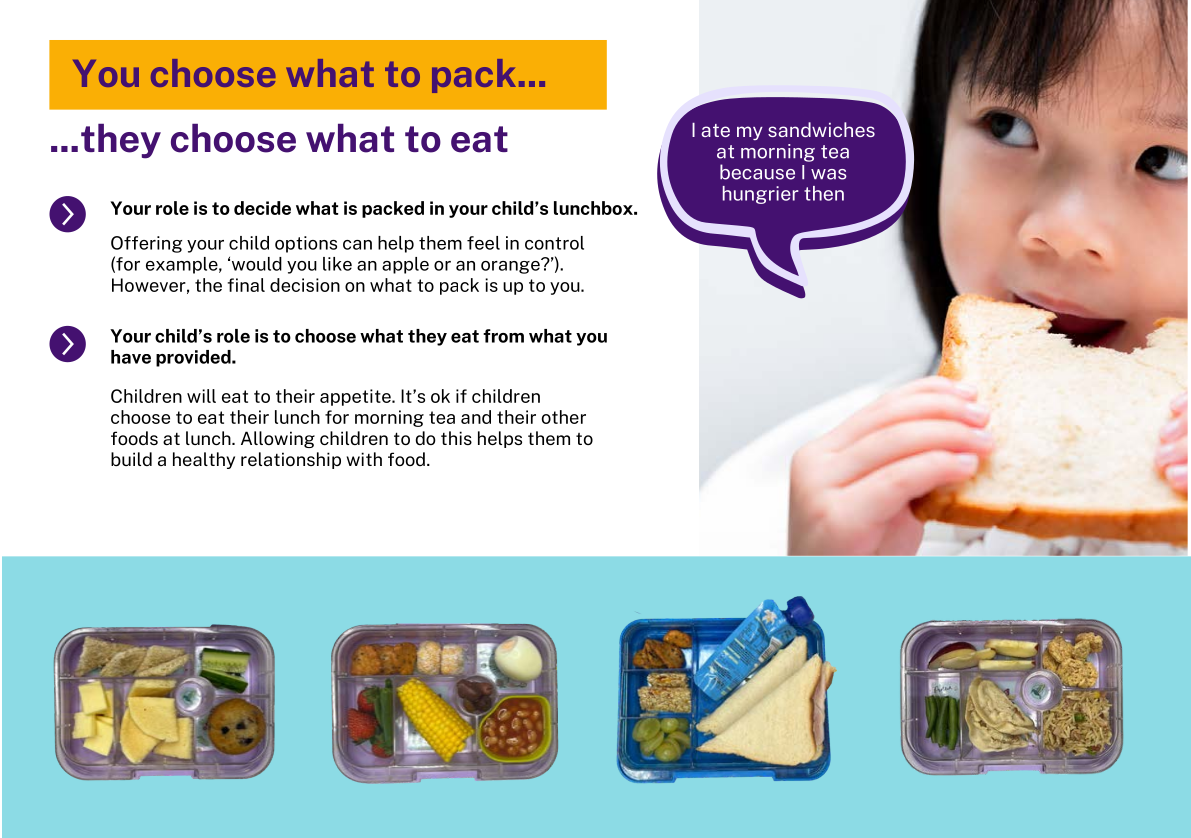
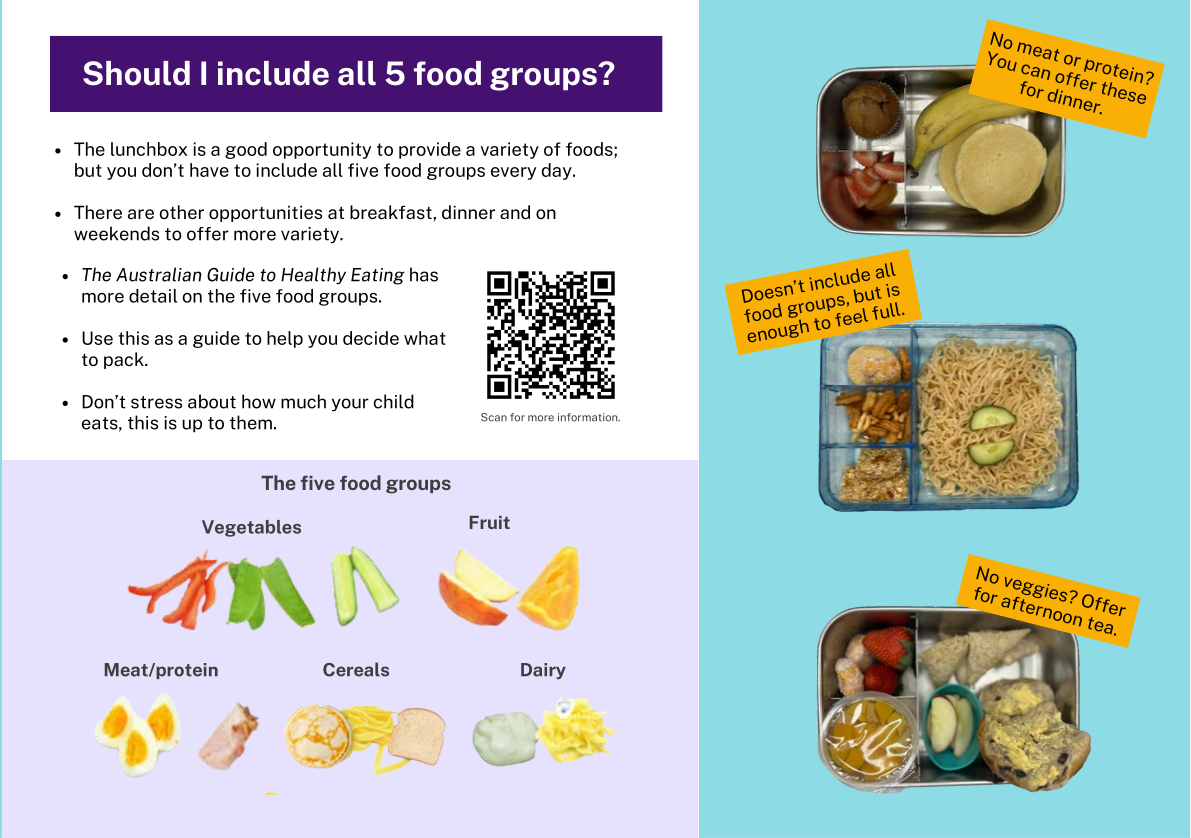
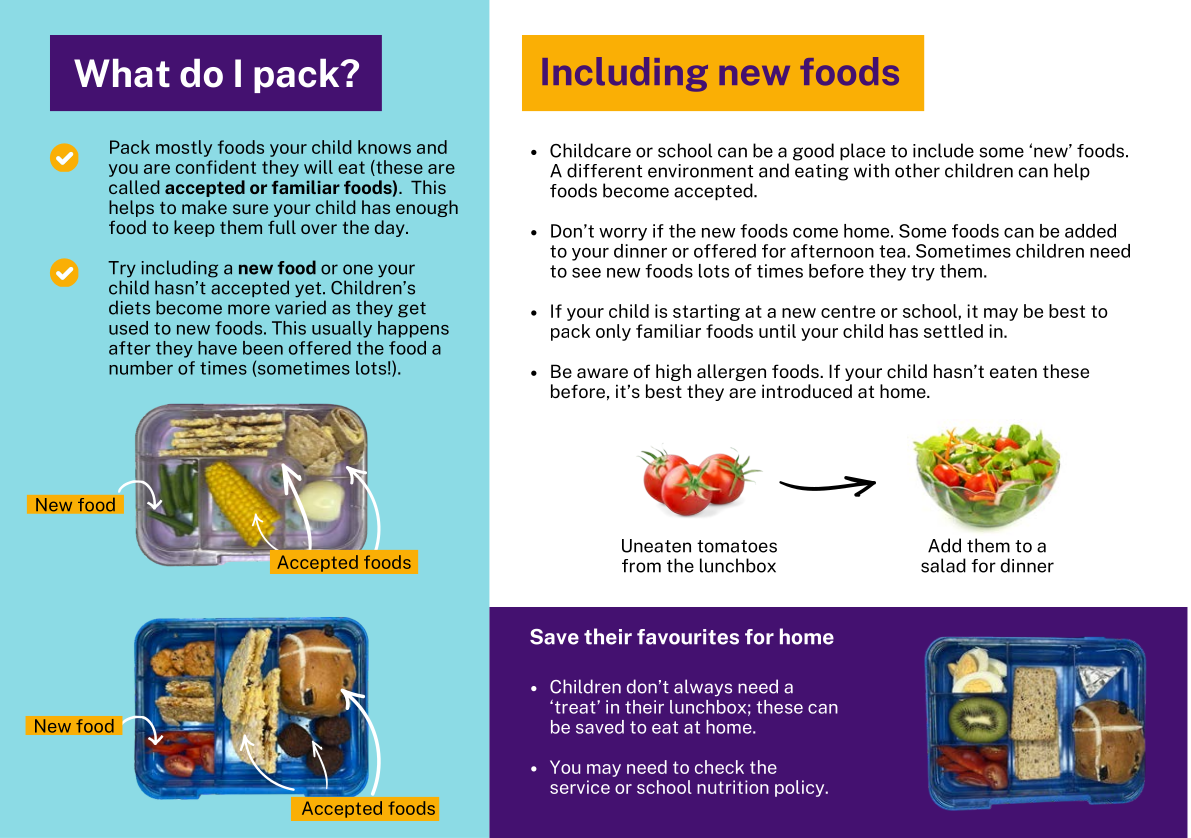
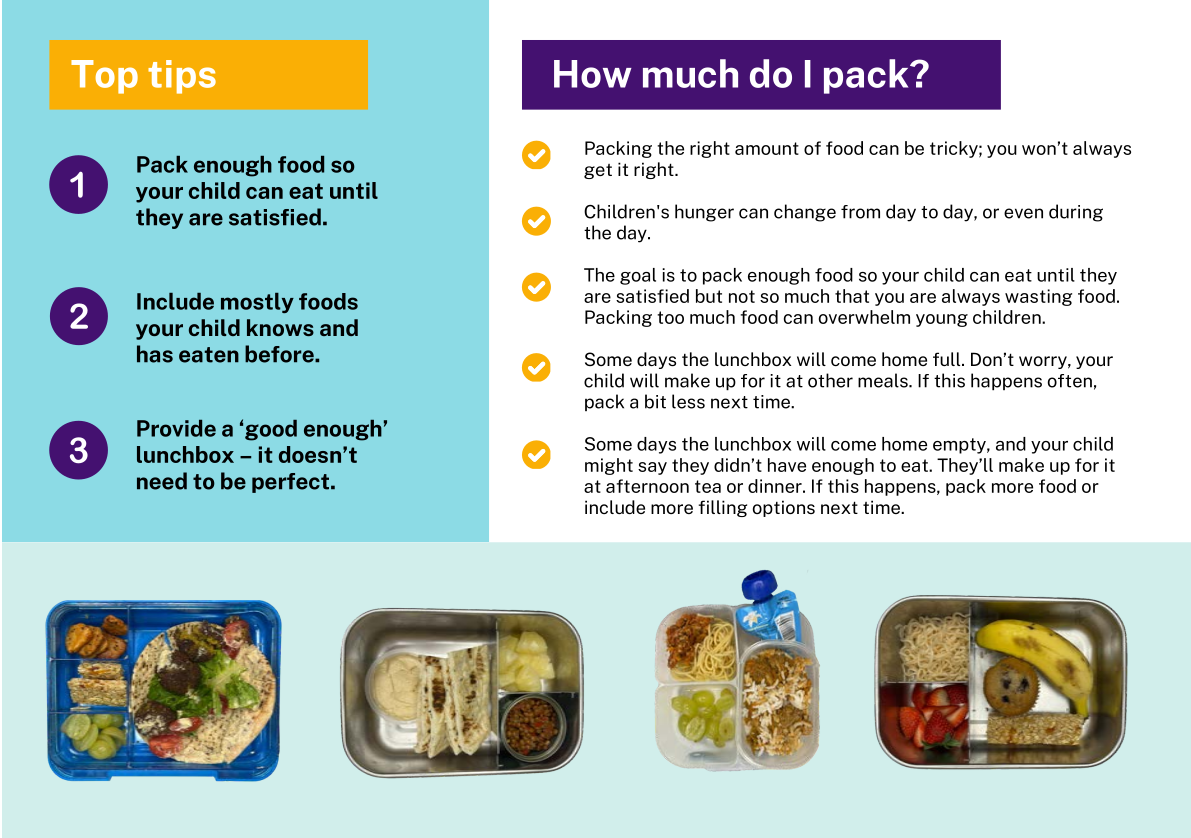
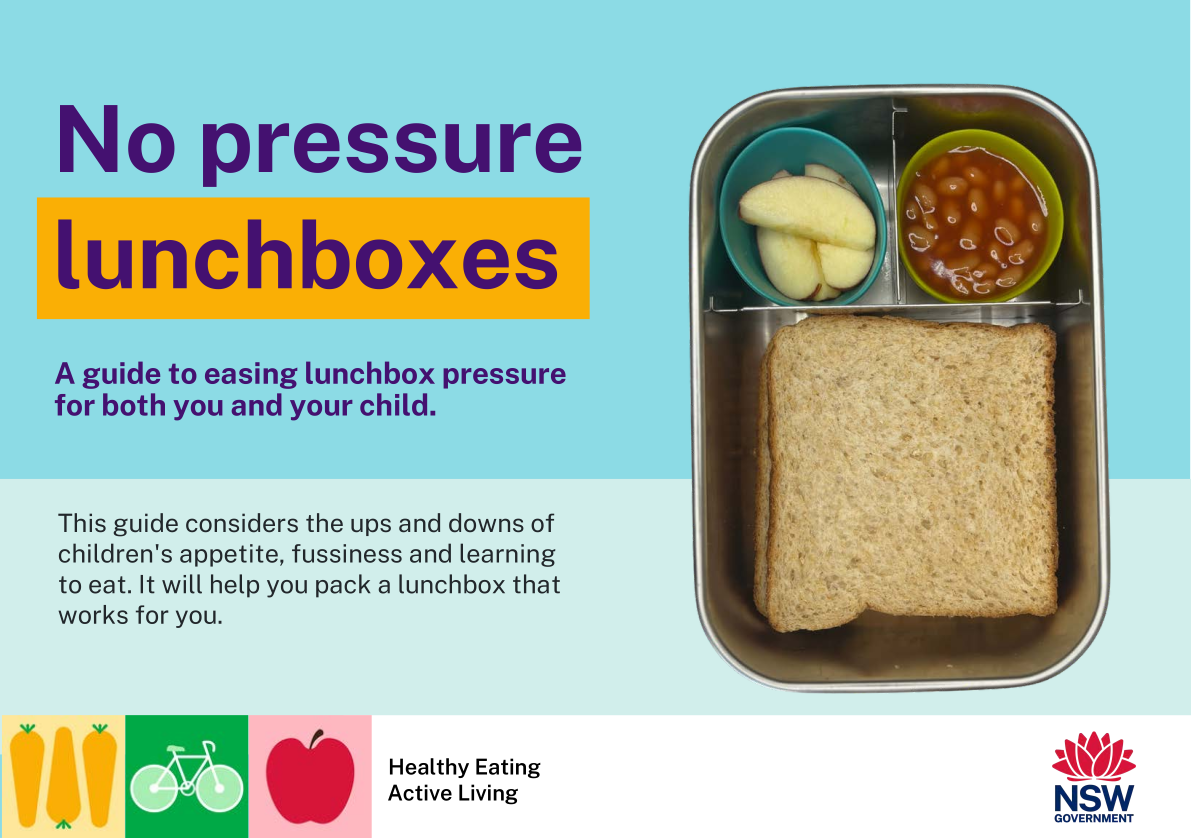
In 2025, Ripponlea Primary School proudly launched our RPS Lunch Eating Program, developed in partnership with Better Health Network through the Lunchtime Expectations initiative
This is not simply a timetable adjustment it will be a cultural shift in how we approach eating, wellbeing and body confidence at RPS.
At the heart of the program is our Food Environment Goal:
“To foster a safe, inclusive, and positive food environment that respects diversity, models neutral language and supports the wellbeing of every student.”
One of the first visible changes was renaming the traditional terms recess and lunch to:
Why? Because language matters. These breaks are not simply about play they are structured wellbeing pauses in the day where nourishment, connection and regulation occur.
We also introduced an Eating Bell at 10:50am for Break 1 (and 1:20pm for Break 2).
When that bell goes:
No lessons running overtime. No creeping into eating time. No rushing.
This directly responds to what students and families told us that learning was sometimes extending into eating time, leaving students with less opportunity to eat.
Through our co-design process, we heard clearly:
Teachers found eating time was inconsistent and sometimes disruptive
So we made a whole-school commitment:
✔ 10 minutes protected eating at both breaks✔ Clear bell signals for start and finish
✔ No going past the bell✔ Outdoor designated eating areas✔ Students may bring food outside if they need more time.
This mantra reflects our move away from “good food/bad food” language.
Research tells us that children as young as 3–5 are already developing weight bias and ideas about restriction
We know that negative food talk and body talk can contribute to harmful self-judgement
So instead, at RPS we:
Focus on what bodies can do, not what they look like
Students are encouraged to tune into their bodies and eat in a way that supports learning, energy and wellbeing.
Through surveys and co-design:
Support navigating body image conversations
The RPS Lunch Eating Program reflects all of these voices. Stay tuned for more information and updates.
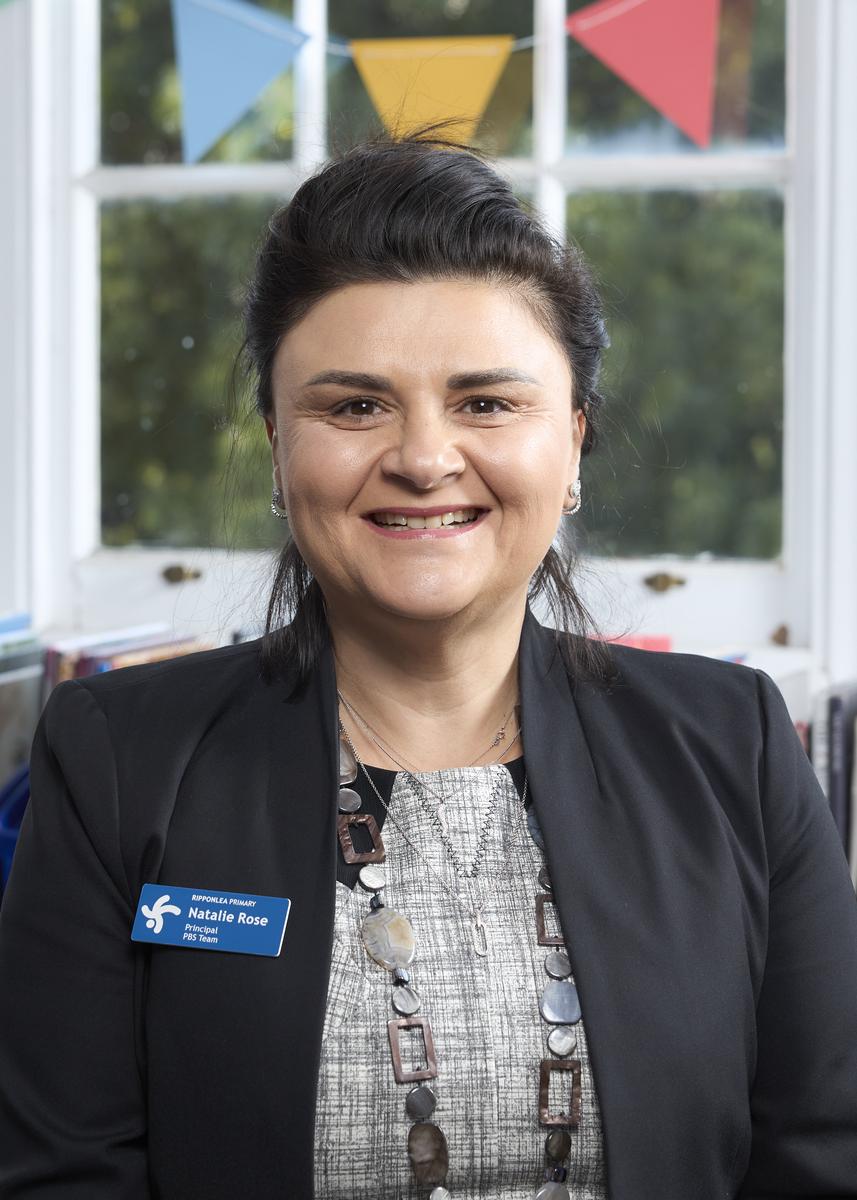
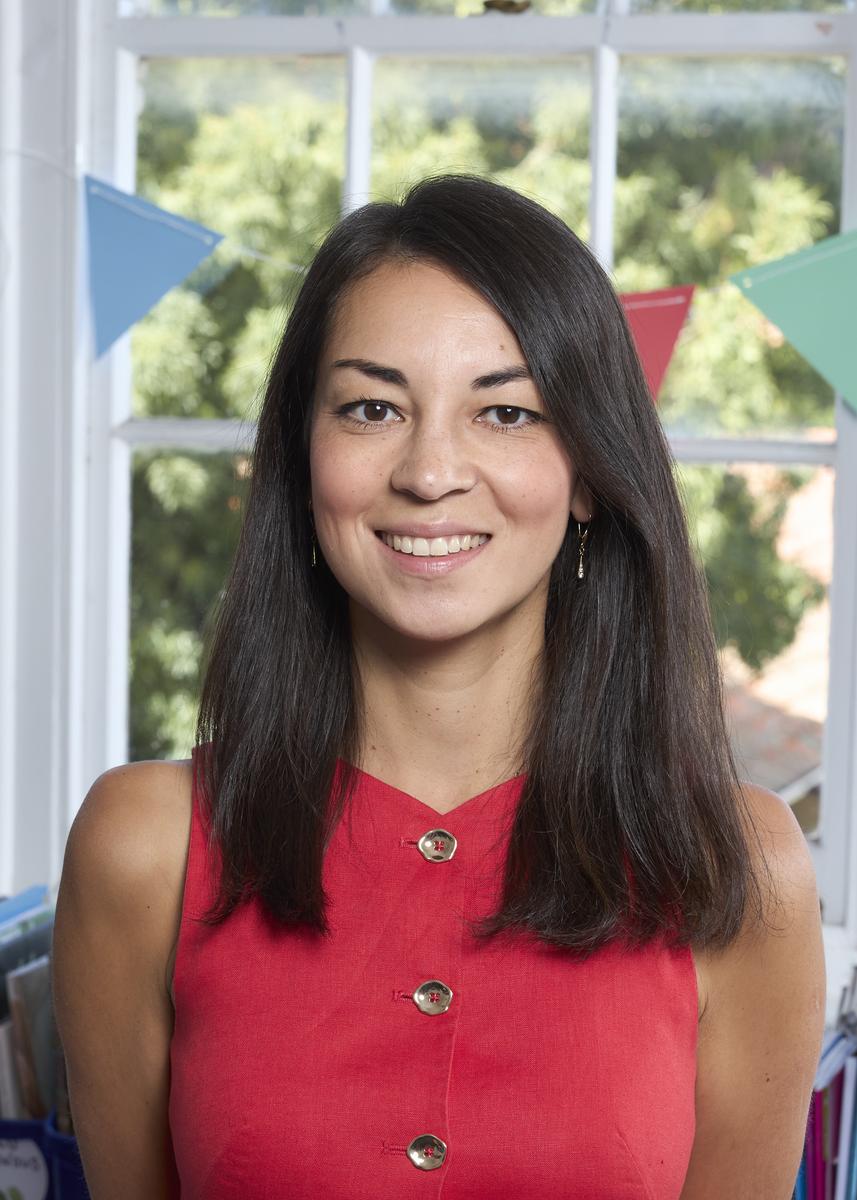
Natalie Rose & Marta Campbell
Principal Assistant Principal