
The Learning Zone
"Learning is a treasure that will follow its owner everywhere." - Chinese Proverb

The Learning Zone
"Learning is a treasure that will follow its owner everywhere." - Chinese Proverb
At St Joseph’s, we proudly celebrate student success each week through the presentation of two class awards. The Learning Well Award honours a student who has shown pleasing effort, perseverance or achievement in a nominated area of the curriculum. The Living Well Award recognises a student who exemplifies our school values through respectful behaviour, positive attitudes and outstanding citizenship.
| Week 5 | ||
| Class | Learning Well Award | Living Well Award |
| K | Kingsley | Elsa |
| 1 | Jensen | Zayne |
| 2 | Ella | Cooper |
| 3 | Nicholas | Ely |
| 4 | Mason | Layla |
| 5 | Charli | Mason |
| 6 | Jackson | Sarah |

| Week 6 | ||
| Class | Learning Well Award | Living Well Award |
| K | Kingsley | Chicago |
| 1 | William | Isabella |
| 2 | Sonny | Luna |
| 3 | Evelyn | Olivia |
| 4 | Mia | Ronali |
| 5 | Aliyah | Angus |
| 6 | Marleeka | Nikita |

What is happening in the world of mathematics at St Joseph's? Let's take a look!
Please see the information below to assist your child at home.
Maths At Home:
Kindergarten - Addition
Kindergarten are moving onto Addition next week. Encourage your child to help you when out shopping by counting and collecting objects to put into the basket, e.g. ‘Can you get 2 apples? (add more) How many do we have altogether?’
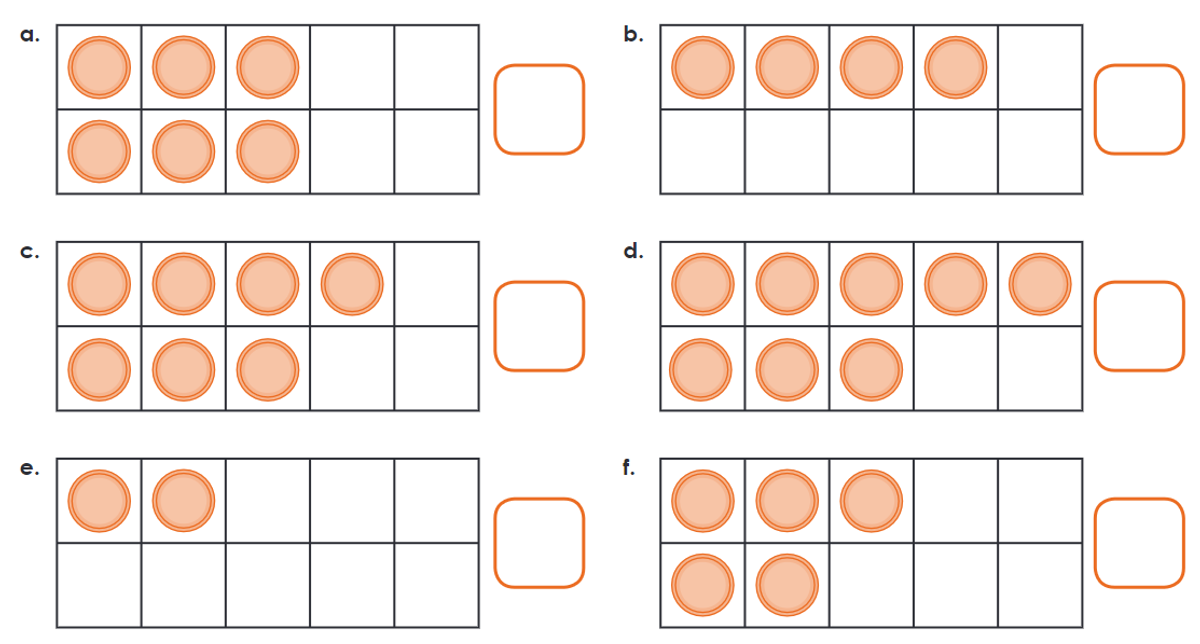
How many more make 10 in each 10 frame?
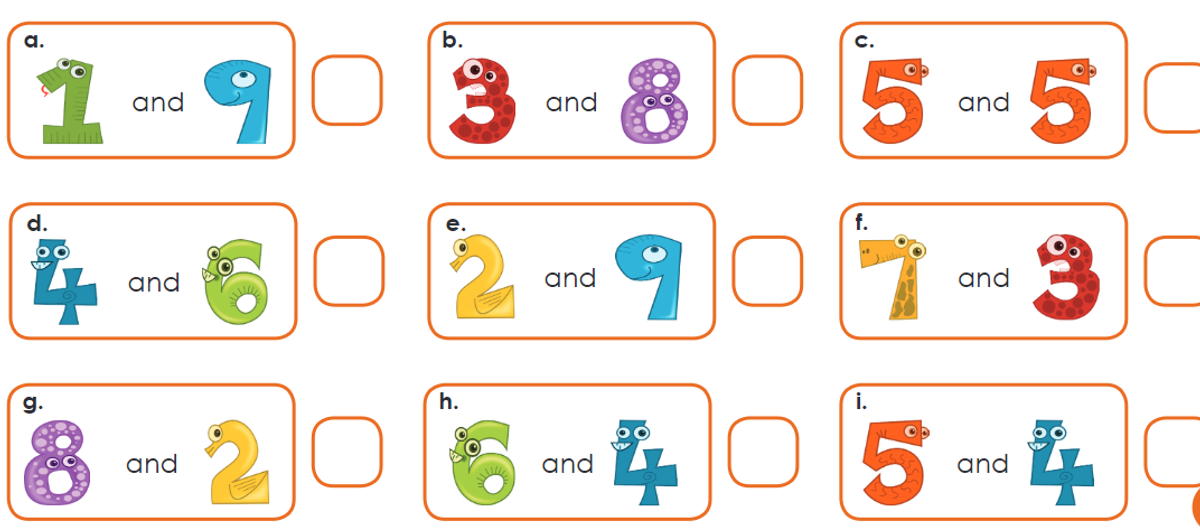
Which combinations above make 10?
Stage 1 - Subtraction
For many years, the expectation was that students use the formal written algorithm rather than their own mental strategies for addition and subtraction.
Rather than teach rules and procedures, we now need to encourage students to explain their strategies using both concrete materials and diagrams to demonstrate their knowledge of addition and subtraction.
Students should develop an understanding that the process of subtraction can be indicated by a variety of language structures. For example, how might a teacher say ‘9 minus 3’?
| Comparison language | Take away language |
| What is 3 subtracted from 9? | Reduce 9 by 3. |
| By how much does 9 exceed 3? | From 9 take 3. |
| What number is 3 less than 9? | Take 3 from 9. |
| What is the difference between 9 and 3? | 9 take away 3. |
| How many added to 3 make 9? | Decrease 9 by 3. |
| How many more than 3 is 9? | From 9 subtract 3 |
Stage 2 - Multiplication
Times tables are a brilliant brain-training exercise for students. Good times-tables knowledge is vital for quick mental maths calculations and problem solving, e.g. if a child knows that 6 x 3 = 18 they will be able to work out that 6 x 30 = 180 or 60 x 3 = 180 almost instantly.
Problems to solve:
In a classroom, there are 3 tables that seat 10 people each. What is the total number of students who can be seated in the classroom.
I have to attach legs to 20 stools. Each stool has five legs. How many legs will I attach?
Stage 3 - Time
Next week Stage 3 will be working on Time.
Create Real-life Scenarios: Help your child understand the practical application of both 12- and 24-hour time systems by creating real-life scenarios. For example, discuss with them why 24-hour time is used in contexts like train schedules or international communication to avoid confusion between AM and PM.
Start and Finish Times: Practice calculating the elapsed time between start and finish times of events. Use a variety of scenarios to make the practice more engaging. For example: school starts at 8:40 am and morning tea is at 11:05 am. How long is it between school starting and morning tea?
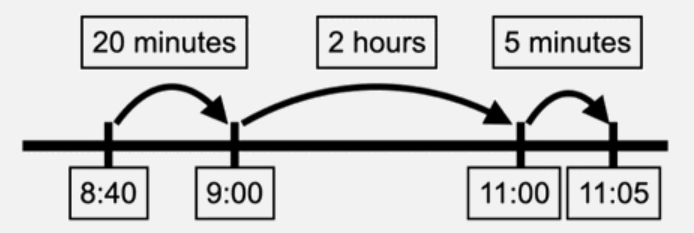
Mental Math Strategies: Practice using mental strategies for adding and subtracting time. Bridging strategies, such as breaking down larger intervals into smaller ones, can be particularly useful.